



Excuse me, Mr Man,
Has a male friend or colleague ever 'begged" for a photograph with you?
I can almost see your eyebrows rising and your lips curling into a smile of contempt. What's there to 'beg' for in a photograph, especially when both individuals occupy similar positions in the hierarchy? Exactly. When two men take a photograph together, it is often seen as a sign of camaraderie, networking or mutual respect. But what happens when a woman asks for a photograph with a man? Suddenly, the man assumes the role of a superior, and her casual request is transformed into an act of 'begging'.
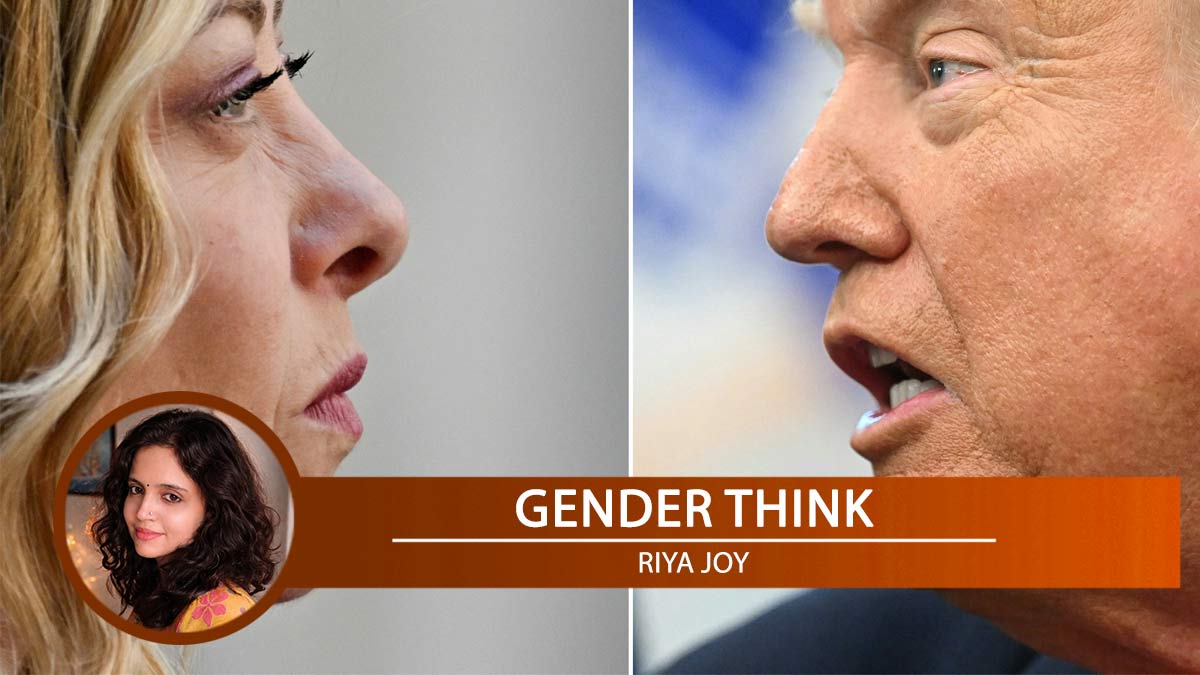
Don't get confused. This is not about a silly photo session. US President Donald Trump's casual remark that Italian Prime Minister Giorgia Meloni 'begged' for a photograph with him during the G7 summit deserves a deeper political and feminist reading. Trump's use of the word 'begged' is a classic example of how patriarchal language attempts to reframe a woman's dignity and achievement.
In high-profile political meetings, interactions between male leaders—handshakes, hugs, group photographs—are celebrated as signs of diplomacy, strategy and alliance-building. But when a woman leader engages in the same political ritual, the narrative often acquires a different colouring. It is no longer diplomacy; it is recast as admiration, attraction or personal fascination with the 'Superior Male'.
Meloni is the prime minister of Italy, one of the most powerful elected positions in Europe. When Trump says she 'begged' for a photograph, he effectively reduces her from the head of a government to a fan girl. Patriarchy has always found comfort in underestimating powerful women. That is why Margaret Thatcher was often discussed as 'The Iron Lady', Hillary Clinton as the ‘ambitious wife' and Kamala Harris as a 'DEI (Diversity, Equity Inclusion) candidate', as though their identities mattered more than their achievements.
Trump's statement also carries traces of the old sexist script of 'she wants me' politics. For centuries, women have been portrayed as the 'admirers' and men as 'the admired', irrespective of the woman's power, intelligence or social standing. We grew up listening to stories of 'Prince Charming' and the 'damsel in distress'. The narrative of male desirability and female pursuit has travelled from fairy tales to modern politics and popular culture.
The term 'begging' belongs to the vocabulary of power. It imposes inferiority and diminishes the dignity of the person at the receiving end. It suggests that one person possesses status while the other seeks validation. Trump's remark reminds us that patriarchy often struggles to acknowledge a woman's political stature, no matter how powerful the office she holds. Perhaps, it is the real issue. Not the photograph. Not even Meloni. But the persistent tendency to view women through the lens of admiration rather than authority, and to interpret their actions through stereotypes rather than status. Feeding the alpha male ego has always been one of patriarchy's favourite habits and challenging it remains one of modern woman's greatest struggles.
The opinions expressed in this article are those of the author and do not purport to reflect the opinions or views of THE WEEK.
