



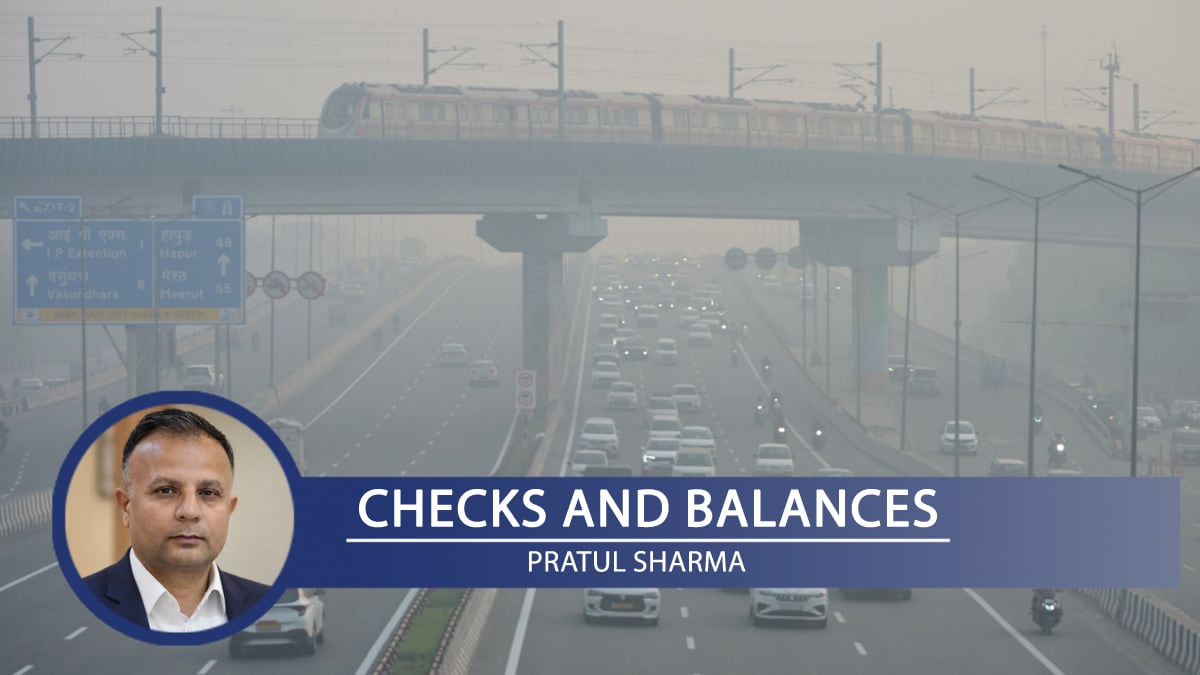
It is that time of the year when conversations in Delhi turn to moving out of the national capital. People talk about escaping the autumn air, heavy with smog and dust. Pictures of places with clean air, blue skies and green surroundings seem to taunt Delhiites. For many households, switching on the air purifier has become as much a part of the Diwali routine as preparing for the festivities.
But amid the annual anxiety over pollution, debates over air quality move to firecrackers and stubble burning. But round the year pressure on the city's infrastructure, the growing number of vehicles on its roads, construction activity and a public transport system which struggles to keep pace with the city's need are bigger contributors. Cold weather and low wind speeds make matters worse by trapping pollutants close to the ground.
There is little sign of a sustained public effort to change the way the city functions. Most people look to the government for a solution. Governments, in turn, blame their predecessors, neighbouring states or one another. The result is a cycle of accusations and temporary measures.
On November 6, Chief Justice of India Surya Kant brought attention back to one of these problems: the number of vehicles on Delhi-NCR's roads. The Supreme Court flagged heavy traffic and vehicular emissions and questioned whether the region's public transport system was good enough to reduce dependence on private vehicles.
The observations came at a time when Delhi's air quality was already deteriorating ahead of Diwali. On the morning of Dhanteras, the Air Quality Index (AQI) was close to 400.
A decade ago, few people outside environment circles knew what the AQI meant. Today, it has become one of the most discussed numbers in the capital. Checking the AQI is now part of the morning routine for many residents. The first question is often how bad the air is and how much worse it could get.
One debate that frequently returns to polarising position is around firecrackers and of course stubble burning.
Delhi has frequently blamed stubble burning in Punjab and Haryana for its pollution. Punjab, in turn, has pointed to the economic difficulties faced by farmers and the need for greater support from the Centre.
For years, the Delhi government and the Centre blamed each other for failing to control pollution. That political equation has now changed. The BJP governs Delhi, Haryana and the Centre, while AAP remains in power in Punjab. These governments now have an opportunity to work together to address pollution across the region. The question is whether they can move beyond political blame and put in place a common plan.
The larger problem is that governments tend to respond when pollution reaches alarming levels rather than work throughout the year to prevent it. When the AQI crosses certain limits, restrictions under the Graded Response Action Plan (GRAP) are introduced. Stage II was invoked on November 2, when the AQI reached 325. As winter progresses, more restrictions are announced. These may provide some relief, but they do not address the sources of pollution that operate throughout the year.
Since last year, the cloud-seeding experiment raised hopes in the desperate times. Conducted by IIT Kanpur, the scientists said there was not enough moisture in the air to produce rain. This year, more trials are expected. But even if cloud seeding produces rain, its effect on pollution is temporary. It cannot address the sources of emissions.
What is missing is a wider effort to make pollution control a year-round responsibility. Governments, businesses and residents all have a role to play. People cannot depend only on restrictions announced by the administration when the air becomes difficult to breathe.
There needs to be a public movement, backed by the government, to bring about changes in everyday behaviour. The initial years of the Swachh Bharat Mission offer one example. The campaign encouraged people to take responsibility for keeping their surroundings clean. A similar sense of ownership is needed for pollution control.
The good thing is that solutions are available, and there are examples from other cities around the world. The odd-even scheme, despite its shortcomings, showed that people could change their travel habits when required. However, many found ways around the restrictions by maintaining vehicles with both odd and even number plates.
Asking people to leave their cars at home will work only when good alternatives are available.
The Delhi Metro carries a large number of passengers, but overcrowding remains a concern. Last-mile connectivity outside Metro stations is another problem. Poor footpaths, inadequate feeder services and unsafe walking routes make it difficult for people to complete their journeys without using private vehicles.
The city also needs regular no-vehicle days, better public transport and safer walking and cycling routes, particularly in market areas. Greater attention must also be paid to public safety, which remains a concern for many people using public spaces. Such steps cannot remain one-day campaigns. They need to become part of urban planning and daily life, and celebrated to ensure greater participation.
Delhiites take pride in the Delhi's monuments, festivals, markets and malls. This is where they celebrate its spirit. Perhaps, a movement is needed for everyone ensure capital's health. It's in everyone's interest.
