



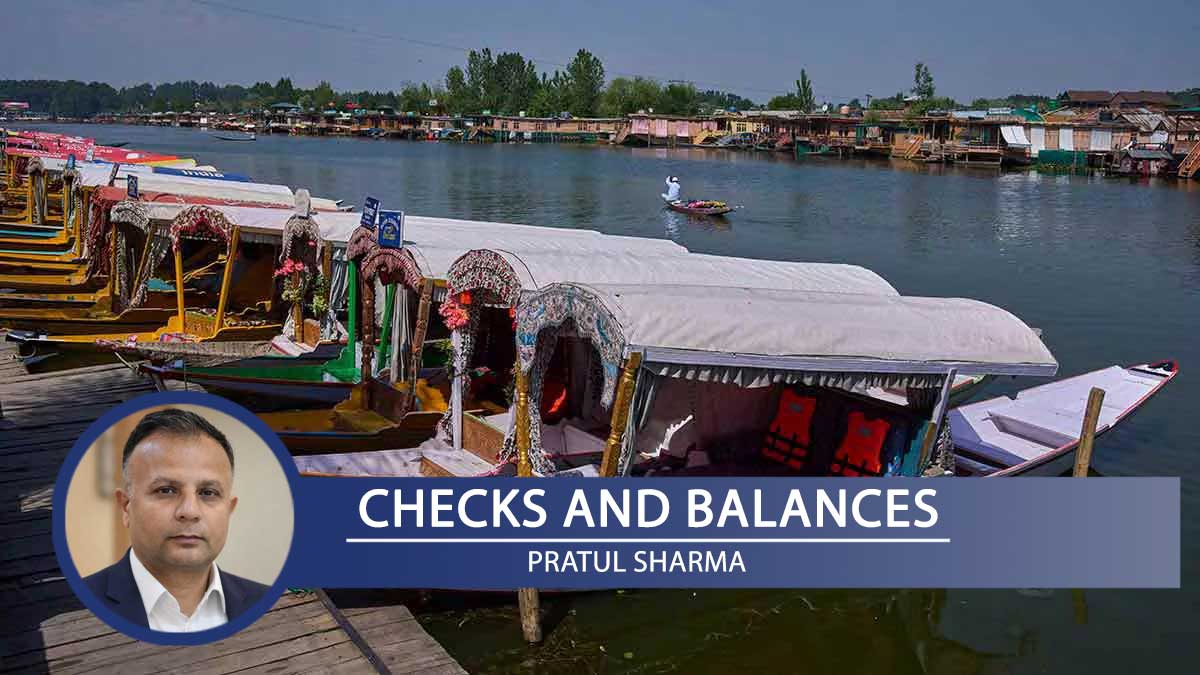
Srinagar is full — well, almost. Tourists are making a beeline to the capital, clogging roads in ways that bring to mind Delhi traffic. The summer months also draw government panels and parliamentary committees, drawn as much by official business as by the cooler climes. Yet, not every shikara is full. Last spring's Pahalgam attack lingers in the minds of travellers, even as locals insist the situation is far more settled than outsiders believe.
The Valley is also witnessing a hundred-day padayatra led by Lieutenant Governor Manoj Sinha — the Nasha Mukt Jammu Kashmir Abhiyan — a mass campaign against drugs that has drawn considerable crowds, tapping into the deep anxieties of women and families about drugs' reach into their homes and neighbourhoods.
Yet, for all its surface calm, residents are acutely aware of where real power resides: not in the Secretariat, but in the picturesque Zabarwan hills, where Lok Bhawan — the LG's office — sits as the centre of governance. Political parties are increasingly jittery as their authority appears to be quietly eroding, and the ground-level activity that sustains a party's relevance is thinning. On June 3, Omar Abdullah took his legislators and ministers to Dachigam National Park for an off-site review. After a day-long review, NC had announced a protest in Delhi on the opening day of Parliament's monsoon session, to press for statehood.
Aga Syed Ruhullah Mehdi, the Srinagar MP now openly estranged from the party, has been raising more emotive themes to build independent traction, while the BJP has been applying pressure of its own, suggesting the government is headed for collapse. PDP and other parties have been insisting on a joint front to engage with the Centre.
Statehood was the explicit assurance given at the time of Article 370's abrogation in 2019, conditioned on delimitation and fresh elections. Both have since been completed. The Ladakh engagement last year — when the Centre finally sat down with protest leaders after sustained agitation — has only sharpened the appetite of Kashmiri parties for a similar dialogue.
But statehood, as far as all the indications go, remains distant. Home Minister Amit Shah had set 2029 as the deadline for J&K and the northeast to be free of terrorism and insurgency. The Naxal deadline of March 2026, bracketed alongside these, has already been declared met. Until the J&K security threshold is satisfied to the Centre's satisfaction, there is little chance in Delhi to cede the administrative leverage that UT status provides. The likelier moment for statehood may be around the 2029 election cycle.
In the interim, Sinha is seen as filling the governance deficit that had existed for long. In contrast, Omar Abdullah faces frustration due to the structural limits of his office.
Across a cross-section of conversations, a more nuanced picture emerges. Not everyone is clamouring for statehood with urgency; many are watching the pace of delivery, be it roads, utility infrastructure or investments which were creating employment facilities. Once the Valley’s residents get used to prosperity, as they invest in peace and development, the chances of militancy or separatism returning recede, goes the political argument.
Kashmir increasingly follows what officials and observers are calling the Delhi model: a dual power structure in which the elected government and the centrally appointed administration exist in uneasy parallel, with the Centre holding the upper hand.
The statehood demand is legitimate and politically resonant. The ground has visibly changed. But peace here remains tenuous; it will take some time yet before J&K reaches parity with neighbouring states. For now, the Centre's calculus is security first, infrastructure next, political restoration later. With the NDA in command in Delhi, the Valley will have to wait a little longer.
