



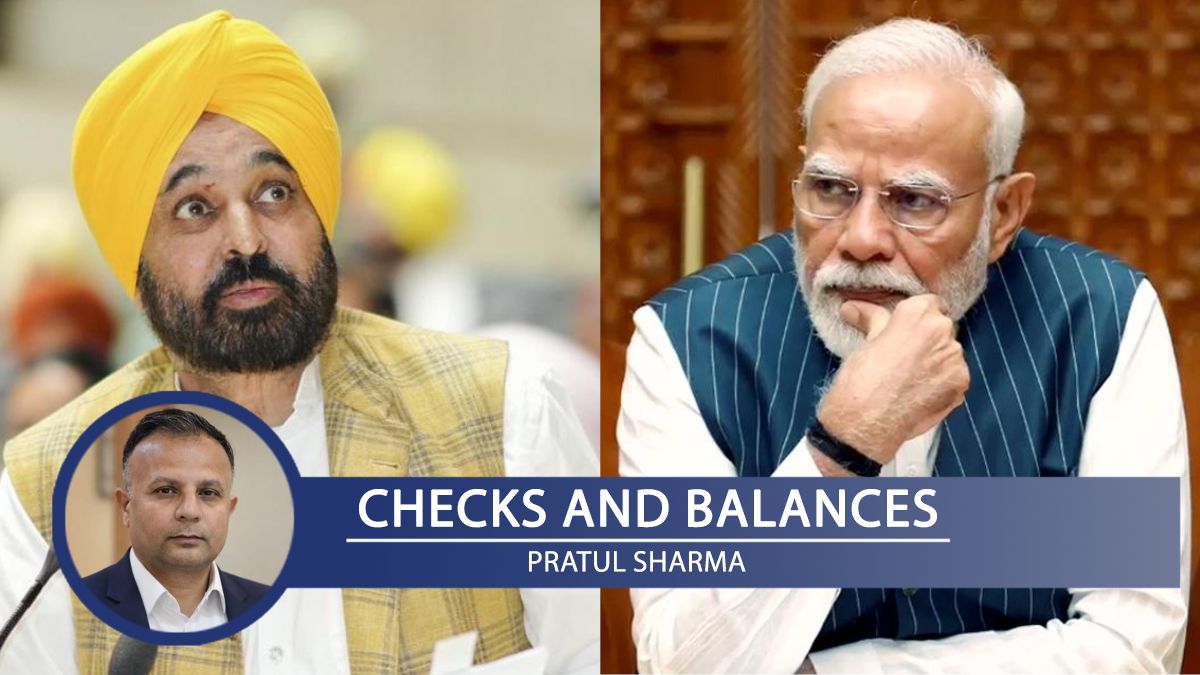
From Jammu and Kashmir to Gujarat, Rajasthan, Uttarakhand, Bihar, Uttar Pradesh, Arunachal Pradesh and Assam, the Bharatiya Janata Party (BJP) today has a significant presence in most border states.
In Jammu and Kashmir, despite the Omar Abdullah government being in office, the Lieutenant Governor continues to control security and key parts of the administration. Even in Meghalaya, where it is not the dominant force, the BJP is part of the National Democratic Alliance (NDA) government led by Chief Minister Conrad Sangma.
Punjab, India's most strategically important border state, remains an exception.
The Bengal elections, in which the party invested nearly 15 years of political effort, have given it confidence that it can eventually have its own chief minister in Punjab.
The BJP's focus is now firmly on the 2027 Assembly elections, reflected in the slogan: 'After Bengal, it is Punjab's turn.'
Whether this is political ambition or a realistic goal remains open to debate. What is clear is that the BJP wants a much bigger role in Punjab politics. The party's recent appointment of Kewal Singh Dhillon as its state president reflects both that ambition and its limitations.
Dhillon, a 75-year-old businessman and former Congress leader who joined the BJP in 2022, has lost several elections. He is not the kind of grassroots leader many party workers expected. The choice appears more symbolic than organisational.
For decades, the BJP's image in Punjab has largely been that of an urban Hindu party dependent on its alliance with the Shiromani Akali Dal for Sikh votes. That alliance, once projected as being in the national interest, eventually collapsed.
The last 12 years of BJP rule at the Centre—as argued in the last column—have weakened many entrenched political families in the Opposition space. Even the Badals, who dominate the main Akali faction, face a difficult political road without the BJP's support.
Alongside Dhillon, the BJP has also placed another Sikh face in an important position in Delhi. Former diplomat Taranjit Singh Sandhu has been appointed Lieutenant Governor.
Haryana CM Nayab Singh Saini too often appears in a Sikh turban during Punjab-related events. The outreach fits into the Modi government's wider engagement with the Sikh community in recent years.
The BJP's effort to build strength has not been limited to the state unit. In April, seven of AAP's ten Rajya Sabha MPs crossed over to the BJP using the two-thirds merger provision. The move increased the BJP's strength in Parliament and put the ruling AAP under pressure.
However, the civic body election results showed that AAP remains the preferred choice in much of the state.
Congress finished a distant second, while the BJP remained a minor player in most local bodies. For CM Bhagwant Mann, who had been facing criticism over governance and rising gang- and terror-related incidents, the results came as a major relief.
Still, almost every political party sees an opening in 2027. The AAP carries the burden of anti-incumbency. Congress continues to struggle with infighting. The Akalis are trying to regain lost ground while remaining divided.
In this situation, the BJP believes it can increase its vote share and emerge as a stronger force. Even BJP opponents admit that the party is making a serious effort, though many still doubt whether it can make a major breakthrough on its own.
The coming months could shape the political mood in the state. The Special Intensive Revision (SIR) of electoral rolls has already created concern among sections of Punjab's population, because many families now have members settled abroad.
A strict revision of voter rolls could raise fears that genuine voters may lose their names if close family members have migrated overseas, even though they themselves continue to live in Punjab or maintain ties with their villages. Opposition parties have already started calling the SIR exercise an attempt to exclude Sikh voters.
Punjab's voters have often viewed politics through issues of identity, federal rights, agriculture and the feeling that the state has repeatedly been politically exploited. Almost every major political party in Punjab has used versions of these arguments at different times.
The BJP believes Punjab is politically within reach in a way it was not a decade ago. Its rivals, weakened by infighting and anti-incumbency, have created space for it. The party is pushing promises of industry, jobs and infrastructure development.
The BJP's confidence also comes from the 2024 Lok Sabha results, where its vote share rose sharply. If translated into Assembly segments, the party would have been leading in around 23 seats, up from just two in the 2022 Assembly election.
Its challenge in 2027 will be to turn its outreach to the Jat Sikhs, Dalits and OBCs—along with its urban support base—into votes. For that, the BJP will have to convince Punjab that its politics in the state goes beyond symbolism and electoral strategy.
