



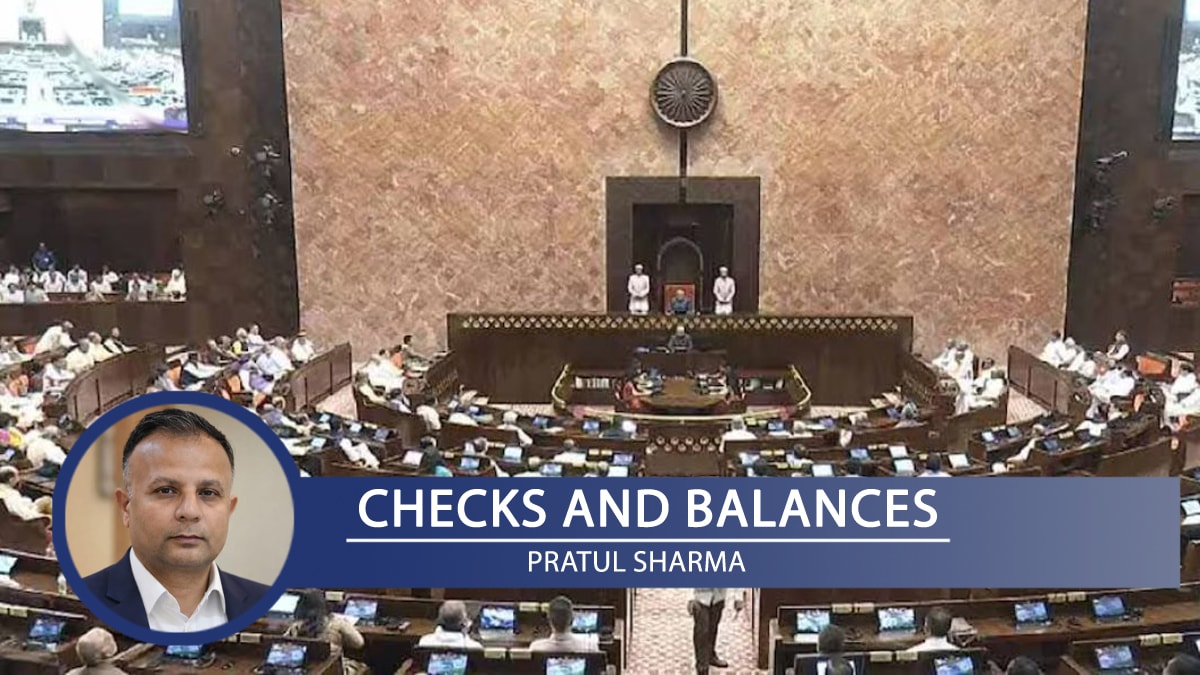
Rajya Sabha has been unusually alive, pointing towards realignment and rebalancing within the party formations. After the most visible one, the resignation of Vice President Jagdeep Dhankhar last year over his differences with the government, to more recent ones involving members who were apparently perceived as being soft towards the ruling dispensation.
Aam Aadmi Party's poster boy Raghav Chadha was accused by his party colleagues of resorting to 'soft PR' by raising issues that do not sufficiently unsettle the government. That charge, however, holds equally true for most of AAP's nominated MPs from Punjab, who have not been raising issues forcefully enough to corner the ruling dispensation. Sanjay Singh, who represents Delhi, remains the sole exception — consistently at the forefront of raising political issues aligned with AAP's core focus, whether defending Arvind Kejriwal or staking out ideological positions. When Chadha was removed, ahead of the 15th anniversary of the anti-corruption movement launched by Anna Hazare, which later morphed into AAP, it did spark debate. Though the debate in social media and public conversation remained polarised, the issues he raised were in the public interest but were not seen as pointed enough to represent the voice of AAP.
Chadha has long been perceived as carving out an independent image, distancing himself from the AAP crowd even when Kejriwal was in jail. Overall, it also casts a lens on parties born out of movements, as their key leaders go separate ways in their political journey.
The Chadha episode does raise a pointed question: How should an MP conduct himself in Parliament to remain aligned with his party's image and stated purpose?
It is broadly agreed that the party line runs supreme in Parliament. Members have the freedom to raise issues of their constituency, but must follow the whip during the passing of bills or no-confidence motions. Members' positions are bound by the anti-defection law, which curbs voting beyond the party position and is often seen as curbing dissent.
Congress MP Manish Tewari had introduced a private member's bill asking that MPs be allowed to vote freely across party lines on most bills and motions, except in cases of confidence motions and money bills. He articulated a view expressed by many MPs in private — that whips make them subservient to party lines, which hinders parliamentary debate.
Predictably, many leaders who maintain an independent line face a cold shoulder from their respective party leaderships, but cannot be wished away because of their individual popularity.
Unlike Chadha's case, a change in Biju Janata Dal's strategy did not attract as much debate. BJD parliamentary party leader Sasmit Patra resigned from his position to allow the party to install a new leader more in tune with Naveen Patnaik's thinking. Former Chief Minister's political advisor Dr Santrupt Misra has now entered the Rajya Sabha as a new MP and is expected to play a key role in party strategy. The timing matters: BJD suffered multiple embarrassments when six of its MLAs cross-voted in recent Rajya Sabha polls, and a BJP MP's accusations against party icon and former Odisha Chief Minister Biju Patnaik were not as strongly contested.
Both AAP and BJD have kept their distance from the Congress-led INDIA bloc — understandably, given that they have defeated the party on their home turfs in the past and were the grand old party's main opponent in their respective states. But the situation has changed. Both now face a far bigger challenge from the BJP. Their policy of remaining unaligned — particularly in BJD's case — has begun to cost them more than it benefits them.
The third instance, which did not attract as much debate, is the nomination of JDU MP Harivansh Narayan Singh to the Rajya Sabha by the President after his own party, JDU, denied him a ticket. With Nitish Kumar himself now entering the upper house, Singh would have stayed out of the Rajya Sabha as his second term had ended. But he got a third term through the government's nomination quota. This hints at a nuanced realignment ahead of a change of chief minister in Bihar — with the BJP set to occupy that post for the first time.
As some of these cases show, parties can accommodate a degree of personal branding among their members, but draw a firm line when it begins to overshadow the party's own political position.
Rajya Sabha, by virtue of its composition, rarely commands sufficient public attention, yet it plays a crucial role in the passage of legislation and debates. The changes within the party teams point to coming challenges. The next big test before all parties will be delimitation and women's reservation.
After delimitation, there will be a significant increase in the number of seats — making it difficult for most parties to field a sufficient number of credible candidates across expanded constituencies. The only party that appears genuinely equipped to contest upwards of 800 Lok Sabha seats is the BJP. It has a large reservoir of turncoats and its own long-serving cadres who have yet to be accommodated despite years of loyalty to the party. In 2029, those opportunities will arise.
For all non-BJP parties, the critical task will be to hold their flock together and prevent defections ahead of the next general election. As past experience has shown, parties that project a clear and strong political identity are far better at keeping their MPs in line than those that remain ambivalent — and the ambivalent ones are invariably perceived as the first to switch.
As delimitation sets into motion, both Lok Sabha and Rajya Sabha may witness sharper, more hardened political lines — rather than the equidistance many have maintained thus far.
