



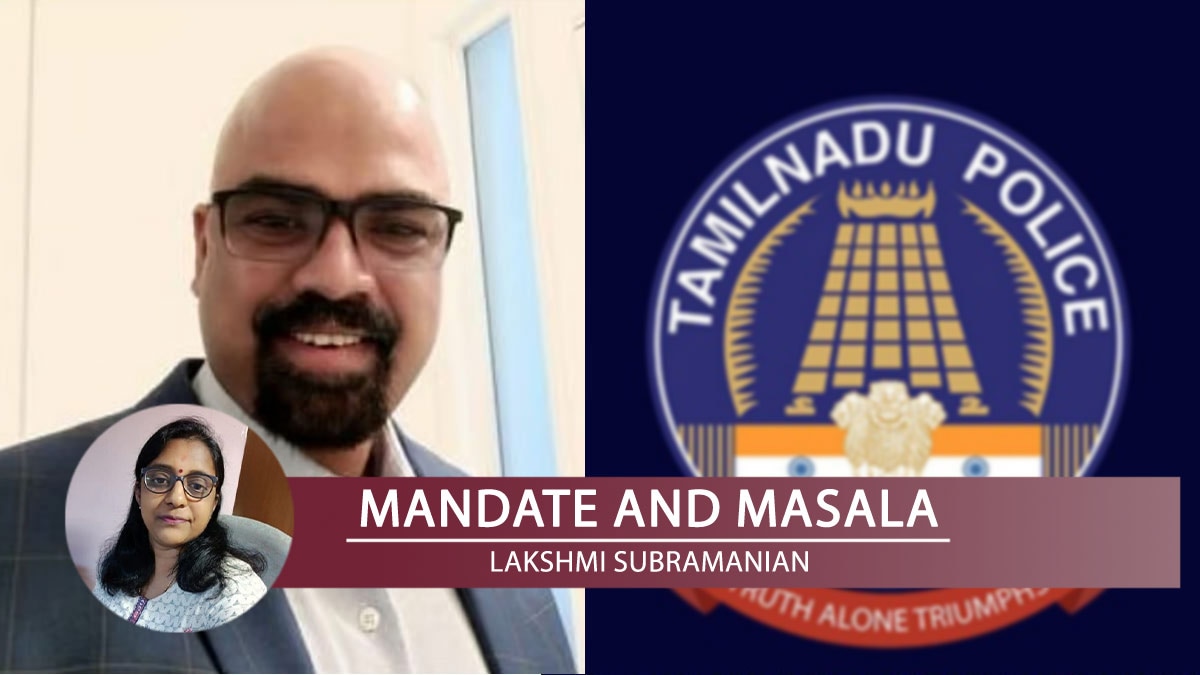
There is something deeply disturbing me since Friday evening, after I heard how Professor A. Kalaiyarasan was picked up by a few policemen in plain clothes from his house in Adyar in the wee hours of Friday. I have known Kalaiyarasan for many years. An intellectual who had always been straightforward in his thoughts, he has co-authored a book titled ‘Dravidian Model of Governance’ with Prof Vijayabhaskar, which is an insightful read with data, statistics and perspectives that defend the role of successive Dravidian party governments in Tamil Nadu over the past five decades.
The concern is not just about the arrest. But the manner in which Professor A. Kalaiyarasan, an associate professor at the Madras Institute of Development Studies (MIDS), was picked up by the police over an abusive Instagram comment allegedly directed at a TVK legislator. The social media account carried his photograph as a profile pic. That, apparently, was enough for the police to land at his doorstep around five in the morning.
Vijay's meeting with Professor A. Kalaiyarasan may have helped contain the immediate embarrassment for the government. But it cannot erase the disturbing questions raised by the police action. A citizen's rights cannot depend on the chief minister's intervention. There is something deeply disturbing about the image of three plainclothes policemen arriving at the home of an academic at the crack of dawn, taking away his mobile phone and asking him to accompany them for questioning over a social media post he says he never made.
This was not merely a case of mistaken identity. It raises serious questions about personal liberty, police powers and the protection of fundamental rights. Article 21 of the Constitution guarantees the right to life and personal liberty. Police investigations cannot become exercises of intimidation simply because someone has complained about an offensive social media post.
Why was the account not verified before the police reached his house? Was its digital footprint examined? Who authorised the operation? Why was an academic taken away in a private vehicle without the basic procedures being followed? And what explains the reported halt near Pallavaram, where the policemen allegedly made several calls before deciding to take him back home?
These are not trivial questions. They demand answers from the police leadership, which ultimately falls under the chief minister, who also holds the Home portfolio.
There are also concerns about whether Kalaiyarasan’s public criticism of the government had anything to do with the incident. There is no established evidence of a political motive. But the government must ensure that the investigation is transparent enough to dispel such suspicions.
Vijay’s meeting with Kalaiyarasan and the government’s acknowledgement that the police had made a mistake are welcome. But an apology cannot substitute for accountability. Nor should a citizen’s rights depend on whether he has the access or influence to meet the chief minister. Would an ordinary citizen, without academic standing or public support, have received the same attention?
Vijay came to power promising a different political culture. The test of that promise is not how quickly he meets someone wronged by the system, but whether he makes the system answerable. The government must establish who authorised the operation, examine the conduct of the officers involved and make the findings public.
Today it is an academic whose photograph was misused. Tomorrow it could be a journalist, an activist or an ordinary citizen.
Vijay may have apologised to Kalaiyarasan. But Tamil Nadu deserves more than an apology. It deserves a police force that verifies before acting, respects constitutional rights and answers for its mistakes. A personal gesture of regret cannot become a substitute for institutional justice.
