



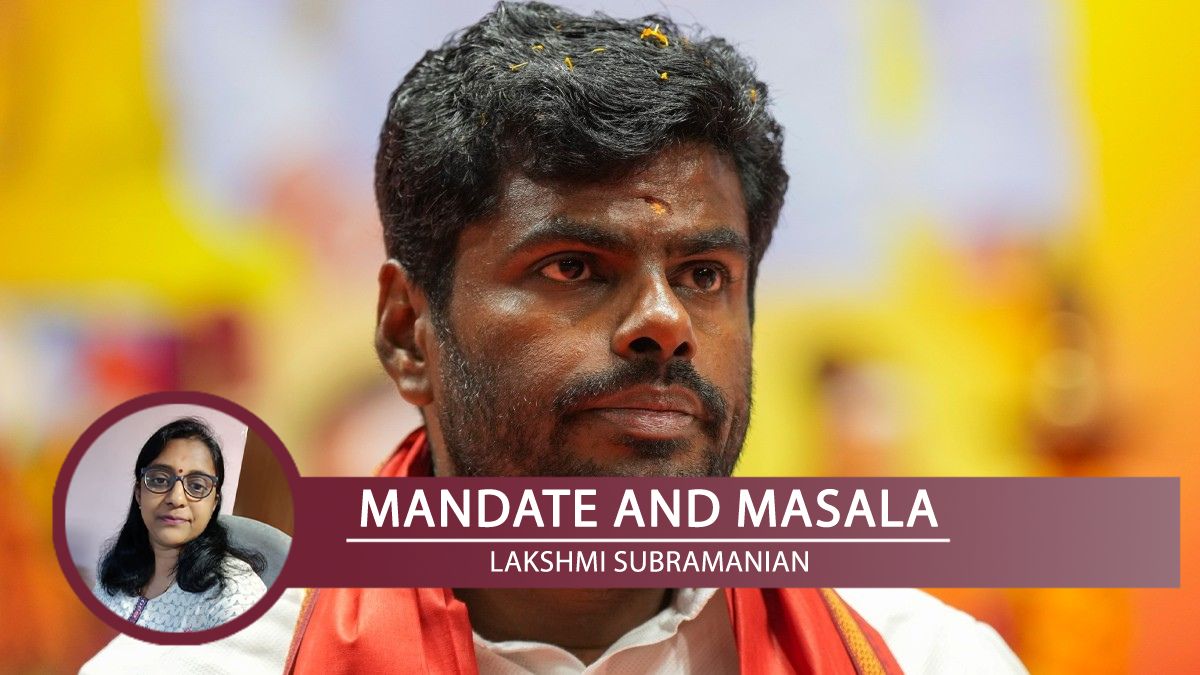
For years, K. Annamalai was the Bharatiya Janata Party’s most combative face in Tamil Nadu. The former IPS officer built his political identity around confrontation, taking on the DMK and challenging the Dravidian political establishment.
He was projected as the leader who could expand the BJP’s footprint in a state where the party has struggled to emerge as a major independent force.
Just five months after the 2026 general election, now, Annamalai’s confrontational energy towards his former political bosses has surprised everyone. A few days ago, Annamalai’s criticism of the BJP’s response to the Cockroach Janata Party (CJP) protests marked a significant shift in his public positioning. The man who once defended the party’s ideological positions is now questioning its methods—particularly its tendency to portray critics as anti-national.
The question is whether this represents an ideological departure—a personal disagreement with the BJP leadership or the beginning of a new political identity.
Annamalai’s argument is that a government which has been in power for more than 12 years should be able to answer its critics rather than routinely portraying dissenters as enemies of the nation. His objection is not necessarily an endorsement of CJP or its political agenda. Rather, it concerns the principle that opposing the government should not automatically mean opposing the country.
This distinction matters. In fact, in his statement, Annamalai has invoked Narendra Modi’s own criticism of police action against anti-corruption protesters in 2011 to highlight what he sees as a contradiction between the BJP’s earlier defence of dissent and its response to protests today. He has maintained that he does not support CJP’s politics, while insisting that the right to protest and that the requirement of due process be respected.
His argument places the BJP in an uncomfortable position. A party that once mobilised public opinion against the Congress-led government over corruption and the treatment of protesters must also explain how it responds to criticism when it holds power.
Yet, Annamalai’s intervention should not automatically be read as a complete break with the BJP’s ideology.
Even when he tries to shrug off the Hindutva and the BJP tag, his earlier staunch association with the leaders in the BJP are likely to continue as a shadow behind him. Incidentally, he has continued to express respect for Modi even while questioning the party’s functioning and its approach to dissent. His criticism appears directed more at political methods and organisational culture than at every aspect of the BJP’s ideological project.
His political estrangement also reflects a larger contradiction.
Annamalai was presented as an outsider capable of challenging Tamil Nadu’s established political order, but his own ambitions and disagreements with the party leadership eventually raised questions about how much autonomy a state leader could exercise within a centralised national organisation.
Now his new platform, We The Leaders, gives him space to develop an independent political identity, but criticism alone cannot sustain a political movement.
Also, criticising the BJP and Modi may not help him capture the deep rooted anti-BJP space in Tamil Nadu—he might have to demonstrate consistency, particularly when defending the rights of people whose politics he opposes.
Annamalai’s new avatar is therefore not simply that of an anti-BJP leader. It is that of a former insider questioning whether patriotism can be defined by loyalty to a ruling party, and this could be a harder battle for Annamalai in the near future.
