



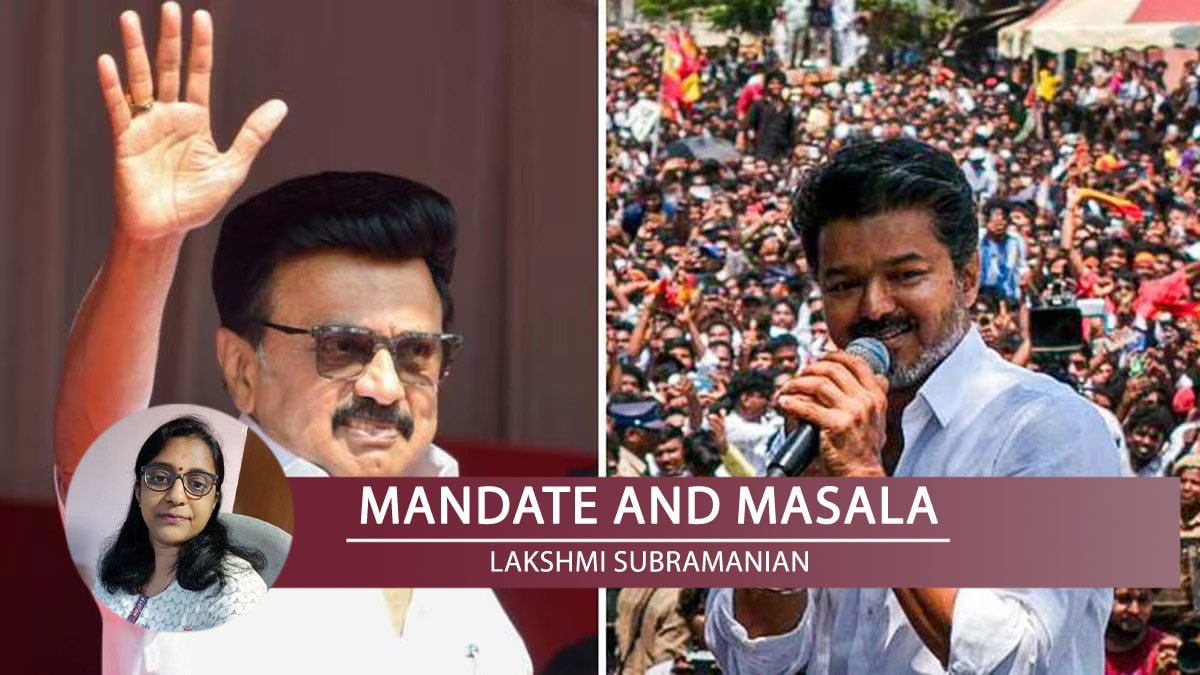
On September 7, a day before the Tamil Nadu Assembly’s budget session concluded, Chief Minister C. Joseph Vijay made a gesture by touching and lifting his jaw, which was interpreted as a ridicule of the beating suffered by DMK leader M.K. Stalin during his detention under the Maintenance of Internal Security Act (MISA). The following day, the DMK criticised the gesture as an intentional attempt by the chief minister to “body-shame” Stalin.
A week ago, the TVK’s IT wing had posted a picture of M.K. Stalin and Chennai Mayor Priya Rajan, apparently mocking her new hairstyle and appearance. Responding to what she described as verbal abuse from the TVK’s online supporters, she said, “If I eat a burger, it’s an issue. If I cut my hair, it’s an issue.” A few days ago, while seeking votes for his party’s candidate in Dharapuram ahead of the October 6 bypoll, Stalin referred to TVK candidate Sathyabama as “Balti Bama”. The remark soon triggered a controversy, with the TVK accusing the former chief minister of body-shaming its candidate.
Tamil Nadu’s political discourse has always had a taste for the theatrical. The punchline, the counter-punch, the nickname and the sharp one-liner have long been part of the state’s political vocabulary, regardless of which party is in power. Political satire, whether delivered through the mouthpieces of the two major Dravidian parties or through speeches by their leaders at public meetings, has traditionally been a distinctive feature of the state’s political culture—and one that voters have embraced, in one form or another.
But over time, political satire appears to have crossed a more troubling line, with the human body increasingly becoming a weapon in attacks on political opponents. The controversy over the Dharapuram campaign and Vijay’s jaw gesture are telling examples. Stalin’s remarks mocking TVK candidate P. Sathyabama’s physical appearance drew criticism from rival parties, and the TVK has filed a complaint with the Election Commission. The irony, however, is that Vijay’s jaw gesture did not attract the same level of criticism on social media as Stalin’s remarks.
Both episodes matter not merely because of the words spoken or the actions involved, but because they raise a larger question: why is a politician’s body increasingly becoming legitimate ammunition in political attacks? Tamil Nadu has a long tradition of political rhetoric built around humour, satire and ridicule. Traditionally, the target of that ridicule has been a political decision, a policy, a party symbol or a public record. Turning a person’s physical appearance into the punchline is difficult to justify as political satire.
And this is not a problem confined to any one party. In recent months, Tamil Nadu politics has seen several controversies involving personal, gendered and sexually suggestive attacks. AIADMK MP C.V. Shanmugam faced criticism after bringing actor Nayanthara into an attack on Stalin. BJP state president Nainar Nagenthran was criticised across political lines after making a remark involving actor Vijay and his co-star and friend Trisha Krishnan. In August, DMK leader Udhayanidhi Stalin was arrested over remarks that were widely interpreted as sexually suggestive references to Vijay’s relationship with a female actor. Another case has been registered against Udhayanidhi over allegations that he made children in Dharapuram raise slogans targeting Vijay. The apparent inconsistency in the response to such incidents, however, is also worth examining. The police, under the Home portfolio held by Vijay, did not publicly condemn the TVK IT wing’s social media posts targeting Chennai Mayor Priya, even after she called out the abuse. Similarly, several women actors and other prominent voices on social media who have previously spoken out against online abuse did not publicly condemn the TVK post targeting Priya.
But the more worrying aspect is that women, in particular, often find themselves at the receiving end of this politics of appearance. In Tamil Nadu’s highly active social media environment, women politicians, journalists and activists continue to face intensified gendered online abuse, particularly during election seasons. There is an uncomfortable hypocrisy here. Political parties and their leaders, including Chief Minister Vijay, routinely speak about women’s dignity, empowerment and participation at public forums. Yet campaign rhetoric and the social media ecosystems surrounding political parties continue to reduce women to their bodies, clothes, relationships and perceived physical appearance.
The damage goes beyond the individual being targeted. These verbal and online abuses always send a message to every young woman watching politics from the sidelines, saying that if you enter public life, not only your policies may be scrutinised, but also your body and your appearance. This is something that precisely what Tamil Nadu’s political culture should always resist.
Politics is already a demanding arena. Candidates should be questioned about their promises, records, ideology, finances, governance and credibility. If a candidate changes parties, voters can ask why. If a politician changes position, voters can challenge the contradiction. If a government fails, it can and should be attacked. But weight, complexion, clothes, age, facial features, haircut or physical appearance are not political arguments.
The irony is that Tamil Nadu’s political tradition was built, in part, on challenging inherited hierarchies and asserting the principle of self-respect. Yet the language of politics now risks becoming a means of humiliating people for the bodies they inhabit, making political discourse increasingly cruel, particularly for women.
