



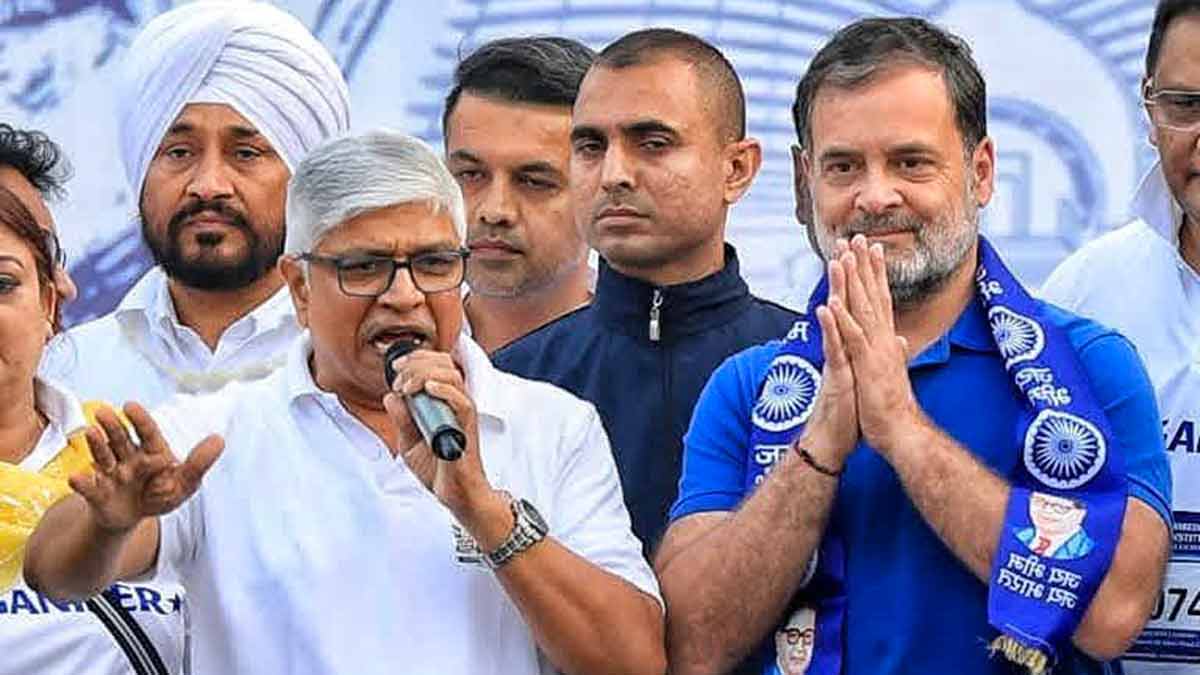
ON SAMAJWADI PARTY chief Akhilesh Yadav’s birthday on July 1, Congress leader Rahul Gandhi did more than post a greeting on X. In his message, he reaffirmed the Congress’s commitment to the PDA plank—comprising pichda (backward), dalit and alpsankhyak (minority) communities—signalling a shared direction for the two parties and cementing the alliance ahead of the 2027 Uttar Pradesh assembly polls. The Congress had already sent a political message to the PDA four days earlier by appointing dalit leader Rajendra Pal Gautam as its Uttar Pradesh in-charge.
Although the state unit president heads the party organisation, Gautam—born in Delhi but with roots in UP—has stepped beyond his role and begun directly reaching out to dalits, who account for about 22 per cent of the state’s population, the state’s largest social group. Muslims make up around 19 per cent and Yadavs roughly 13 per cent, both traditionally the Samajwadi Party’s core support base. About 95 per cent of Muslims and 82 per cent of Yadavs reportedly voted for the SP-Congress alliance in the 2024 Lok Sabha polls.
The alliance’s challenge is to expand beyond this Muslim-Yadav base, and the most promising constituency seems to be the dalits. In the 2024 Lok Sabha polls, around 40 per cent of dalits voted for the INDIA bloc, while the remaining votes were evenly split between the BJP and the Bahujan Samaj Party. With Mayawati’s declining electoral fortunes and increasingly limited political engagement, the opposition believes a vacuum has opened in dalit politics.
Political observers say many dalits shifted to the INDIA bloc in 2024 because the BSP was not perceived as effectively voicing their concerns, while the Congress successfully campaigned around the allegation that the BJP was trying to change the Constitution and weaken reservations for backward communities.
The Congress now hopes for a repeat of 2024. The Constitution campaign helped the SP-Congress alliance win 43 of Uttar Pradesh’s 80 Lok Sabha seats. This time, with the 2027 assembly elections heading towards a bipolar contest, the Congress believes dalit mobilisation can convert parliamentary gains into assembly seats.
According to political analyst Aditya Rathi, if the Congress is able to establish itself as the party of dalits, many non-Jatav dalits, who make up around 50 per cent of the dalit population, and a significant section of Jatavs could shift towards the party. It is this possibility that the Congress believes Gautam can help unlock.
Gautam belongs to the Jatav community, which accounts for nearly half of the state’s dalit population. While he may not be a widely recognisable dalit face, Congress leaders say his appointment has generated interest on the ground. “Dalits know his name because he has earlier been an activist for their cause,” said a Congress leader.
If the Congress is able to strengthen its organisational structure and communication strategy, it believes it can strengthen the alliance’s position in nearly 100 assembly seats where dalits form more than 30 per cent of the population. The SP’s core Muslim-Yadav base enabled it to win 111 assembly seats in 2022. A broader dalit-Muslim-Yadav consolidation could push it beyond the majority mark of 202 seats in the 403-member assembly.
The SP’s outreach has broadened to include non-Yadav OBC communities as well, apart from dalits. It is not overtly focusing on Thakurs, the community to which Chief Minister Yogi Adityanath belongs. Akhilesh is seeking to expand the coalition rather than rely solely on the Muslim-Yadav bloc that has defined SP for decades.
“UP is a mini India,” Gautam said. “Dalits, Muslims and Other Backward Classes account for more than 60 per cent of the state’s population and want a proportionate share, but right now only a few communities helm the affairs. Dalits have suffered for centuries.”
The Congress, Gautam said, wanted to strengthen the alliance. “There is clarity that the INDIA bloc will contest together. The struggle of dalits that is going on right now can only be taken up by a national party. There is a need to take up their issues; if we won’t, then who will?”
The Congress is hoping to secure at least half of the dalit vote this time. Until the early 1980s, dalits—alongside Muslims and Brahmins—were the Congress’s core vote bank in the state. The rise of Kanshi Ram and Mayawati’s Bahujan movement gradually shifted dalits to the BSP, while Muslim and Brahmin votes got dispersed among regional parties and the BJP, leaving the Congress marginalised in the state.
According to Verender Guddu, former general secretary of the party’s state unit, the Congress still had a committed base that continued to support it. “In almost every assembly seat, there are 2,000 to 5,000 votes that people will give to the Congress on its name. In some seats, that number will be more than 10,000,” he said.
Once dalits return to the party, the Congress believes it could attract Muslims and sections of Brahmins. That possibility presents its own challenge, though. A stronger Congress could make the SP wary of conceding too much space during seat-sharing negotiations.
Santosh Bhartiya, political analyst and former Lok Sabha member, said the Congress currently lacked an organisational structure or grassroots presence to contest alone. “The party’s real focus is not 2027, but the 2029 Lok Sabha elections,” Bhartiya said. “From this perspective, whether Akhilesh wins or loses in 2027 serves the Congress’s long-term strategy, as it aims to rebuild its social coalition by bringing Muslims, a significant section of dalits and other communities into its fold.”
