



KOLKATA
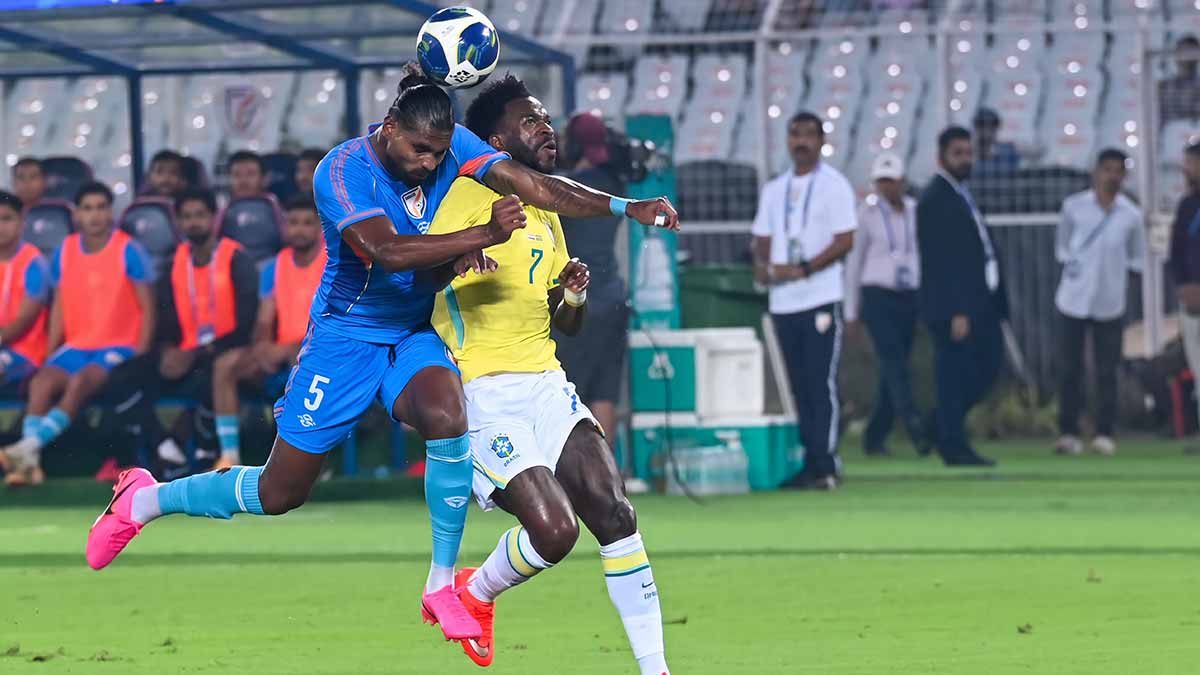
Bruno Guimaraes looked around, scanning, as top midfielders often do, and realised he was the only player left in a room full of journalists. He had stopped for a chat after Brazil’s 4-0 win over India in Kolkata on October 3. Probably eager to get on the bus, he saw the perfect opening to make a parting statement when THE WEEK sought his opinion on Team India. “Good team... they played well,” he said, before adding with a smile as he walked away: “You got a new fan now!”
Soon, the comment went viral. Premier League India and Premier League Brasil collaborated on Instagram to call it “high praise for India from the Arsenal midfielder”—the static post had 57,000 likes, 7,685 shares and 176 comments when this story went to print. While reactions of the netizens were celebratory for the most part, there were sceptics, too. Said one of them: “Deffo played well! But ‘got a new fan’ kuch zyada ho gaya (was a little too much).” As gaurabu_desu so eloquently summed up there, polite platitude aside, Bruno had a point.
Against Brazil, The Blue Tigers were inspired and inspiring. India, ranked 138th, were going into the match on the back of an impressive 1-1 draw against Panama (ranked 44th at the time) in Bengaluru on September 25 in their first game of this international window. There had been phases of that game India dominated, against opponents who were at the recent World Cup. Despite this, India were expected to be more cautious against the five-time World Cup winners in Kolkata.
However, head coach Khalid Jamil went with a bold approach. India displayed great defensive discipline to repeatedly catch Real Madrid’s Vinicius Junior and Chelsea’s Estevao Willian off-side. By the end of the match, Brazil had been off-side 10 times.
In possession, the defence played out from the back rather than hoofing the ball long. The midfield focused on keeping things simple and the ball moving, and the forward line worked hard in both attack and defence. Holding a higher defensive line allowed India to transition faster and threaten the Brazilian defence.

When India went long, there was a clear plan. For instance, most of the kicks went to the left—Manvir Singh, playing as a striker, joined Ashique Kuruniyan on the flank and made the shorter side of the Brazil defence—right-back Matheuzinho and captain Marquinhos—work hard during aerial duels. Similarly, on the right, India’s Australia-born attacker Ryan Williams took on and beat Brazil’s current first-choice left-back Douglas Santos. India showed great confidence on the ball, too; Sahal Abdul Samad caught the eye with some deft touches in tight positions. Manvir, meanwhile, was as fearless as he was tireless, trying (albeit unsuccessfully) to outmuscle Arsenal centre-back Gabriel Magalhaes before (briefly) outmanoeuvring Marquinhos, who is also the captain of European champions Paris Saint-Germain. In the middle, Anirudh Thapa was calm on the ball and showed great defensive intelligence to make crucial interventions.
In short, India came with a coherent strategy and largely executed it well. There were lapses in concentration and questionable decisions, but these issues will only improve with more exposure. Ultimately, two of Brazil’s four goals came from unconvincing goalkeeping by India captain Gurpreet Singh Sandhu and the third from an intercepted pass by the otherwise imperious centre-back Bijoy Varghese. The last one was the only goal where India were completely outclassed.
So, there were plenty of positives for India to carry into the October 6 Uruguay clash. However, there was a chance the match was going to be tougher for India than Brazil. This is because the Brazil game happened in a scenario favourable to the home team. While India trained hard for a week in Kolkata, Brazil reached late on October 1, less than 48 hours before the match. They had a hectic schedule, having played against Australia in Brisbane on September 29. According to Bruno, it was over 50 hours of travel. He also said the heat hindered Brazil and that the pitch was “very different”. To add to all this, 10 Brazilian players had not played for the national team before this window.
In contrast, Uruguay had arrived in Kolkata on September 30 and had only three new players in the 26-man squad. Moreover, India only had a couple days to recover from the exertions against Brazil, whereas Uruguay had last played on September 28—a 4-1 win against South Korea. So, Uruguay, ranked 20th ahead of the game, were always going to be a significantly tougher opposition. But, India belied belief by getting off to an electric start. The hosts were unfortunate to concede a penalty, scored in the 11th minute by former Liverpool striker Darwin Nunez, but fought back to equalise in the 22nd minute through Thapa. India had looked the better team when play was halted by lightning.
But, when the game restarted, the four-time world champions (two World Cups and two Olympic golds are represented in the four stars on Uruguay’s jersey) took control and never lost it. The Blue Tigers had played their best first half of the window and fought bravely till the end, but the gulf in quality was too large, as reflected in the 6-1 scoreline. It was a sobering end to an exciting international window. Nonetheless, this remains an unprecedented level of exposure for the Indian men’s team. And, notably, they produced battling performances despite India being one of the few countries in which the domestic league has not started this season, not to mention the chaos of the last domestic season. As Williams said, if players had had games, it would have been better preparation for such tough matches.
Former India captain I.M. Vijayan is emphatic in his praise of the marquee matches. “These matches are a huge step forward for us,” he told THE WEEK. “Criticisms of facing heavy defeats or spending a lot of money do not carry much weight.” India’s spending—conservatively thought to be around Rs70 crore, while some estimates put it closer to Rs90 crore—on these matches had been criticised, including by former India captain Bhaichung Bhutia. The Sikkimese Sniper had chastised the AIFF for pulling out of the inaugural FIFA ASEAN Cup to prioritise the friendlies, saying the tournament would have offered more meaningful exposure.
But, Vijayan feels losing to top-tier teams is far more valuable than playing against smaller teams. “Given the current state of our football, these matches have given our players a new experience and feel,” he said. “The confidence and exposure gained are unmatched. Scoring against a team like Uruguay is no small feat. Despite conceding early, our boys fought back.” He added that the team would reap the benefits of this exposure in upcoming matches against Asian teams. He also felt that playing against big teams more often would raise the standards of our players and eventually help to qualify for a World Cup. “We should play matches against top Asian teams like Japan and South Korea,” he said. “And let powerhouses like Brazil and Uruguay come—it will energise not just the team, but the entire footballing ecosystem.”
That is where the question of money becomes important. It is estimated that India had paid appearance fees of around Rs40-Rs50 crore to Brazil, Rs12.5 crore to Uruguay and Rs5.5 crore to Panama, plus charters costing Rs6 crore, Rs3 crore and Rs50 lakh, respectively. Other organisational costs are in addition to this. Senior football writer Antony John, coordinating editor at the Malayala Manorama, feels the money being spent on grassroots and age-group exposure would have had a more positive influence on Indian football. “A match against Brazil is a spectacle,” he said. “It is not a development programme.”
If we assume Rs90 crore is available for Indian football, John provides a break-up of how it could be allocated over three years: Rs20 crore towards age-group exposure, Rs18 crore for a domestic youth calendar that actually runs, Rs25 crore for pitches that can survive the monsoon, Rs12 crore for coaches and referees and Rs15 crore for a girls pathway and scouting net.
A 22-player youth squad, with staff, for 12-14 days and three or four games typically costs Rs80 lakh to Rs1.5 crore, depending on whether the destination is Uzbekistan, Qatar, Japan, South Korea or a Portuguese or Spanish academy block. An allocation of Rs20 crore, therefore can easily fund 15-20 such tours. This could be a calendar of two tours each year for U17s, U19s and U21s. “India does not learn that much from Vinicius at full speed,” said John. “It learns against Uzbekistan’s U20s, Korea’s K-League reserves, Japanese university sides and Qatar’s Aspire age groups.” He said a fixed window each March and September, with video review and a written technical report after every tour, is worth more than marquee nights at Salt Lake.
The domestic youth calendar is equally important as Indian age-group sides often go abroad undercooked because the home calendar is thin. John said Rs18 crore can run U15, U17, U19 and U21 national leagues for three seasons—travel, match officials, medical cover, cameras and centralised scheduling so ISL or I-League clubs cannot treat youth games as optional.
On pitches, Rs25 crore builds 15-20 FIFA-quality artificial turfs at Rs1.2-1.8 crore each. “The non-negotiable part is a maintenance endowment,” said John. “A ground without a groundsman and a sinking fund is a photograph, not infrastructure. This is also where girls’ football gets a ground it can actually book. The Rs12 crore allotted to coaches and referees can be used to subsidise AFC B and A licences for 200-300 coaches, plus C-licence cascades.” In the case of pitches and coaches, he suggested a higher weightage to football hotbeds like the northeast, West Bengal, Kerala, Goa and Punjab. “A smaller slice [of the allotment] can be used to professionalise a core of referees on retainers, so youth leagues are not officiated by whoever is free on a Sunday. The AIFF’s own recent budgets have cut grassroots and coaching allocations to well under Rs1 crore in some years.”
When it comes to girls’ football, tours are cheaper and the competitive return is higher because the gap to Asia is narrower. “The rest pays regional scouts, a basic video database and medical screening, so that selection is not limited to whoever is already in an ISL academy.”
On the whole, when you weigh the benefits of a marquee friendly against what can be created by following a formula like this, it seems like the more compelling case is to direct funds towards development. “The political case [for marquee matches] is strong,” said John. “The football case is weak. Appearance fees do not stay in the Indian system and friendlies of this gulf do not change the player pool.” When it comes to funds, the AIFF’s March 2026 liquid balance was Rs11.25 crore; so, it is not like there is an endless cash reserve to draw from. “A practical rule is simple: one marquee senior friendly in a World Cup year, paid for by tickets and a title sponsor,” said John. “Everything above that should go towards development.”
Indeed, this could also be the most feasible way to popularise football in India. When more players develop, especially from north India, and if, in the future, some of them are able to go and perform in one of Europe’s top five leagues, India may organically fall in love with the beautiful game. The real solution then may not be importing stars for our viewing pleasure, but making them in India.
—With Hariprasad A.
