



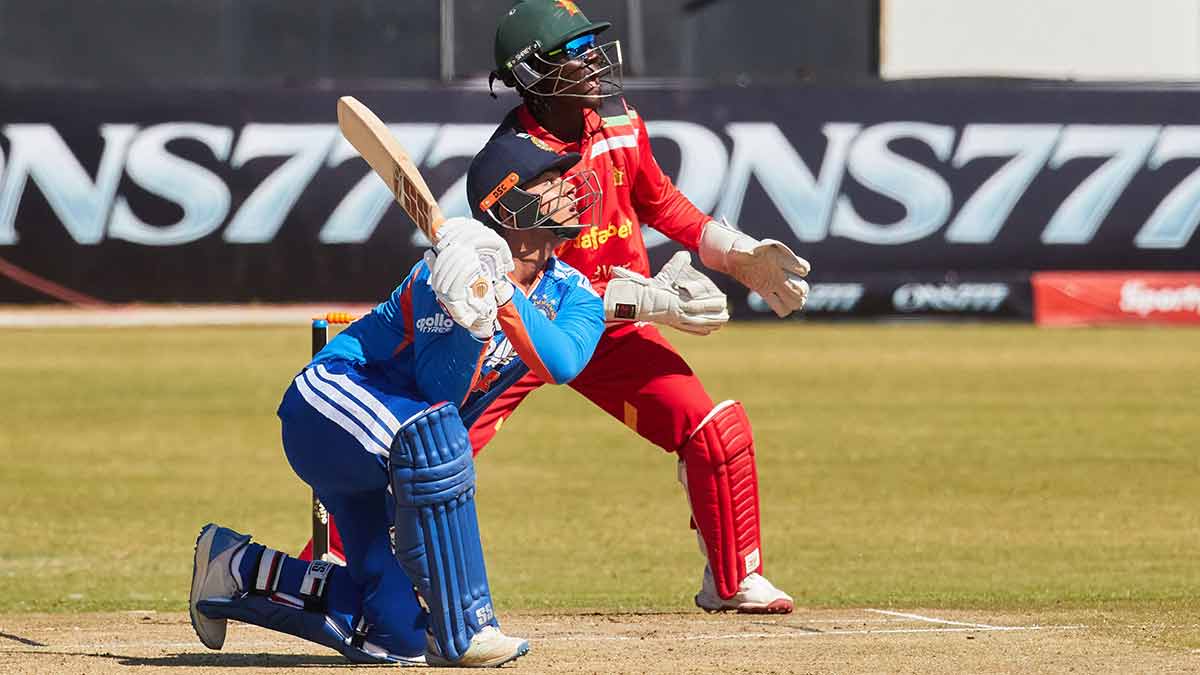
Eyes closed. Down on his haunches. Behind the wicket, facing the bowler’s end. Vaibhav Sooryavanshi’s pre-match ritual seems innocuous. Almost boring. That is, till the umpire calls play. The fireworks that follow have lit up millions of screens, as well as an entire format of cricket.
“Vaibhav is nearly the IPL this year. He is the story of the tournament,” Jos Buttler, former Rajasthan Royals star and arguably England’s best-ever white-ball batter, said in his podcast with English legend Stuart Broad. This season, the 15-year-old scored 776 runs at a strike rate of 237.30.
“As long as he trained, I have never seen him practise defence,” his childhood coach Manish Kumar Ojha told The Cricket Monthly.
Fans, even legends, were left in awe. “The boy is simply outstanding. He can be the next demigod of cricket,” former World Cup winner Krishnamachari Srikkanth told THE WEEK in a podcast.
Aussie great Greg Chappell wrote in Cricinfo: “In his elegant downswing and flawless balance, there are distinct echoes of the great Graeme Pollock and the incomparable Sir Garfield Sobers. When he slashes across the line or lofts over extra cover, one glimpses the ferocious, instinctive genius of Brian Lara, combined with the devastating, ball-one intent of Adam Gilchrist.”
Naturally, given the hype, eager Indian fans pushed for his India debut. And they didn’t have to wait long. At 15, he broke Sachin Tendulkar’s record to become the youngest cricketer to debut for India, against England, in early July. India lost the T20I series 0-4, with Sooryavanshi scoring only 42 runs in three matches. In the recent Zimbabwe series, however, which India swept 3-0, he showed glimpses of his devastating self: he made 151 in three matches, with an 18-ball 50 in the first, and a more composed 81 in the last.
In 40 T20 matches so far, Sooryavanshi has an average of 42.82 at a strike rate of 216.32. In this year’s IPL, he even out-hit West Indies great Chris Gayle, with 72 sixes—the most in a season—compared with the latter’s 59 in 2012.
But T20 was never the question, especially after IPL 2026. It was more about how he would fare in the longer formats. In the ODI tri-series featuring the A teams of India, Afghanistan and hosts Sri Lanka in June, Sooryavanshi made little impact in the first four matches, barring a 22-ball 44. In the final, though, he shut down doubters with a 29-ball 94. It helped his List A average rise to 43.38 after 13 games.
The sample size in First-Class cricket is even smaller—in eight matches for Bihar, he has averaged just 17.25, albeit with a strike rate of 90.

The dilemma is essentially this: do you give him space to grow in a format where he can become the greatest, or do you risk taming the genius to make an above-average player across formats? It’s a discussion that goes beyond Sooryavanshi. These days, it is hard to find a top-level batting talent playing all three formats for a country. The ones that do are exceptions, like Australian opener Travis Head or England white-ball captain Harry Brook. The closest in India is Shubman Gill, who captains in the longer formats, but is yet to find a stable position in T20Is.
The generation of the Fab Four was the only one to play all three formats with equal seriousness. And in that, Virat Kohli was arguably the best at all three combined.
But even with Kohli, as analysts have argued, the core of his game changed little across formats. He would tweak his technique to suit the format, but would not make drastic changes. His strike rate of 137.04 in T20Is is a far cry from those of the boys today. He was always an accumulator; the likes of Sooryavanshi are not taught to be that. A high-elbow punch is beautiful; a slog over mid-on is effective.
This need for speed is fuelled by changes like the Impact Player rule in the IPL, the two-ball rule in ODIs and flat pitches. This year’s IPL saw 61 totals above 200, up from 52 last year. The overall run rate rose to an all-time high of 9.85, up from 9.62 in 2025. Pacers averaged 32.31 at an economy of 9.94, their worst in an IPL season. Spinners, too, recorded their most expensive season, going at 9.26.
“Earlier, power hitting was all about stronger guys; the [Andre] Russells and [Kieron] Pollards,” former India opener and commentator Aakash Chopra told THE WEEK. “Then came the innovative kind—AB de Villiers and his ilk. And now we see someone like Sooryavanshi hitting sixes for fun. Batters are redefining it.”
Logically, this six-first approach could run into trouble in Tests, where pitches are spicier and endurance and patience matter more.
Bihar coach Vinayak Samant believes Sooryavanshi has that extra gear to play the longer format; only his mindset needs to change. He added that if the teenager changes his technique to ‘fit’ the other formats, the runs will dry up. “He has to be smart; play in singles and doubles when the situation demands it, and attack whenever there’s a chance,” the former Mumbai wicketkeeper-batter told THE WEEK.
Sooryavanshi has shown hints of this prudence. In the final T20I against Zimbabwe, Sooryavanshi tried an attacking shot only 22 times in his 49-ball knock. Stand-in coach V.V.S. Laxman called it a “mature” innings on a weary pitch, as India did not score a single boundary between overs seven and 10.
Earlier this year, in the U19 ODI World Cup, Sooryavanshi curbed his instincts when needed. In the match against Bangladesh, on a damp wicket, he played a watchful innings of 72 off 67 balls. Then, in the final against England, he took his time, scoring 15 off his first 17 balls on a quick pitch. Once he got his eye in, he raced to a match-winning 175 off 80 balls.
The conversation with Samant inevitably drifts to Virender Sehwag, who turned the role of an opening Indian batter on its head, especially in Tests. “Sehwag used to play his natural game, but when the fielders were deep, he would deal in singles and doubles,” said Samant. “It’s all about adapting to the situation.”
There is another angle. Chopra said that players with certain roles, like a finisher in an ODI, might move from one format to another because there isn’t a major change in skill set. “Players like Gill and Yashasvi Jaiswal might find a gear suited for [domestic] T20 cricket,” he said. “But it will be difficult to make the cut at the international level across formats.”
He added that India should not obsess over all-format players. “You have enough and more people,” he said. “Test cricket can be the prerogative of batters who are technically more solid. They can also be the ones who play the ODI format because ODI is not really evolving at the pace of T20 cricket. I am absolutely at peace with the fact that there will be some superstars in cricket who would not play all three formats. The world is changing. You can’t expect everybody to follow the same norm.”
Interestingly, the quest for spectacle and results in Tests has in a way encouraged aggressive batting. An analysis of Cricinfo’s data showed that in the 2023–2025 World Test Championship cycle, only four of 78 Test matches ended in a draw, thanks to ‘Bazball’ but not restricted to England alone.
And this has affected team compositions. Gone are the days of Test specialists like Cheteshwar Pujara in the Indian team. Among those who debuted in the past two years, barring a few, there has been a distinct IPL flavour in selection.
Veteran cricket journalist and THE WEEK’s sports consultant Ayaz Memon said this set the wrong precedent. “What message does it send when the top wicket-taker in Ranji Trophy, Auqib Nabi, is not picked in the Test team? That’s a terrible decision,” he said. “Around five years ago, we had more players playing across formats regularly. Be it Kohli, Rohit Sharma, Ravindra Jadeja, Hardik Pandya or Jasprit Bumrah. Not any more.”
India’s series defeats against New Zealand and South Africa at home have reopened the debate for grooming horses for courses. Memon said India’s huge talent pool could make three separate high-quality teams, but the concern is whether there will be any takers for the longer formats, starting from the grassroots. “There’s a classic story that Sunil Gavaskar talks about,” he said. “As youngsters, during practice, if they hit the ball in the air, the coach would ask them to pack up and go home. But today, if you don’t hit the ball in the air, you have to pack up and leave.”
He did, however, add that a technically sound batter could still thrive. “If you judge line and length well and early, have a wide repertoire of strokes and an appetite for risk-taking and innovation, then you can succeed in any format,” he said.
Samant agreed, and pointed out that the consistent performers in the IPL have been batters who are technically solid, be it Kohli, Gill or K.L. Rahul. He said that coaches must insist on their wards getting the basics right, and be honest with them and their parents—not everybody can be a Sooryavanshi.
Which is exactly what fuels the hope that he can conquer all formats. Samant said the teen would be the happiest person on earth if he gets the Test cap. But, it all boils down to what he aspires to be and his workload.
“I keep calling him the AI version of modern-day batting,” said Chopra. “Just like AI, Sooryavanshi has infinite possibilities. He may transcend formats. He may not. I guess we will discover it along the way. It’s a journey that all of us have to take together, not just the kid.”
