



On June 5, 2023, the chandeliers, 19th century paintings and gilded ceilings of the Elysee Palace in Paris looked down on a gathering of around 150 people. A 15-year-old stepped forward to face the audience, including first lady Brigitte Macron, for the final of an oratory competition. If the grand setting made Ayyoub Bouaddi nervous, he didn’t show it. As he spoke, he maintained eye contact with his audience, used his hands to complement the different intonations that he employed and never consulted his notes. It was as if he knew he was going to win.
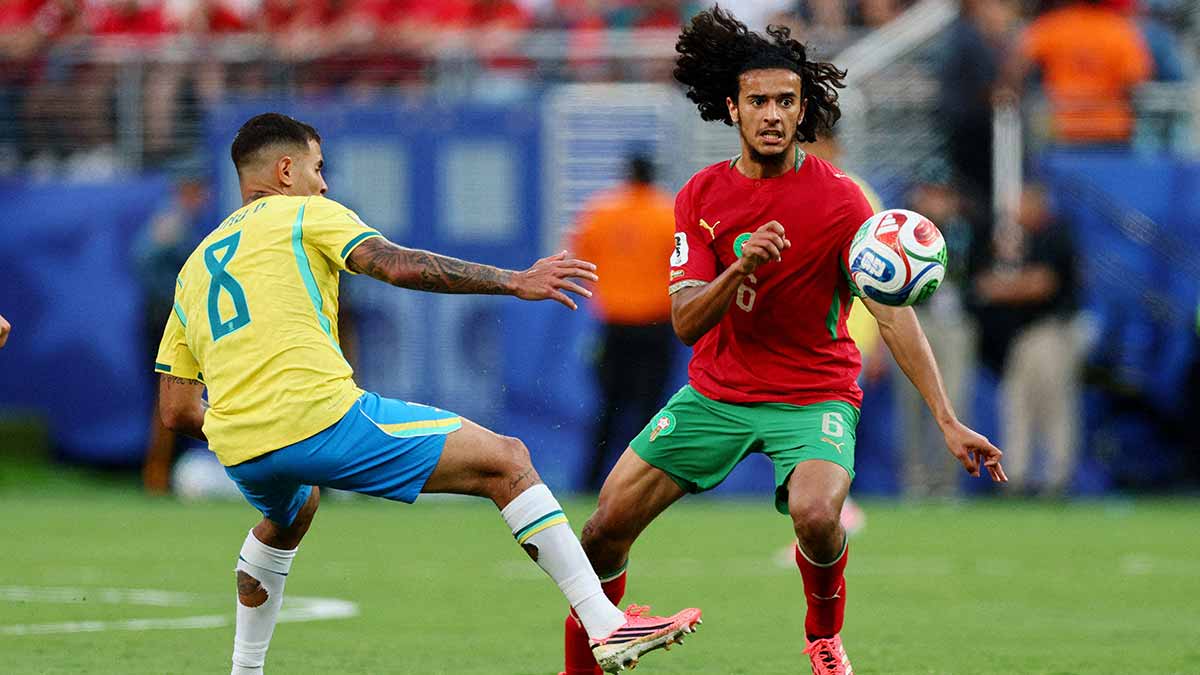
On June 13, 2026, Bouaddi brought that confidence to the World Cup. In a competitive debut for the ages, against five-time world champions Brazil at the venue that will host the World Cup final, the 18-year-old French-born Moroccan had names like Casemiro and Bruno Guimaraes chasing his shadow in the midfield. Once again, he was unfazed by the setting. In fact, in the 87th minute, he took the time to applaud a pass played under pressure by teammate Chadi Riad, before gathering the ball and gliding forward. It was as if he knew he was going to dominate Brazil.
Morocco coach Mohamed Ouahbi said as much. “He didn’t impress me because we already know what a player he is,” he said. “We were... certain that he’d have a big match.... It (Brazil) wasn’t the kind of match for taking risks.”
Though he played only twice in the group stage—he was rested for the third match against Haiti—the No. 6 was one of the standout performers of the round. He had a more difficult game in the round of 32 against the Netherlands, but still held his own against a midfield run by Barcelona’s Frenkie de Jong. Overall, in terms of pedigree of performances in his position, his arrival at the World Cup stage is comparable with Kylian Mbappe’s in 2018. The difference is Mbappe was already a household name, having moved for €180 million before his maiden World Cup.
However, though Bouaddi had yet to attract global fame, he was familiar to those following European club football closely. Brazil coach Carlo Ancelotti was also well aware of Bouaddi. On October 2, 2024, the day he turned 17, Bouaddi shone for Lille against Ancelotti’s Real Madrid, which had Aurelien Tchoumeni, Eduardo Camavinga, Jude Bellingham and Federico Valverde in midfield. Weeks later, he was the player of the match in a 1-1 draw against Juventus. By mid-November, he had become the third youngest player to feature for the French U21s.
By the end of the 2025-26 season, he had made 112 senior club appearances, and had become a key figure in the national U21 team. Remarkably, through all this, Bouaddi has also aced other pursuits. His father Hassan is a former handball player who built a post-sporting career as a banking director. He also served as deputy mayor of Creil, a town about 50km north of Paris. So, sport and education were equally valued by him. And, like on the football field, Bouaddi delivered in the classroom, too. He finished school with top marks at 16, a year ahead of his 2007 cohort, and is now pursuing a mathematics degree. Continuing studies, he has said, keeps his mind alert, and maths helps him “understand the game quicker”. This growing understanding is abundantly clear every time he steps on to the field—chest out, head up, constantly scanning the space and movements around him. With a 6’1”-and-still-growing frame to support his mental attributes, Bouaddi is poised to become a perfect modern holding midfielder.
Naturally, he was marked as a potential mainstay in the Les Bleus midfield. However, national team coach Didier Deschamps wanted him to continue in the youth ranks. It is plausible that Bouaddi’s all-round ability worked against him. Given the abundance of attacking talent in the French squad, Deschamps needs his midfield to be primarily defence focused and Bouaddi relishes starting attacks as much as his defensive duties.

It just so happened that Morocco was in need of a midfielder exactly like him. Under Ouahbi, they were looking to move away from the defensive tactics that got them to the semifinals at Qatar 2022 and play more technical football. So, when France chose to wait, the Atlas Lions pounced.
In the wake of his World Cup showings, a photo of a 10-year-old Bouaddi sporting a Morocco shirt at Russia 2018 had gone viral. But, despite what this indicates, getting him on board the Morocco project was not straightforward. It took multiple meetings, but, finally, in May, Bouaddi, who had captained France U21s in March, switched to Morocco.
It now seems the next big move for Bouaddi is on the horizon. Arsenal, Liverpool, Real Madrid, Barcelona, Bayern Munich, Paris Saint-Germain, Manchester City and Manchester United are all reported to be chasing his signature. Whichever suitor he chooses, football fans will be hoping that he gets the right environment to continue his development. Ayyoub Bouaddi is one precocious talent that the world of football cannot afford to see failing.
In 2012, the year Bouaddi began his youth career at AFC Creil, Deniz Undav was let go by the youth academy of Werder Bremen for being too small.
The rejection stung. “When Werder told me at 14 that I didn’t have a future with them it broke my heart,” he said. What followed was a patient, unglamorous climb through German football’s lower reaches. In his late teens, he was playing for TSV Havelse in the fourth tier while working full-time shifts in a factory. He would wake up at 4am, get to the factory after a 40-minute bus ride and a 40-minute walk and operate a laser machine for eight hours before heading to training. He would reach home at around 9:30pm and then do it all over again the following day. For two years. The drive to keep going was not hard to find, according to Undav. “Football has always been my life,” he said.
As a boy, he had spent hours watching Thierry Henry and Ronaldo, pretending to be them in kickabouts with friends. Following them on to the biggest stages seemed, by his own admission, not even a dream. “I didn’t believe it,” he said. “I just wanted to carry on playing for another 14 or 15 years.” The next step was modest: a move to SV Meppen in the German third division in 2018. But, it was enough, at least, to let him give up the factory.
Then, in 2020, at 23, came the move that changed everything. Union Saint-Gilloise, then in Belgium’s second division, signed him on a free transfer. The Brussels club had been identified as a sleeping giant of Belgian football since Brighton & Hove Albion owner Tony Bloom’s investment in 2018, and they were on the rise. So was Undav. He scored 17 goals in his first season to fire USG to promotion, then 26 more in the top flight the following year—finishing as Belgium’s top scorer and being named the league’s player of the year for 2021-22. Brighton signed him in January 2022 for €7 million and loaned him back to USG to complete the season. He moved to England ahead of the next season.
The Premier League proved a different proposition. “I thought it would be hard, but it’s even harder than I thought,” he said in November 2022. “It’s the best league in the world.” His first four appearances were under Graham Potter (Sweden’s World Cup coach), all as a substitute. Potter then left for Chelsea, and Undav waited five months for his full league debut under Roberto De Zerbi. He finished the season with five goals in 22 league appearances—though not much, those came in the final eight games, including a finish off the bench in a 3-0 win at Arsenal. Brighton qualified for Europe for the first time. It looked like the beginning of something for Undav.
It was not. The club signed Joao Pedro for £30 million. Fearing reduced game time, Undav accepted a loan move to Bundesliga club VfB Stuttgart. De Zerbi explained: “It is with some regret we decided to let Deniz go and play. Last year he was crucial for us in achieving our goals, but he deserves that chance.” After an impressive loan spell in the 2023-24 season—he scored 19 goals and assisted 10 in 33 games in all competitions—Stuttgart activated their purchase option, paying Brighton around €27 million—a €20 million profit for the English club. He has contributed 57 goals and 30 assists in 117 appearances for the German club, helping them into the Champions League twice. Last season, he scored 19 Bundesliga goals, finishing second only to Harry Kane.
His route to the Germany squad was no smoother than his journey in the club game. After making his international debut in 2024, at 27, he had only six appearances until this year, and looked to have dropped out of contention. Till he came off the bench to score a winner against Ghana in March. He immediately complicated his position by saying publicly that he wanted to push for a starting role. Coach Julian Nagelsmann suggested Undav would not have scored had he started.
Undav responded the only way he knows—two goals and an assist in a 4-0 win over Finland in May. He arrived at the World Cup as Germany’s most in-form striker, but did not start in the group stages.
It did not matter. Undav, who turns 30 in July, was subbed in for all three games and, in the first two, got three goals and two assists in 56 minutes—one goal involvement roughly every 10 minutes, putting him ahead of Lionel Messi, Mbappe and Erling Haaland at the same stage of the tournament. Even as Germany lost its third game to Ecuador, Undav made an exceptional run in the box late on and was highly likely to score had the pass been better—it was too close to the goalkeeper and was caught. In the round of 32 exit at the hands of Paraguay, Undav got a start. But, like much of the German team, he, too, was largely ineffective. The late bloomer’s first World Cup thus ended on a low. However, even as Germany mourns, Undav may be remembered as the one silver lining of the campaign.
Beyond Germany, Undav is already too important to ignore. The son of refugees, he is the first footballer of Yazidi descent to represent Germany at a major tournament. In the village of Khirbet al-Ghazal in northeastern Syria—where many residents are related to his mother—a small group had gathered at the home of community leader Ismail Dalaf to watch Germany against Ecuador. “When people see a Yazidi entering the field, scoring and changing the result of matches, it changes public perception,” Dalaf told the Associated Press. “It tells the world Yazidis have a role in it.”
