



LISBON
It is a mystery how Lionel Messi can miss a penalty kick in World Cup games. Three of them across six World Cups, the most by any player. It is also a mystery how he can thread the ball past multiple defenders, yards away from the goal post. What goes on inside his head as he glides into position to receive a ball, only he can tell. What pundits can decipher is that Messi has evolved his game to suit his advancing age, 39 in this World Cup. In the group match against Austria, his average speed was around 12kmph, certainly not suited to the modern power game where the long-legged Erling Braut Haaland can create minor tremors with his pounding run. But Messi has turned the slow pace into his strength. It gives him time to plot, process and execute. It suits his age. It brings his experience and ground awareness into play.
It is easier to understand Cristiano Ronaldo, whose game is more physical—at 41, he is the oldest non-keeper in this World Cup, and still has a body chiselled out of marble. Veins that glisten under stadium lights, muscles with more definition than 4K. The problem, critics say, is that he now moves like someone actually made of marble.

While Messi has scored all of Argentina’s five goals, and the most in World Cup history, Ronaldo started his sixth World Cup without impact. DR Congo held Portugal—among the favourites—to a 1-1 draw, and just one game in, critics and even fans started asking: Is Ronaldo a burden?
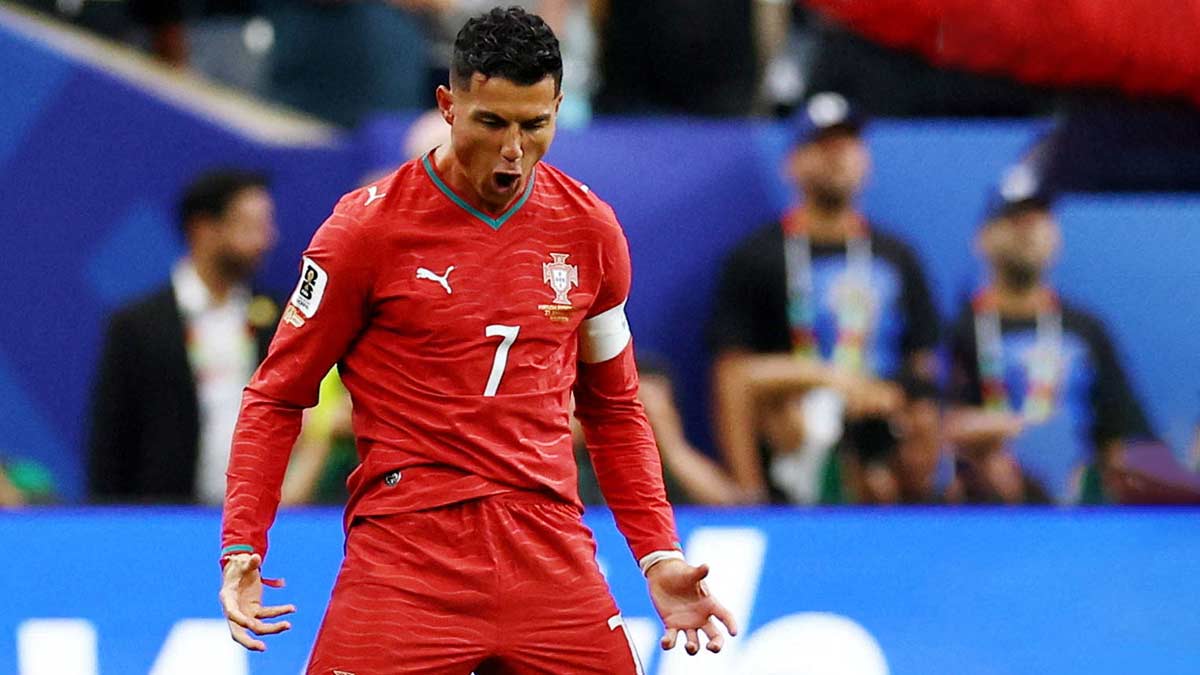
He gave glimpses of his old self with a brace against Uzbekistan, but this was a team whose inexperienced defence might have struggled against CR7’s Saudi club Al Nassr. “I’m back,” he shouted at the TV cameras after Portugal won 5-0. Answering his critics? Yes. Also, perhaps himself and his self doubts. Later, talking to Portugal’s Sport TV, he admitted that it was a difficult, dark week. “It felt like I had already retired from football, but I held on as I always do because I believe more in hard work than in football,” he said. And, as he explained, he has to do it again and again, against better teams. Explaining his “I’m back” statement, he said he was reminding the people who have been writing him off: “Always, 23 years like this.”
What the scoreline against Uzbekistan didn’t show was that Ronaldo had five clear chances to score. A younger version would have reached and converted from the two crosses from Nuno Mendes.
The superstardom hides the fact that, these days, Ronaldo’s main job for Portugal is to slot in penalties and occupy defenders. “He opens up more spaces than any other player,” said coach Roberto Martinez after the match. Ronaldo knows the opponents’ eyes are always on him. Which perhaps explains why he acted as decoy to the Mendes free kick that landed Portugal their second goal against Uzbekistan. A well thought-out strategy, as Ronaldo indicated soon after the ball found the back of the net.
Having removed the mental block of not scoring, the legend’s real test will now begin. Portugal next play Colombia, which will really assess whether he is indeed back.
The striker did come into the World Cup with some form, scoring five goals during the qualifying cycle, including a penalty, to match the totals of Kylian Mbappe and Robert Lewandowski. Overall, he holds the all-time record in these qualifiers, with 41 goals in 52 games, and has at times single-handedly dragged Portugal into the World Cup.
However, since 2023, nearly 30 per cent of his goals have come against weaker sides such as Luxembourg, Armenia and Liechtenstein. That he is past his prime is evident in one fact: it has been nine years since Ronaldo last won the Ballon d’Or, and five years since he received a single vote for the award.
There was a time when a chip or cross would enter the penalty box and Ronaldo, with the leap of a gazelle, would net the ball with his bullet header. Those iconic jumps defined a generation of Portuguese football.
Against DR Congo, the cross came in, the anticipation built, but the gazelle was too slow. And not in that instance alone. In the whole match, he managed just 25 touches and three shots, all off target.
In fact, he has scored just twice in Portugal’s past ten major games, and in the knockouts of the World Cup and the Euros, he last scored in 2016. Ten years later, he has become almost entirely a penalty-box striker, waiting for crosses and rebounds, and getting agitated when assists are poor. When the team moves its entire play towards him, the attack becomes predictable and easy to counter.
“Watch the second half against Congo,” said Joao Pimpim, international sports editor of Portuguese newspaper A Bola. “Every attack ended at the same place, near Ronaldo. The wingers stopped dribbling. Bruno [Fernandes] stopped shooting. The whole team plays with one eye on him. When he came off in the friendlies before the World Cup, the ball moved faster. That is not an opinion, it’s what we’ve been seeing!”
Argentina still revolves around Messi, but they do not freeze around him. Rodrigo De Paul and Enzo Fernandez move the ball with purpose, giving Messi freedom. But Portugal, against DR Congo, looked caught between two ideas: trust their brilliant midfield, or keep feeding their most famous name. The result was slow and sterile football. Portugal had 75 per cent of possession and still finished with just one shot more than DR Congo. “After the first goal of (Joao) Neves, instead of attacking, they went defensive, giving room for Congo to score,” said Pimpim.
The relentless drive for personal glory is what made Ronaldo one of the greatest ever, but he is no longer the player who can charge into a match and magically pull out a drowning team. His reflexes have slowed. In a crucial moment against DR Congo, instead of leaving a pass for a wide-open Fernandes, Ronaldo chose to force the shot himself. It seemed like the desperate instinct of a man trying to prove he still belongs at the pinnacle. Covering the tournament for Fox Sports, France legend Thierry Henry didn’t hold back, pointing to the veteran’s positioning and stating bluntly: “The team needs to score, not you.”
Andre Biveti, president of the local council of Sao Vicente, Lisbon, had an honest reading of the moment. “Ronaldo is not selfish in a bad way,” he said. “He is selfish in the way every great striker is selfish. But there is a difference between wanting to score and needing to score. Against Congo, he ran into Bruno’s space instead of away from it. That is not the Ronaldo of 2016.”
Added Ricardo Moreira, a lawyer in Barro, Portugal: “Cristiano has spent 20 years as the hero, but there is a fine line between drive and obsession. When he crosses paths with Bruno Fernandes just to be on the score-sheet, he isn’t playing for the badge any more, he’s playing for his own YouTube podcast. At this level, that ego costs us goals.”
While it would be easy to blame Ronaldo alone, Portugal’s structure against DR Congo was poor from the start. The midfield balance seemed off and the defence sorely missed the injured Ruben Dias. Fernandes, who has worked wonders at Manchester United, never once took control of the game. This is crucial because the current Portuguese team doesn’t lack talent. It just lacks clarity.
They were better against Uzbekistan, but would have to sustain the momentum against stiffer challenges.
“You cannot underestimate what Ronaldo means in that dressing room,” says Goncalo Miguel, centre-forward at lower division club Grupo Desportivo Fabril. “Half of those players grew up with his posters on their wall. So, when we ask if the team plays freely without him, we must also ask if they even know how to. That is a mental habit, not a tactical one, and habits take time to break.”
Fernandes, speaking before the tournament, said that finally winning Ronaldo a World Cup “would be something amazing”, and that he hoped Portugal could achieve it “for everything Cristiano gave to football and the world”.
All of this brings pressure back to one man: Martinez. Unlike former coach Fernando Santos, who benched Ronaldo for the knockout stages in 2022—triggering fans and creating tension within the squad—Martinez has always favoured diplomacy over confrontation. “Martinez was hired to do two things,” said Paulo Tinoco, an architect and town planner in Lisbon. “To modernise the team and manage Ronaldo’s exit with dignity. So far, he has done the second job better. If Portugal go out early, the conversation will not be about Ronaldo’s last dance. It will be about why a squad this talented looked like clowns on the big stage. And that’s enough for the coach to get sacked.”
Ronaldo has nothing left to prove in football. His records, trophies and influence on the sport are beyond any debate. CR7 is a global brand. The World Cup would be the cherry on top, yet his legend doesn’t fade without it. Generations of players laced their boots because of him, and that legacy will remain long after this World Cup.
“I am Portuguese before I am a Ronaldo fan, and Portugal needs goals, not statues,” said Joao Diogo, a junior team football coach from Lisbon. “If Goncalo Ramos is better tomorrow, he should play tomorrow. Ronaldo himself once said the team is everything. We should hold him to his own words.”
Whether Ronaldo takes his team deep into the knockout stages would depend on his own willingness to adapt, his coach’s courage to make difficult calls, and his teammates’ ability to trust their own game rather than orbit him. For Portugal, the clock has started ticking. “But this is CR7,” said Diogo, “he has always made his comebacks, done the impossible and shut the mouths of haters.”
