



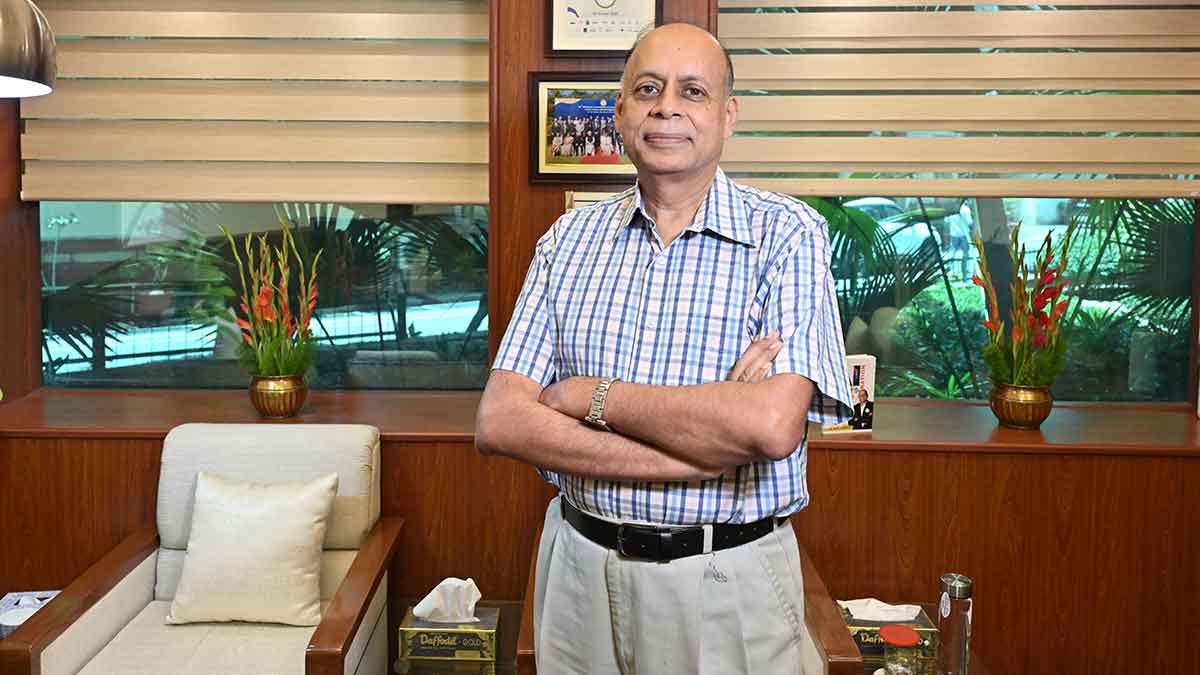
Interview/ Dr Ajay Kumar, chairman, Union Public Service Commission
AS INDIA PUSHES to position itself as a global artificial intelligence powerhouse, a parallel crisis is unfolding within one of its most critical public institutions—the education system. Long regarded as the backbone of India’s meritocratic promise, the examination systems are aimed at nurturing capable individuals to take forward India’s economic growth and redefine governance. However, India’s ambitions in artificial intelligence, digital governance and technological governance cannot coexist with outdated examination systems vulnerable to manipulation. The solutions, therefore, lie in strengthening the educational architecture through technological reforms.
In AI Nation: Bharat’s Path to AI Power, Dr Ajay Kumar, chairman of the Union Public Service Commission, presents AI as a transformative force that will redefine governance, education and economic growth. In conversation with THE WEEK, Kumar reflects on this intersection where technological possibility meets institutional vulnerability and outlines what it will take to rebuild credibility in India’s examination ecosystem. Excerpts:
Q/ What are the biggest misconceptions about AI in India today?
Interestingly, India is relatively optimistic about AI compared to many countries. Industry and society are keen to adopt it. The real challenge is not perception, but preparedness. We face a shortage of trained talent. Our education system is still catching up in terms of pedagogy and teacher training. Another concern is job displacement. While AI will disrupt some roles, it will also create new opportunities. If managed well, India could become the world’s largest supplier of AI talent.
Q/ AI is changing the very nature of examinations. How do you see this shift?
The traditional model of testing, focused heavily on memorisation, is becoming less effective. With AI tools capable of generating structured responses instantly, such formats lose their relevance. The future of examinations will emphasise skills that AI cannot easily replicate—critical thinking, creativity, interpretation and problem-solving. Questions will have to be designed in a way that requires original thought rather than reproduction of standard answers. This is not just a technological shift but a pedagogical one. It requires rethinking how we teach and how we assess learning outcomes.
Q/ Evaluation has also been a major concern, with delays, inconsistencies and allegations of bias. Can AI address these issues?
From a technological standpoint, AI is already capable of evaluating answers with speed and consistency. It can analyse patterns, provide structured feedback and reduce variability in marking. This can significantly improve efficiency, especially in large-scale examinations where manual evaluation is time-consuming. However, adopting such systems at scale involves important considerations.
Q/ What are the concerns around AI-led evaluation?
The primary concerns are fairness, transparency and accountability. An evaluation system must not only be accurate, but also be perceived as fair. If candidates do not understand how their answers are being assessed, it can lead to mistrust. There is also the question of nuance. Human evaluators can interpret context, originality and intent in ways that machines may not fully capture yet. Therefore, any move towards AI-based evaluation must be gradual, with clear safeguards and oversight.
Q/ What should India prioritise to become an AI power?
Three things: ecosystem, skilling and compute. We need to create an ecosystem where individuals, academia and industry can innovate. AI cannot be built by a single entity. It requires widespread experimentation. Second, skilling is critical. Without trained people, progress will stall.
Third, we need compute infrastructure, data centres, storage and processing capabilities. These are foundational to AI development.
Q/ How do we counter misinformation and deepfakes effectively?
The response has to be multi-layered and proactive. We cannot rely on a single solution because the problem itself operates across different dimensions.
First and foremost, there is a need to build an information literacy ecosystem. When we launched Digital India, the focus was on digital literacy, teaching people how to access and use technology. Today, that is no longer enough. People must be trained to critically evaluate the information they consume. This should begin at the school level itself. Students should be taught to question content, ask whether it fits the context, whether there is an underlying incentive to manipulate it, and whether the source is credible. This kind of cognitive framework is essential in an age where information can be easily fabricated. Interestingly, we are already seeing some natural adaptation. Younger generations, particularly Gen Z, appear to be more adept at identifying fake content. If you look at cases of digital fraud or so-called digital arrests, the victims are often older individuals. Younger users tend to be more sceptical and digitally aware. However, this instinctive awareness must be formalised through structured education.
Second, there is a clear role for regulation. Governments need to establish frameworks that ensure accountability. This includes mechanisms for certifying AI-generated content, defining liability for misuse and creating deterrents against malicious actors. Regulation, however, must strike a balance. It should be effective without stifling innovation.
Third, and perhaps most critical, is the use of technology itself. Manual fact-checking is simply too slow in today’s environment. By the time a human-led verification process concludes, misinformation has already spread widely. Therefore, we need AI-driven systems that can detect, flag and remove deepfakes in real time. This is similar to how cybersecurity operates today, where threats are identified and neutralised at digital speed. The same principle must apply to misinformation.
