



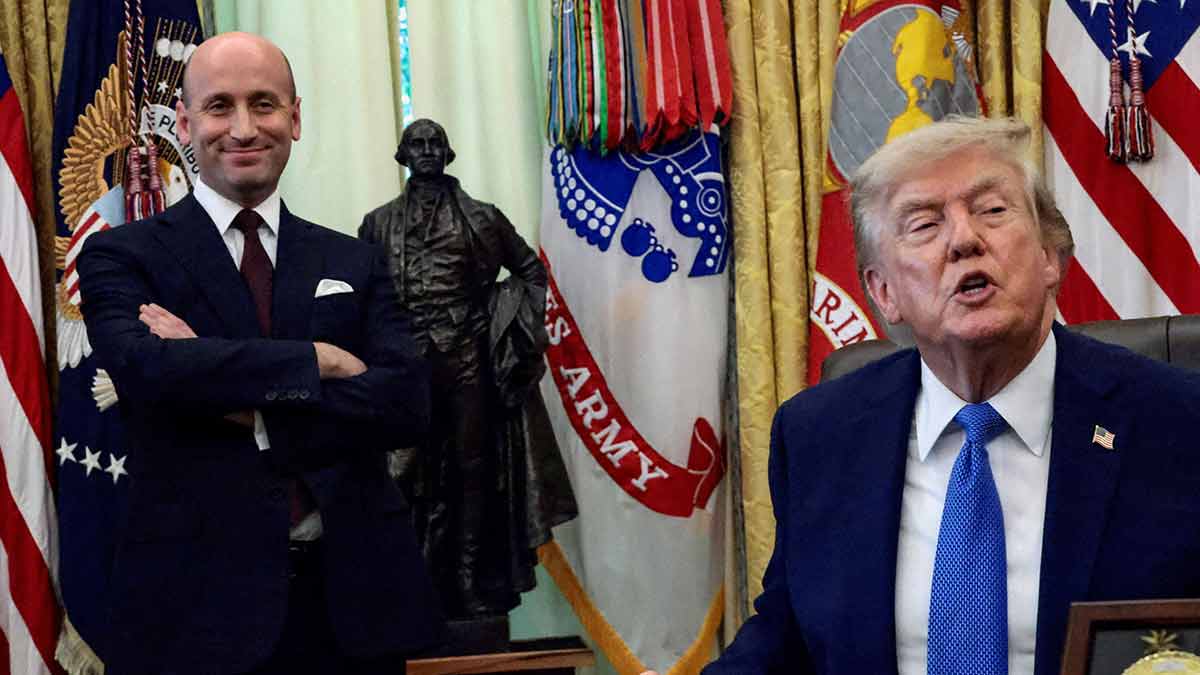
TRUE TO FORM, Donald Trump, rather than being chastened by the midterm electoral setback, has effectively declared that the world should expect more of Trumpism rather than a return to the centre. In appointing Stephen Miller as his White House chief of staff, Trump has signalled that he intends to reinforce the hardline ideological direction of his administration. Miller, hitherto a senior adviser at the White House, will henceforth demand unwavering loyalty to the MAGA agenda, in its extremist avatar, from all those shaping Trump’s economic, political and social policies, particularly where these relate to US international relations.

The world should prepare for a more aggressive pursuit of MAGA’s three-pronged programme of US isolationism, protectionism aimed at reshoring production capacities and a pushback against any further expansion of the ‘woke values of liberalism, multicultural social fabric and rules-based global order'.
US interests, narrowly defined, will remain the fulcrum of the country’s engagement with the world. Real hard power and clearly visible, effectively deployed leverage will determine the nature of bilateral ties with the US. The Trump-Miller-Kushner worldview will be a hardcore, self-serving strategy aimed at maximising short-term gains for the US. Indian negotiators and the political leadership would do well to keep that in mind.
Against this backdrop, what can we realistically expect from the ongoing Indo-US bilateral discussions on economic ties? India’s total exports of goods and services to the US, at $152 billion, were less than 4 per cent of total US imports in 2025. However, these exports constitute nearly 20 per cent of India’s total exports. India’s exports to the US account for a paltry 2.5 per cent of total US imports, with a slightly higher share of 3.5 per cent of total US services imports. The simple yet critical conclusion is that India has very little leverage in its bilateral economic ties with the US.
For a US administration focused almost exclusively on its domestic consumer constituency, India does not pose any risk of adverse price or supply behaviour affecting US consumers. Therefore, a prolonged stalemate in bilateral negotiations with India, or even their breakdown, would not cause serious concern at the US department of commerce or in the White House.
Our negotiators would, therefore, do well to identify sectors in which India has some leverage. Two sectors immediately come to mind: generic medicines and higher education, in which India has a significant foothold in the US economy. Any move, such as a sharp hike in import tariffs on generics, would exacerbate inflationary pressures on American consumers. Given that rising prices have been identified as one of the principal factors responsible for the ‘blusunami’ in the midterms, US negotiators would be wary of any such consequences, giving Indian negotiators sufficient room to protect and even expand these exports.
Indian students make up more than 30 per cent of all foreign students at US higher education institutions. A 17 per cent decline in the enrolment of Indian students in the 2025-26 cycle has already placed considerable stress on the US higher education sector. Moreover, nearly 20,000 Indian researchers secured postdoctoral assignments in the US in 2024-25. Any significant slowdown in this brain drain from India would be severely detrimental to the US high-tech and R&D industries. Can we not use our considerable strength as a source of human talent to our negotiating advantage?
The newly launched initiative called ‘Mission Research’ should be quickly and substantially strengthened and, in conjunction with the Anusandhan National Research Foundation (ANRF), used to enhance our capacity to absorb researchers and send the intended signal to the US.
The midterm results will most likely compel the Trump White House to negotiate even harder on behalf of its core MAGA constituencies of farmers and dairy producers, concentrated in the Republican-leaning agricultural regions of the Midwest. In response, we should be prepared to allow larger imports of corn and soyabeans, as these can be used to ramp up our domestic production of ethanol. The higher ethanol blend is already creating an increasingly acute conflict between food and energy security in our country. Larger imports of US grains, to be used for ethanol production and, at best, as cattle feed, could help address this emerging conflict.
On dairy products, the other major demand from US negotiators, we could agree to importing these products exclusively for re-export to other countries after processing and value addition in designated special export zones. In short, India will have to accept some reasonable compromises in the face of a more belligerent US negotiating stance. Breaking off the trade negotiations is clearly not an option, but neither is capitulation.
With a senior state department official already having publicly stated that the US has learnt its lessons from China’s rise, which was facilitated by the US, India should not expect any concessions. The US is not committed to India’s economic rise, and the recent bonhomie between Xi Jinping and Trump in Washington should make it clear that the US no longer necessarily envisions India as a counterweight to China.
A chastened US administration could be expected to be a harder negotiator, especially with trading partners perceived by the White House as having limited negotiating leverage. We can try to surprise them.
The author is chairman of the Pahlé India Foundation and a former vice-chairman of NITI Aayog.
