


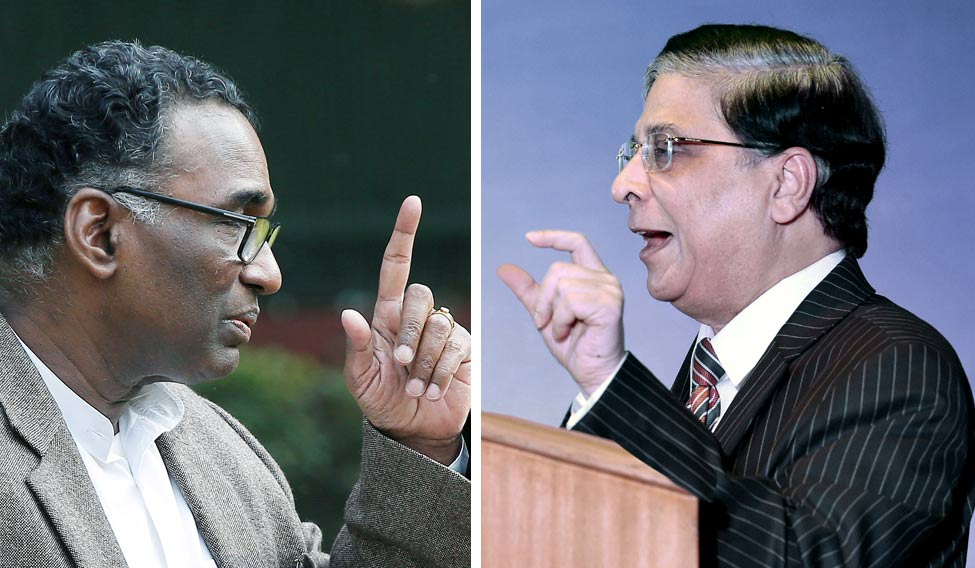
Justice Jasti Chelameswar
The second most senior judge of the Supreme Court has, time and again, emerged as a strong voice of dissent. Chelameswar has been persistent in his questioning of the Supreme Court collegium. He was the ‘one’ in the four-to-one verdict in 2015 that scrapped the National Judicial Appointments Commission.
The former Gauhati and Kerala High Court chief justice was at odds with Chief Justice of India Dipak Misra in November 2017, with regard to the assignment of a case pertaining to alleged bribery of Supreme Court judges by medical colleges. In 2014, he dissented from the majority ruling on holding open court hearings for petitions by death row convicts.
It was Chelameswar who referred the Aadhaar issue to a larger Constitution bench to decide on whether privacy was a fundamental right. In 2016, the mayor of Naperville, Illinois, US, declared October 14 as ‘Justice Jasti Chelameswar Day’ in honour of the several landmark judgments he has made in India.
In legal circles, it is said that Chelameswar, who hails from Andhra Pradesh, sees himself as a victim of the system. Chelameswar had become a High Court chief justice before J.S. Khehar and Misra. However, Khehar was appointed to the Supreme Court almost a month before Chelameswar and Misra took oath on October 10, 2011. And, Misra took oath before Chelameswar, making him senior. If the appointments were made strictly on the basis of seniority, Chelameswar, who will retire in July, would have become CJI after Thakur. Chelameswar has a keen interest in Telugu literature, and has a flourishing library.
Chief Justice Dipak Misra
Misra was appointed as CJI on August 28, 2017. He brought with him a reputation as a firm believer in convention, which he blended with innovative solutions to smoothen the functioning of the court. However, a few months into his tenure, Misra came under attack, ironically, for alleged non-observance of convention.
The polite, soft-spoken and affable Misra offers a stark contrast with his predecessor, J.S. Khehar, who was known for a short temper and booming voice. He has been popular with lawyers and litigants for his tendency to give interim relief, and has also built a reputation as a citizen’s judge. His well-known judgments include upholding the defamation law and the decision to remove the ban on dance bars in Mumbai. However, his judgment making the playing of the national anthem mandatory in cinema halls was met with immense criticism, and was seen in the backdrop of the ruling dispensation’s discourse on nationalism.
The poet judge, with a penchant for quoting from Hindu mythology and western classics, belongs to an illustrious Odiya family. His paternal grandfather was a renowned Odiya poet, and paternal uncle Ranganath Misra was the 21st CJI.
His appointment as CJI was accompanied by allegations of corruption. His name was allegedly mentioned in former Arunachal Pradesh chief minister Kalikho Pul’s suicide letter. However, the allegations failed to gain traction. But now, after criticism from the four most senior judges of the apex court, Misra has to redeem his own credentials, and more importantly, restore the credibility of the judiciary.