



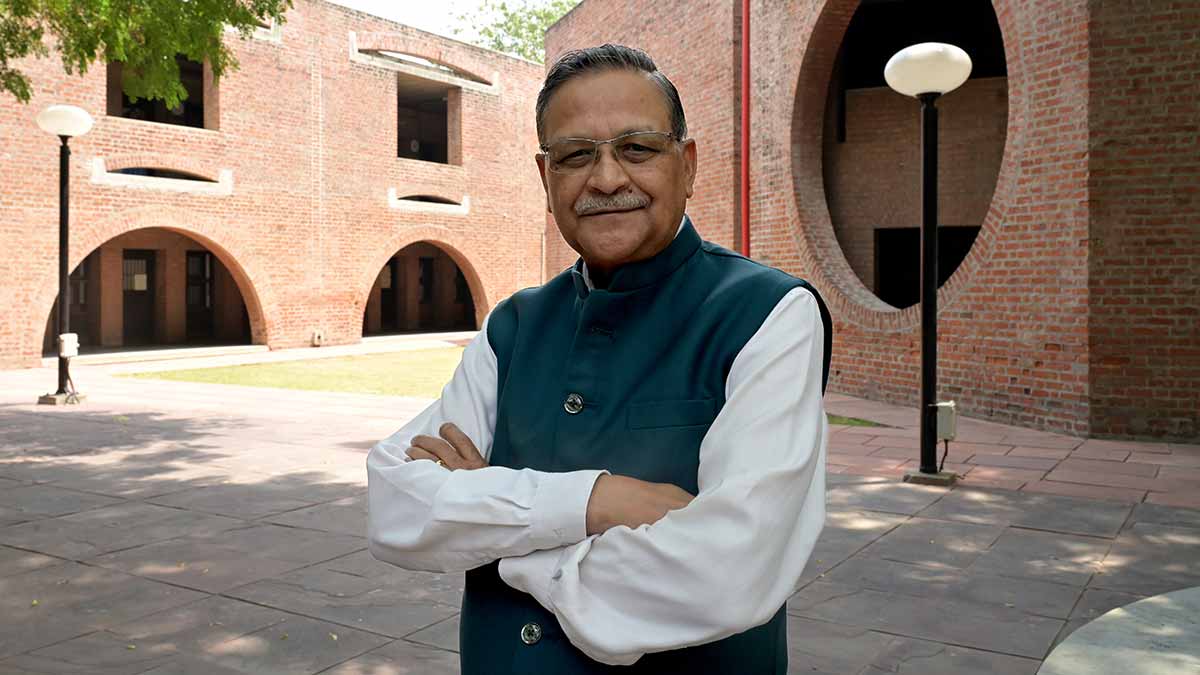
Interview/ Prof Bharat Bhasker, director, IIM Ahmedabad
Q/ What improvement should be made in the way management education is currently designed in India?
There are two aspects. One is developing the core leadership aspect; the second is putting a layer on top of the current business environment.
The core doesn’t change over time, though technology enhances it and accelerates things. A good corporate leader has to be a visionary who thinks about people and not about himself or herself alone. He should have a vision for the whole corporation and set priorities on how to achieve it. He should communicate well; he has to carry the whole organisation with him. And he needs resilience: there is no straight line to the goal, and one should be able to rise from setbacks. Today the business and geopolitical and economic environments are intertwined, so understanding them is also part of management education.
Then comes the practice part, which makes you ready for tomorrow’s job. In the 1980s, our curriculum had a layer focused on manufacturing, industrial relations and trade unions. Then the economy turned towards services, and IT gave rise to e-commerce. Good businesses adapted and survived. Today e-commerce has become quick commerce, and many e-commerce companies have begun to die out.
This top layer changes every decade, if not earlier, and our curriculum has to adapt to it. The core layer, the characteristics of the leader you are building, remains the same.
Q/ Is the two-year MBA still the right model for the Indian economy?
A one-year MBA suits mature economies, where people have jobs and productive roles, understand the basics of business and want to move into managerial roles. India’s growth requires the two-year MBA programme because at the fresher level there is a lot of talent available in our country. Given the cost, the career and the demand, the two-year MBA is much preferred in India and will remain relevant for a long time. We require more managers than we are producing.
Q/ How should management education change now that AI can perform tasks that were traditionally part of business school training?
Earlier, information was scarce, and the organisation with better information went ahead. Then IT brought lots of information. Somebody had to curate it and give the leader the right amount to take proper decisions. Young managers did this. That task has now been taken over by AI.
The challenge is various models offer different information. They also hallucinate. What should the leader rely on? So supporting managers are needed. First it was information scarcity, then information abundance; now it is curating AI.
Finally, the manager has to use his/her own insights, because AI only thinks what it has been taught by others. The human brain has capacities that can’t be codified; that’s why you say of someone, “Arrey, he is a fantastic turnaround specialist”.
Q/ Are Indian business schools doing enough to teach students how to deal with India’s specific challenges, or are we still largely importing western management frameworks?
For more than 150 years, industry has been driven by western thought. Indian factories imported the machinery and the problems along with it. The frameworks were not wrong, and we try to incorporate Indian elements. Just-in-time inventory matters whether in the west or here. But India traditionally had its own business model, very different from the western one. Western economies created consumerism: when we say 8 per cent growth, it means consumption has grown. Our model was not about growth rates; 1 per cent was good enough because we did not monetise everything in life. We said consume less: “Dus shirt ki jagah do shirt mein kaam chalana hai (make do with two shirts instead of 10).” Consumerism says throw it and buy a new one. The whole global economy is driven by that, but consumerism has a limit. That is why they are talking about sustainability today.
Companies like Amul operate an Indian model and are globally competitive. We write lots of cases on Indian companies and bring them into the classroom, so students understand both frameworks.
Q/ How has strategic management changed in recent years?
It has become more important. AI and robotics will take over many operational decisions, which are more deterministic; an autonomous system can arrive at the same decision a human would in the same situation. Strategic-level people operate in a completely uncertain environment, where the basic parameters are not known. Human thinking is then probabilistic: what is the likely outcome, and how will I adapt? When routine decisions move to machines, the entire burden on human beings falls on uncertainty and strategic direction. When I don’t know tomorrow whether the route through the Suez Canal will shut down, it is all about strategic direction.
What used to be long term has become medium or short term. A business platform took 40 to 50 years to transform; today it transforms in 10. When electricity came, even if I ignored it for the first five or 10 years, I was still in business; I had 30 to 40 years to catch up. New technology doesn’t give you that opportunity. So there is nothing called long term, and that’s why strategy is more important. It has to be rethought every five years and be adaptable, because things may change while I am executing it.
