



NEARLY THREE DECADES after the 1997 ceasefire between the government of India and the National Socialist Council of Nagalim (Isak-Muivah) reduced violence in Nagaland and much of the northeast, the deeper infrastructure that sustained the insurgency has not been fully dismantled. Foreign sanctuaries, transnational linkages and illegal arms and financial networks have managed to survive.
Today, the challenges Indian security agencies face extend far beyond Nagaland. The insurgency infrastructure survives in the form of sanctuaries in Myanmar, logistics routes through Bangladesh and strategic links with Pakistani and Chinese interests. Indian agencies believe the NSCN(IM) could use its strategic depth across borders to revive its dormant military infrastructure.
“They never left Myanmar,” said a senior security official. “Whether it was the 1990s, the early 2000s, somebody or the other has always been there.”
One of the earliest documented illegal arms consignments linked to the NSCN(IM) moved through a clandestine Southeast Asian corridor on December 25, 1991. The shipment was facilitated by cadres of Myanmar-based Mon ethnic group, then fighting the Burmese military. It was despatched from the Thailand-Myanmar frontier, crossing the Three Pagodas Pass before being taken to an island off the Mon coast, where it was temporarily stored. The consignment eventually reached an area south of Cox’s Bazar in Bangladesh.
Security officials later alleged that a senior NSCN(IM) commander was aboard one of the boats involved in the operation. Several more consignments reportedly followed the same route before Indian agencies could disrupt the corridor. “The route revealed how insurgent groups across the northeast, Myanmar and Bangladesh were beginning to operate through a shared transnational supply chain,” said a former security official.
The lingering concern is that the NSCN(IM) could leverage the instability across Myanmar and Bangladesh, combined with the strategic interests of the People’s Liberation Army of China and the Inter-Services Intelligence of Pakistan, to put pressure on India. “We are aware of the threat and are keeping a close watch,” said a senior security official.
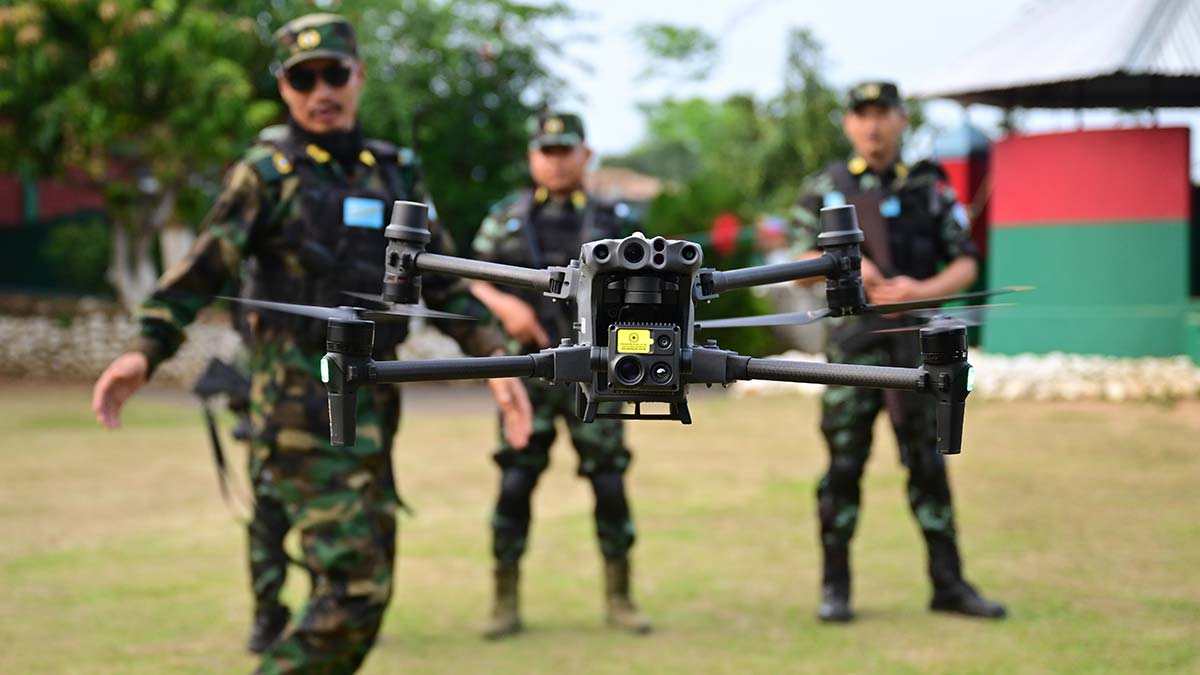
The NSCN(IM) continues to use sophisticated weapons and drones, even as many questions regarding its source of funds remain unanswered. “The biggest burden [of funding the NSCN(IM)] is borne by civilians and businesses,” said D.K. Pathak, who was chairman of the Ceasefire Monitoring Group and director general of the Border Security Force. “Many wholesale business establishments have shifted from Dimapur, Nagaland’s commercial capital, to neighbouring Khatkhati in Assam.”

Over the years, the Naga movement has fragmented, creating multiple power centres fighting each other for relevance. After peace negotiations with NSCN(IM) ran into turbulence, a seven-group coalition called the Naga National Political Groups (NNPG) emerged in 2017, expressing willingness to arrive at a settlement within India’s constitutional framework. The Indian government started parallel negotiations with the NNPG, infuriating the NSCN(IM), which saw the move as an attempt to divide the Naga movement.
The NNPG subsequently split into two groups. Divisions within other Naga groups have given birth to at least 30 distinct factions who are eager to have a pie in the final peace accord. But with the NSCN(IM) refusing to budge on key demands, a comprehensive peace agreement remains elusive.
Officials involved in the negotiations say there is light at the end of the tunnel. The government is considering out-of-the-box solutions—including ways to encourage the Nagas living in frontier areas to drop the demand of Greater Nagalim. By notifying the formation of Frontier Nagaland Territory (FNT), a semi-autonomous administrative body with 46 types of functions, the government has met a long-pending demand in the frontier districts. The FNT will begin functioning after the Union ministry of law and justice issues clarifications regarding its legislative functions.
“It is expected to soon become functional,” said a security official. “This will take a lot of steam out of the demand of sovereignty.”
According to S. Kho John, former president of the United Naga Council, the apex civil society organisation representing the Naga community in Manipur, violence will end only when peace is not treated as a political aspiration. “It is an urgent necessity for both the sides,” he said.
Chuba Ozukum, convener of the prominent civil society group Global Naga Forum, said preserving the identity, dignity and historical rights of Naga people is at the centre of the peace process.
“Before fatigue sets in,” he said, “both the sides need to realise that peace is the only realistic way forward.”
