



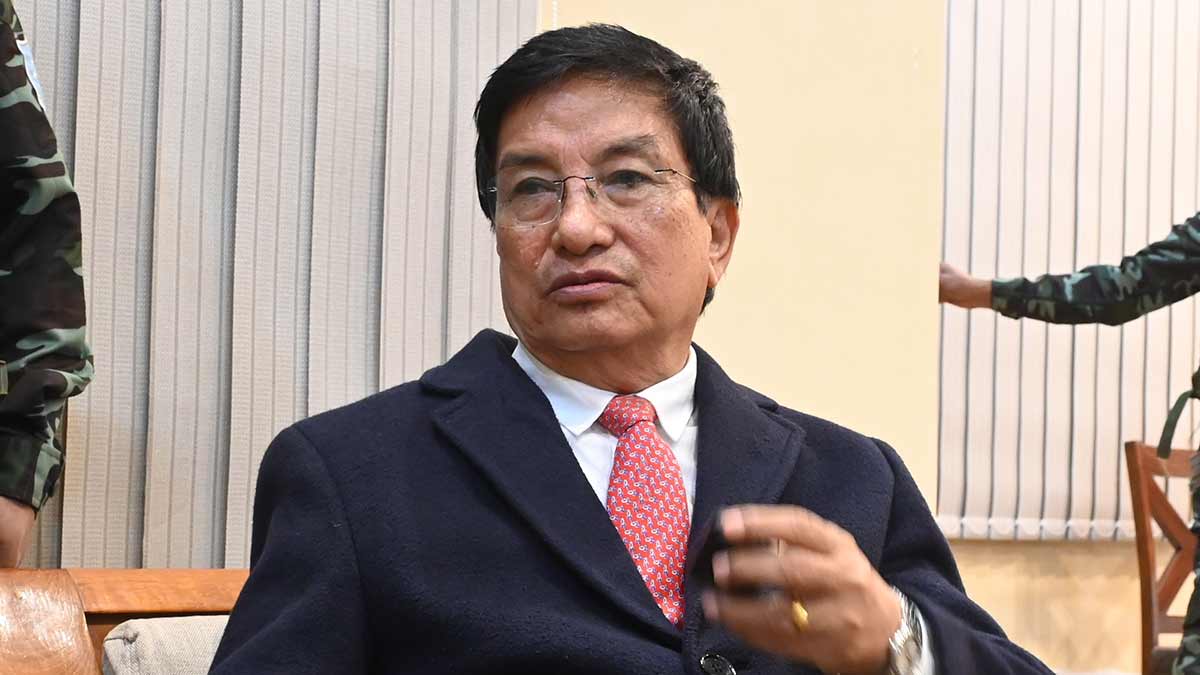
Interview/ Rh. Raising, special emissary of the collective leadership of the NSCN(IM)
RH. RAISING WAS home minister of the Naga parallel government in Hebron when the Indian government and the NSCN(IM) signed the framework agreement on August 3, 2015. Describing that agreement as a “meeting point”, Raising insists that any final settlement must be honourable and rooted in principle. The way forward, he says, is shared sovereignty and joint defence of the borders. “In the event of an invasion or external threat, Naga and Indian forces could jointly defend the land,” he says.
Edited excerpts from an interview:
Q/ You have said that the government of India has recognised Naga sovereignty. What do you mean by that?
The government of India has recognised that sovereignty lies with the people. Therefore, the sovereignty of the Nagas lies with the Naga people, just as the sovereignty of India lies with the Indian people.
Once that is accepted, then there should be no issue over Naga flag and constitution. These are component parts of sovereignty. But the government of India has made these issues contentious. We have always maintained that without flag and constitution, we do not see a real solution.
Q/ Over a decade has passed since the framework agreement was signed.
Unnecessary issues have been raised over the flag and constitution. During discussions, the government of India even produced a paper acknowledging the Naga national flag and constitution, but with restrictions on where the flag could be used. We said no. We will use our flag everywhere, including in official spaces. No power should prohibit us from using our own flag.
Q/ How do you see coexistence if both sides maintain distinct identities?
There are two entities, two peoples. Since India knows the Nagas will never simply merge into the Indian constitutional framework, the logical way forward is coexistence—two entities sharing sovereign power. That is the meeting point.
Q/ How do Nagas coexist with other communities, especially in Manipur, where ethnic tensions have been high?
We are not against any community. Every people has the right to determine its own future. Others must decide for themselves, just as the Nagas must decide for themselves. Our struggle is based on principle, not social grievance alone. We seek a political settlement founded on history and rights. At the same time, we welcome peaceful coexistence with all neighbours.
Q/ There are concerns about NSCN(IM) presence in Myanmar and the cross-border movements of its cadres.
There is a large Naga population across the border. They are our people. But as of now, there exists an international boundary. Since talks with India are bilateral, the eastern Naga issue would need separate engagement with the authorities in Myanmar. We do not recognise these colonial-era boundaries in principle, but realities on the ground require dialogue with respective governments.
