



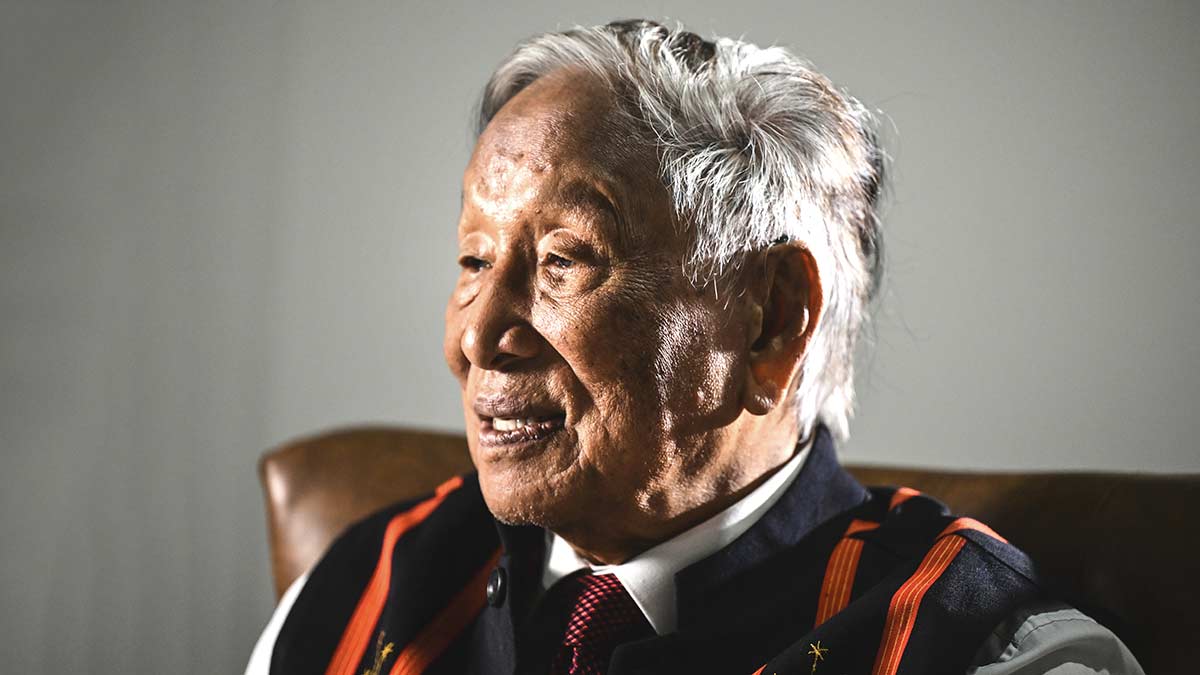
Interview/ Thuingaleng Muivah, general secretary, National Socialist Council of Nagalim (Isak-Muivah)
Q/ How did your growing-up years shape your vision for Naga people?
During my childhood, my mother used to tell the story of how Tangkhul Naga villages—such as Ngahui, Chingjaroi and Chingsui (where the Tangkhul Naga ethnic group has significant presence)—were plundered by nomadic Kuki marauders. Villagers were massacred.
The British tried to colonise Naga village-states using mercenaries. They armed the nomadic Kukis. They arrested and hanged Haipou Jadonang, a patriotic Naga leader from the Rongmei tribe, for resisting British rule. “Son,” my mom said, “you must know the history of your people.”
In 1964, soon after my post-graduation, I joined the Naga national resistance movement. I was elected general secretary of the Naga National Council, a post that was lying vacant after the demise of T. Sakhrie. But, a decade later, as the authorities at the helm of affairs signed the treasonous Shillong Accord on November 11, 1975, betraying the Naga national principle, the committed patriots parted ways from the traitors. Consequently, confrontations between the committed patriots and the reactionary traitors broke out, which finally resulted in the formation of the National Socialist Council of Nagalim (NSCN) in 1980. NSCN was approved and mandated by the Naga national assembly. In the assembly, Isak Chishi Swu was elected chairman of the organisation; S.S. Khaplang was elected vice chairman, and I was elected general secretary. NSCN is now recognised by the government of India, Unrepresented Nations and Peoples Organization and many other sympathiser countries.
Recognising the unique history and political position of the Nagas, the government of India under the leadership of Prime Minister Narendra Modi reached the historic Framework Agreement with the National Socialist Council of Nagalim on August 3, 2015. It took us 50 years to come to this agreement which recognises Naga sovereignty.
Q/ What does Naga national identity mean to you today? Why is it essential for Nagas to have their own flag and constitution?
Every living being possesses a unique identity. Lion and elephant are two distinct species. They are not identical. Every people and nation have their own identities. The Naga national identity comes from Naga foundation. Our history, our culture, our political concepts, our freedom and our faith come from the foundation. And that foundation is the almighty god. The Naga national flag is the symbol of Naga sovereignty. Flag and constitution are inherent parts of sovereignty. Possession of flag and constitution by a sovereign people is a necessity, not a choice.
Q/ What were the challenges during negotiations with the Indian government, and how did you and Naga representatives handle the ups and downs?
The Indian leaders initially viewed the Naga issue through the lens of law and order—a problem of India to be solved within the parameters of Indian constitution. But NSCN leaders firmly maintained that the Indo-Naga problem has always been a political issue which calls for a political solution. NSCN leaders reiterated the historical fact that the Nagas have neither been a part of the Union of India nor Myanmar, either by consent or by conquest.
In 1995, admitting the historical facts of the Naga people, then prime minister of India P.V. Narasimha Rao invited the NSCN leadership for political talks. In the preliminary round, it was mutually agreed that the political negotiations would be held at the prime ministerial level in a third country, without pre-condition.
After the talks, a ceasefire agreement was signed on August 1, 1997. In 2001, ceasefire without territorial limits was mutually agreed upon and signed at Bangkok, but the government of India tried to backtrack on account of opposition by the mob of Meitei chauvinists. However, it was later clarified by then prime minister of India Atal Bihari Vajpayee, who stated, “Wherever there is fighting, there is ceasefire; ceasefire is everywhere.”
In 2002, the representatives of the government of India tabled a draft proposal for solution within the parameter of the Indian Constitution, which was rejected outright by NSCN leaders. After the talks at Amsterdam in 2002, the government of India recognised the unique history and political situation of the Nagas. It implied that the Nagas have the unique history of independence, and that the situation in Nagalim is political and not a law and order problem of India.
In 2005, NSCN leaders were invited by the government of India to come to Delhi for speeding up the process of negotiation. After a gap of five years, the government of India proposed a solution based on the principle of shared sovereignty in 2010. But the Congress leadership instructed then interlocutor R.S. Pandey to continue the talks but not arrive at a solution. So he resigned in protest. After a series of sustained talks, the government of India and the NSCN finally signed the historic framework agreement on August 3, 2015.
Q/ What is the significance of the 2015 framework agreement? How will it impact the Naga people’s future?
Upon the departure of the British, the Nagas did not sign a formal treaty of accession with India, unlike the 565 princely states that joined the Union of India. This historical and political development is proven by the declaration of Naga independence on August 14, 1947, and other similar signed documents and events including the 1951 Naga plebiscite, where 99.9 Nagas voted in favour of Naga sovereignty.
On the other hand, Nagalim holds a unique position because the framework agreement [of 2015] recognises the sovereignty of the Nagas based on the universal principle of democracy. It says in democracy, sovereignty lies with the people, and that the sovereignty of the Nagas lies with the Naga people.
The framework agreement recognises the Naga nation as an entity distinct from India. The Nagas are undoubtedly a nation with all the core characteristics of nationhood. Admitting the historical fact that the sovereign Naga people had not accepted the Indian Constitution in the past, and they do not accept it today, the government of India proposed the option of solving the problem on the principle of shared sovereignty, which was meticulously studied and finally agreed upon by both the parties.
Shared sovereignty means the sovereign Indian people and the sovereign Naga people will share sovereign powers in some areas as defined in the competencies. The framework agreement envisions an enduring inclusive new relationship of peaceful coexistence of the two entities. It focuses on an inclusive approach embracing all Nagas wherever they are, including all Naga political groups.
The new relationship is based on the framework agreement. By coexistence of the two entities, it means coexistence of Indian people and the Naga people.

Q/ How has the Naga community and the Indian government responded to the agreement over the past nine years? Were any responses unexpected?
Over the past four decades, Indian leaders focused more on a military solution than a political one. They imposed solutions on Nagas, but those bogus accords did not solve the problem.
The framework agreement is the only official document mutually agreed upon between the government of India and the Naga people under the leadership of the NSCN. The framework agreement addresses the Naga national issue and the interests of India as well. It is a bridge between the two people. All sections of Naga people are happy to see the light at the end of the tunnel.
In spite of avowed commitments and assurances given to the Nagas, some Indian leaders are still hell-bent on recanting the framework agreement as they did away with the nine-point agreement of 1947. There are also fringe elements within the Naga society who are trying to belittle the significance of this agreement. Against all odds, we will keep pressing towards the goal to seal the deal. We still believe that there are sincere and prudent Indian leaders who are deeply committed to finding an honourable solution.
Q/ How would you describe the NSCN’s presence in Myanmar over the years? Has China played any role in this?
There is no Indian Naga or Myanmar Naga. There is no Assam Naga or Arunachal Naga. There is no Manipur Naga or Nagaland Naga. The Nagas are one people and one nation, and they have been living in their own country from time immemorial. The NSCN is the authentic political organisation of the Naga people. It is for the Nagas wherever they are, and for every inch of their ancestral domains. The so-called international boundary and administrative boundaries arbitrarily demarcated without the knowledge and consent of the Naga people is the work of colonial power. NSCN cadres are being deployed everywhere in the Naga country. Not a single NSCN cadre is in the territory of Myanmar. It is an open secret that when India tried to exterminate the Nagas, China protected and sheltered the Nagas and supported their cause. That was in the past. Now we are on talking terms with the Indian leaders. We must engage with them sincerely and seek out an honourable and lasting solution. Otherwise, fighting will resume and we will again be forced to look for allies elsewhere. We can work out our survival strategy and that’s quite natural.
Q/ Could you talk about your relationship with Isak Chishi Swu and how it shaped the Naga movement?
Isak Chishi Swu and I come from different Naga tribes. But we believed in the same God and were committed to the same cause and mission. We were patriotic comrades. Both of us were deeply committed to the cause of Nagalim for Christ. Our revolutionary brotherhood was shaped by trials and ordeals of the movement. The credit of the framework agreement goes to our collective leadership. We were at the helm of leadership for 41 years till he passed away in June 2016. He shall always be remembered as a beloved leader in the history of the Naga struggle for freedom.
Q/ During the tenures of Rao, Deve Gowda, Vajpayee and now Modi, what have been your memories of the handling of the Naga issue and when were you satisfied the most?
Among the prime ministers of India we had encountered, Rao was a shrewd statesman. He took the bold step of talking with the NSCN at the prime minister level without condition and in a third country, and he kept his word.
Deve Gowda was sincere and truthful. He tried to deal with the Naga issue with conviction, but he did not stay long in the office.
Vajpayee understood the Naga issue very well. He was a big-hearted politician to be adored. Recognition of the Naga national entity, ceasefire without territorial limit and recognition of the unique history and sovereignty of the Nagas are attributed to his leadership.
A mention may also be made of Manmohan Singh. He was a soft-spoken, educated and efficient leader. He understood the Naga issue and looked at it from the correct perspective. It was during his tenure that the option of solving the problem based on the principle of shared sovereignty was tabled during the formal talks.
As a popular prime minister, Modi is eager to solve the Indo-Naga political issue on the basis of “equality and mutual respect”. He is not only shrewd, but also a brave politician. The framework agreement was made a historic document because of his brave and dynamic leadership.
Q/ What does the government of India’s talks with the Naga national political groups signify to you, and does their agreed position reflect the political realities of today?
The government of India has made many bogus accords with Naga traitors and the agreed position is one of them. Those accords are roadblocks, and not at all a solution.
Q/ How feasible do you think is the demand for a greater Nagalim in the face of resistance from other Indian states. What approach should be taken to address this challenge?
There is no greater Nagaland or smaller Nagaland. The Naga people never recognise any artificial boundary arbitrarily demarcated by the aggressors. Anyone who justifies artificial international or state boundaries commits the heinous sin of colonialism, which is already condemned by the world. Nagalim is our portion of land given by the good Lord. We are inseparable from our land. Our land is everything to us. We will never take even an inch of other people’s land, and we will also never give even an inch of our land to them. The government of India has clearly stated that integration of all Naga territories under one political roof is the legitimate right of the Nagas. It is mutually agreed that the issue of integration will be finalised through a political process.
Q/ We have seen ethnic strife in Manipur claiming many lives, and you hail from Manipur. How can the Naga people show the way and bridge the divide?
We know the Kukis to the bone. The British used them to fight against the Nagas. Now they are being used by the government of India to fight a proxy war against the Nagas. I am sure you are also aware of the Kukis aggression against many other communities in the region. They fought against the Meiteis in 2023; and now they have again started fighting the Nagas with the backing of the Indian armed forces. In fact, the Nagas allowed some Kukis to settle in our land on payment of land tax. We have been living together peacefully for decades, but the problem started with the influx of Kuki refugees and immigrants from the Chin state, Myanmar. As incited and backed by the government of India, the Kukis have started shouting for the creation of Kuki homeland—a Kuki state or Union territory to be carved out of Naga territory. That is colonialism. Peace and tranquillity will come only when those refugees and immigrants are sent back to their land.
Q/ Today, Naga people are part of Indian society. Many of the leaders have their children studying and working in different cities in the country. What role do they play in shaping the future?
Like it or not, the Nagas are forced to live in the Indian system. Working and studying in different Indian cities is nonpolitical. It happened to Indians during the British rule in India. It is not a new phenomenon. All Nagas are Naga national issue-oriented; time and place cannot rob them of their Naganess.
Q/ What is your vision for the NSCN’s future? Is there hope of a lasting peace?
The NSCN is the standard bearer of the Naga national issue. It is the compass of the Naga people in the sunny and stormy days of the national resistance movement.
The vision of the Nagas is bigger than freedom. For them, freedom is not the end of the matter. They are looking for the kind of freedom that goes with Christ, the author of freedom. Free Nagalim for Christ is the foundation of Naga politics.
Peace does not go alone; it always accompanies with truth and freedom. We cannot imagine peace without truth and freedom, and we cannot imagine freedom without the author of freedom and truth. For the Nagas, freedom with Christ is the heart of their politics and faith.
