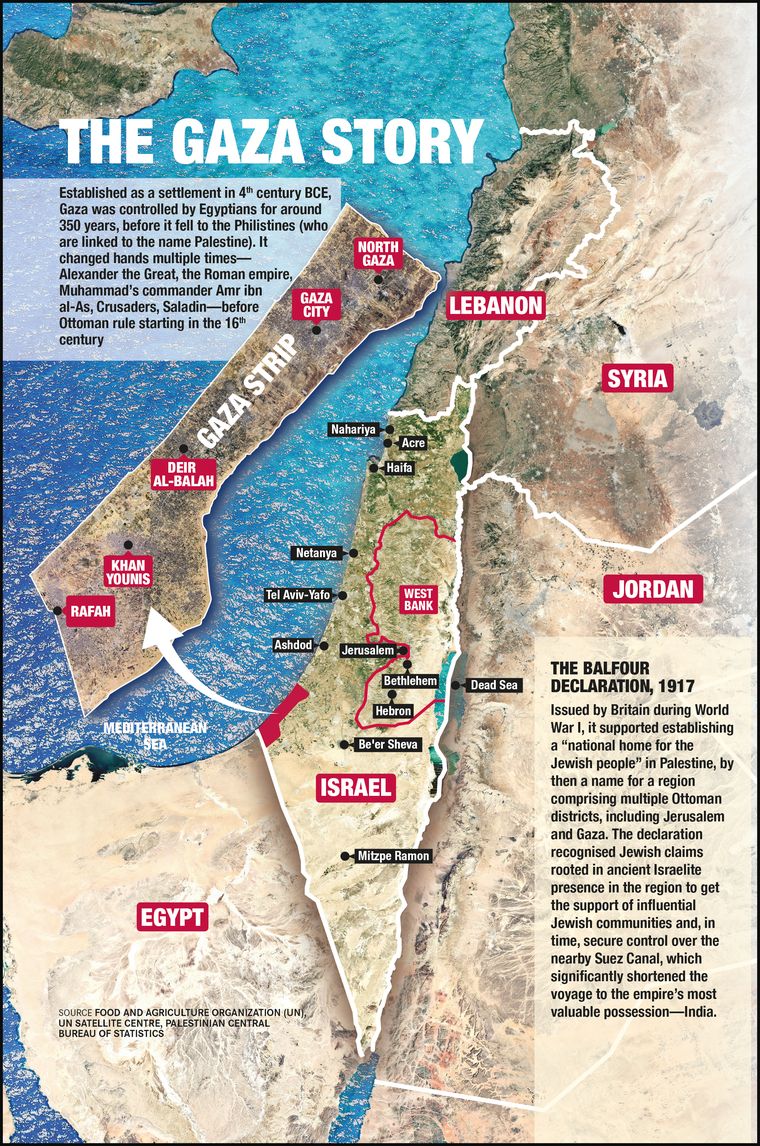
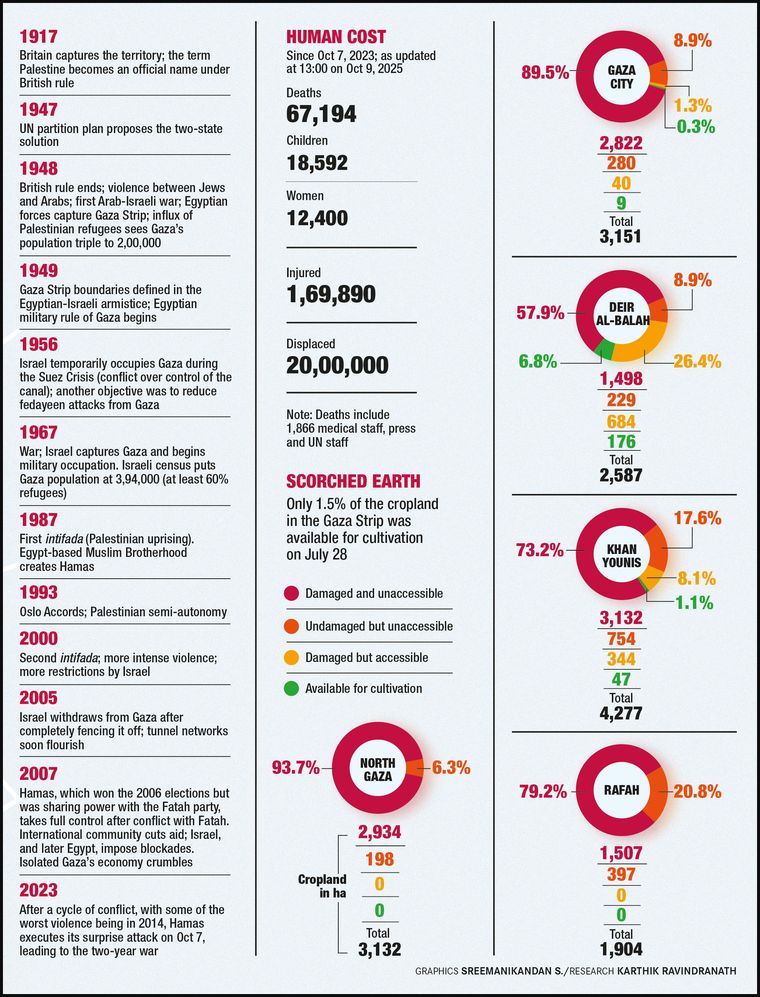
On September 8, a day before Israeli warplanes rained missiles on Doha targeting Hamas negotiators, a high-stakes meeting was underway at Steve Witkoff’s Sunset Island mansion in Miami. Witkoff, President Donald Trump’s Middle East envoy, was joined by Trump’s son-in-law Jared Kushner and Ron Dermer, one of Israeli Prime Minister Benjamin Netanyahu’s closest advisers. They were working on a ceasefire proposal for Gaza, which they intended to pass on to Qatari mediators later that week.
A few hours after the meeting ended, Israeli jets over the Red Sea attacked a residential compound in Doha, killing six people, including a Qatari citizen. The Americans didn't have a clue.

Trump was livid. He reportedly told advisers that Netanyahu was trying to “f**k him”. He believed that the Israeli operation was not only reckless, but also a personal affront. Netanyahu had kept him in the dark about targeting an American ally with which Trump had cultivated both diplomatic and personal ties. Al Udeid Air Base, a critical American military installation, is located in Qatar, which has long played a key mediating role not only in Gaza but in several other conflicts Trump claimed to have resolved.
His frustration was compounded by the fact that he had visited Qatar in May, becoming the first sitting American president to do so, and had accepted a rare gift from the Qatari royal family: a luxury Boeing 747, now being modified to serve as Air Force One. Trump was also concerned about preserving the Abraham Accords, by which a handful of Arab states established diplomatic ties with Israel, which he considered a signature foreign policy achievement.
During a heated phone call with Netanyahu, Trump accused him of endangering a crucial diplomatic effort and called the attack “unacceptable”. Until then, he had largely permitted Israel to continue its military operations against Hamas, in line with his strong political alignment with Netanyahu. But after the Doha incident, Trump reversed course and decided to use the force of his personality and the unmatched power of his office to get what he wanted. He flew to the Middle East on October 13, shrugging off the disappointment of not winning the Nobel prize, and signed a deal to end the Gaza war, at least for the time being.
A few days after the Doha strike, as Trump was contemplating his next move, the White House received an overture from Qatar. The Qatari prime minister reached out to Witkoff and said Doha wanted Trump to host a meeting with Arab and Muslim leaders to discuss an American-led peace plan for Gaza, on the sidelines of the upcoming United Nations General Assembly session. Witkoff relayed the message to Trump, who quickly agreed.
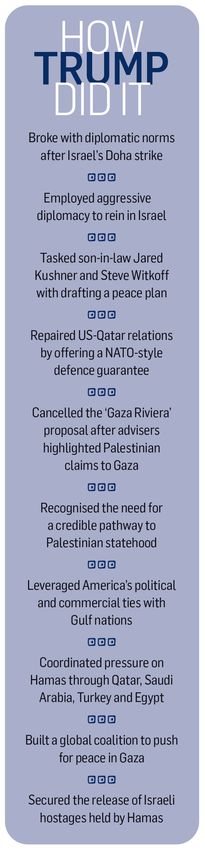
Having shifted his position, Trump launched what insiders described as a “real estate deal”-style diplomatic push. He brought Kushner and Witkoff back in, tasking them with creating a plan. He suddenly wanted a full stop to the war, the release of all hostages and a blueprint to rebuild Gaza. Several proposals had been circulating for months, including plans from France, Saudi Arabia and one drafted by former British prime minister Tony Blair. Kushner and Witkoff decided to integrate the most compelling elements from each into a single unified framework, which came to be known as the Trump plan.

In a significant gesture, Trump abandoned an earlier idea circulating in his inner circle: a redevelopment project dubbed the “Gaza Riviera”, which would have involved mass displacement of Palestinians. Kushner and Blair convinced Trump that this vision was unrealistic, and that any lasting peace would require respecting Palestinian claims to Gaza.
On September 23, Trump hosted the meeting with Arab and Muslim leaders in New York. He emphasised the urgency of ending the conflict and asked Witkoff to present the US proposal. With Trump’s personal backing, the plan found widespread support. Attention then turned to securing Israeli cooperation. Netanyahu was scheduled to meet Trump at the White House on September 29, and the following days were spent working intensively to gain Israeli approval for the plan.
Netanyahu, deeply concerned that the proposal might limit Israel’s ability to operate freely in Gaza and possibly pave the way for Palestinian statehood, was hesitant. Flying into New York, he and his team proposed several amendments. Over a gruelling weekend, Netanyahu and Dermer haggled hard with Kushner and Witkoff. There were marathon negotiations that moved between Kushner’s New York apartment, Witkoff’s suite and the Loews Regency Hotel, where the Israeli delegation was staying. Netanyahu even cancelled several scheduled public appearances in New York to focus on the talks.
Being a skilful negotiator, Netanyahu managed, with Trump’s permission, to dilute the language around troop withdrawal and Palestinian statehood, prompting several Arab leaders to raise objections and ask Trump to intervene. Trump ignored their appeals. In typical fashion, he announced the plan unilaterally, betting that the Arab governments would not oppose it publicly once it was out in the open. The strategy worked. While some Arab leaders were displeased, no one dared to confront Trump directly.

Trump’s pressure campaign on Netanyahu was relentless. In a particularly humiliating moment, he forced Netanyahu to call the Qatari prime minister from the Oval Office and deliver a formal apology for the Doha strike. The apology was composed by the White House with inputs from Qatari officials, and one of them was present during the call to ensure that Netanyahu stuck to the script. A White House photographer captured the moment, with Trump holding the phone on his thigh while Netanyahu read from the prepared statement. The image was later released publicly, sending a clear message about who was in control.
Trump knew he had enough political capital to expend as far as Israel was concerned. He had, in the past, recognised Jerusalem as Israel’s capital, moved the US embassy there, affirmed Israeli sovereignty over the Golan Heights, withdrawn the US from the Iran nuclear deal and authorised military action against Iran to support Israel. Netanyahu stood little chance of resisting. Political analyst Mitchell Barak told the New York Times that Netanyahu likely realised his influence over Trump had reached its limit. “For the first time, Netanyahu cannot disregard the wishes of an American president, because of the way Trump operates. Trump is unpredictable and will not fall in line with the Israeli position.”
Trump also secured a key policy shift from Netanyahu in the final agreement by forcing him to accept a credible pathway to Palestinian self-determination, in other words, a Palestinian state. Although the language was intentionally vague, it represented a significant departure from Netanyahu’s longstanding opposition to Palestinian statehood. Israeli officials tried to push back, but Trump refused to compromise.
Later, in an interview with Fox News host Sean Hannity, Trump recounted a phone call with Netanyahu. “Israel cannot fight the world, Bibi,” said the president. “You cannot fight the world.” That sentiment, rooted in hard-nosed political calculation and a drive for results, defined Trump’s dramatic shift in strategy and the unexpected success of his Gaza peace initiative. “No president, Republican or Democrat, has ever come down harder on an Israeli prime minister on issues so critically important to his politics or his country’s security interests,” former diplomat Aaron David Miller, who is now with the Carnegie Endowment for International Peace, told the Times.
The last time a US president openly challenged an Israeli prime minister was in 1991, when George H.W. Bush delayed $10 billion in loan guarantees to Israel. The funds were intended to help resettle Soviet Jews, but Bush, fresh from victories in the Gulf War and the Cold War, made them conditional on prime minister Yitzhak Shamir halting settlement expansion in the West Bank and Gaza and agreeing to join peace talks with the Palestinians at the Madrid peace conference. The move provoked fierce backlash from pro‑Israel groups and precipitated a sharp decline in Bush’s support among Jewish voters. He had won 35 per cent of the Jewish vote in 1988; by 1992 that fell to just 11 per cent, contributing to his defeat by Bill Clinton. Only Barry Goldwater had done worse, with 10 per cent in 1964. Though Bush’s loss was mainly due to a weak economy, a broken tax pledge and a strong third‑party challenger, the erosion of Jewish support significantly weakened his position. And now here stood Trump, driving Netanyahu into submission.
Trump’s firm response to the Israeli airstrike in Doha was a wake‑up call for the region. For the first time in years, Washington exerted real pressure on Israel—and that shift resonated. Saudi Arabia, Qatar, Turkey and Egypt took notice. Seeing Trump push back on Israel emboldened these states to intensify pressure on Hamas. The message was unmistakable: delays and deflections would no longer be tolerated. The time for decisions had come.
Using his personal relationships and transactional diplomacy, Trump played a central role in aligning Arab states behind his agenda. His ties to the Gulf were not new. The Trump family currently has six ongoing real estate projects with a majority Saudi-owned firm, and is also pursuing a new luxury golf and villa development backed by the Qatari government. Trump's cryptocurrency company, World Liberty Financial, has attracted significant investments from the United Arab Emirates, including a recent $2 billion deal.
Meanwhile, Kushner’s private equity firm, Affinity Partners, received a $2 billion investment from Saudi Arabia’s sovereign wealth fund, controlled by Crown Prince Mohammed bin Salman. Last month, Kushner’s firm joined forces with the Saudi fund and other investors in a $55 billion deal to take video game giant Electronic Arts private, which was the largest leveraged buyout in history.
After the Israeli strike in Doha, Trump moved swiftly to mend US–Qatar ties. He offered a NATO‑style defence guarantee to Qatar by committing US military support in the event of future attacks. The assurance restored Qatari confidence and reaffirmed Doha’s role as the primary negotiating partner of Hamas. At the same time, Trump reportedly pressured changes in Al Jazeera’s Gaza coverage, and convinced Qatari leaders that Hamas officials must eventually leave Doha.
With Qatar back in the fold, Trump turned to Egypt and Turkey, urging them to push Hamas towards compromise. Turkey is an interesting case in point. President Recep Tayyip Erdogan has been one of the harshest critics of Israel's assault on Gaza, and Trump was quick to spot his good standing with Hamas. Trump had a detailed discussion with Erdogan during the UN summit and was in touch with him over phone afterwards. He persuaded Erdogan to send Turkish intelligence chief Ibrahim Kalin for the talks in Egypt, where he put pressure on Hamas to make concessions and move forward.
Trump wielded the unique tools available to America—military, political and economic incentives—and the weight of US prestige. Senator Lindsey Graham made an interesting observation, that Trump had done what previous administrations failed to do—make the Arab world once again take an active role in resolving the Palestinian question. "I think he deserves enormous credit for getting the Arabs, for the first time I can remember, to own the Palestinian phone," said Graham. He argued that Trump’s Iran policy gave him credibility in Arab capitals, and his alignment with Israeli security concerns bolstered his standing in Jerusalem.
Jon Alterman of the Center for Strategic and International Studies told the BBC that Trump developed leverage with Israel and indirectly with Hamas: His ability to act on his timing, without capitulating to the combatants, has been a challenge for many presidents—and he managed it relatively well. Part of that leverage stemmed from actions beyond Gaza. Trump pointed to a pivotal moment in June, when the US and Israel conducted joint strikes on Iranian nuclear facilities. He claimed the strikes neutralised an “imminent nuclear threat”, and by doing so cleared space for diplomacy. “If I allowed that threat to materialise, the Gaza deal would not have been possible,” he said.
The outcome of these efforts was a limited but meaningful agreement. Hamas released all living Israeli hostages on October 13. Israel returned nearly 2,000 Palestinian prisoners and paused its bombardment of Gaza. A phased drawdown of Israeli troops from certain areas was initiated, and international monitors began preparations to oversee implementation. While many critical issues remain unresolved, including the disarmament of Hamas and the long-term governance of Gaza, the agreement marked the most substantial diplomatic breakthrough since the conflict began.
Domestically, Trump read the political currents astutely. American public opinion on Israel had shifted dramatically. A recent Pew Research Center poll showed that 59 per cent of Americans now have a negative view of Israel’s conduct in Gaza. And for the first time since it began surveying Americans on the topic in 1998, a New York Times poll conducted last month found that slightly more voters expressed sympathy for the Palestinians than for the Israelis.
American Jews, historically among Israel’s most steadfast supporters in the United States, have grown sharply critical of Netanyahu and his right-wing government over Gaza. A majority now believe that Israel has committed war crimes through its killing of tens of thousands of civilians and its restrictions on humanitarian aid. Moreover, four in ten Americans now say Israel is guilty of genocide, according to a new survey by The Washington Post.
Also Read
- 11 dead in Gaza airstrikes as Israeli PM Netanyahu accuses Hamas of ceasefire violation in Rafah
- ‘Diplomatic pressure increased after Doha attack’: Israeli ambassador Reuven Azar
- Can Trump’s plan bring lasting peace to Middle East?
- ‘We are victims of Israel and the west’: Raji Sourani
- ‘Truce will be fragile if Hamas doesn’t disarm’: Fleur Hassan-Nahoum
The political fallout is increasingly cutting across party lines. While Republicans have sought to align their party firmly with Israel and portray Democrats as sympathetic to its adversaries, a generational divide is emerging among younger evangelical Christians, a key demographic for the ruling party. Unlike their parents, many of them now view Israel not as a victim but as an oppressor, and that perspective is spreading beyond evangelical circles to other Republican strongholds.
Trump also noted the widespread protests inside Israel itself, where the public had grown increasingly weary of the prolonged war. “The president aligned himself with the 65 per cent of Israelis who wanted to prioritise the return of hostages over the defeat of Hamas,” wrote Steven A. Cook of the Council for Foreign Relations. “This put further pressure on Netanyahu.”
For Trump, the writing was on the wall. Securing a ceasefire would not only win him political credit at home and abroad, but would also reaffirm the United States as the predominant power broker in the Middle East, a position which took a hit after Netanyahu’s Doha misadventure.
Speaking after getting Netanyahu and Hamas to say yes, Trump told Israel’s Channel 12 how he forced a reluctant Netanyahu to accept his terms. “I said, ‘Bibi, this is your chance for victory’. He was fine with it. He’s got to be fine with it. He has no choice. With me, you got to be fine.” And that was how the deal was sealed.