



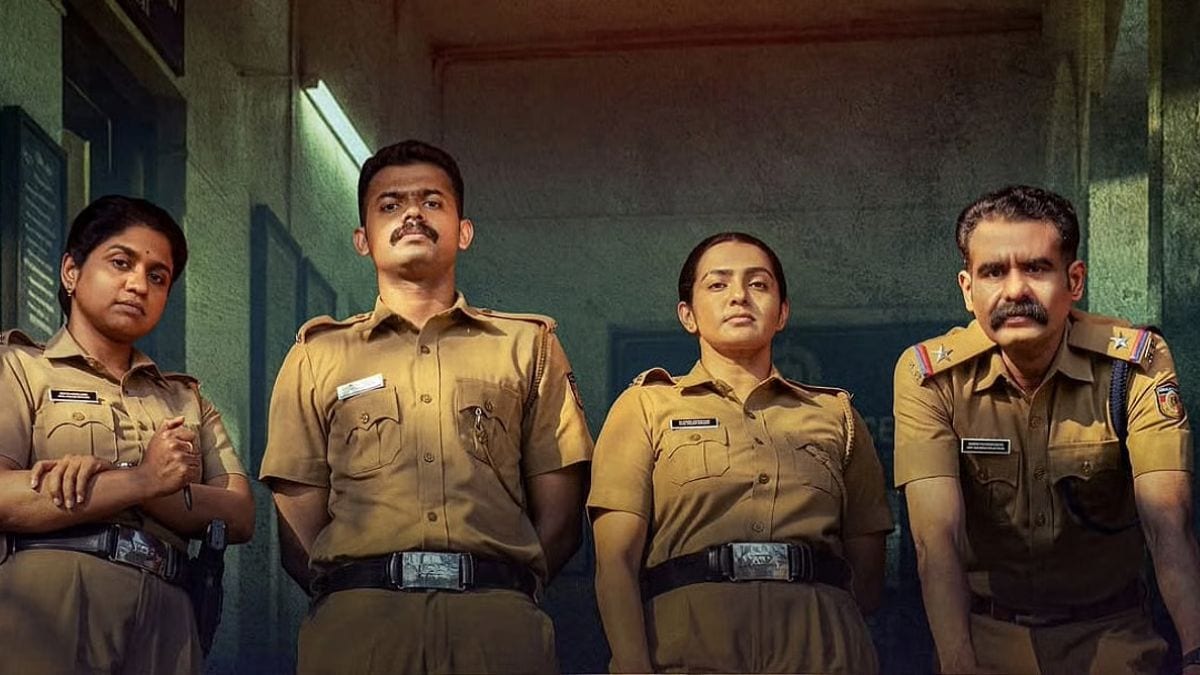
Fear can stimulate the imagination in a way we never expect. It can give you the urge to jump into the water if it means that's only way to save your life: either someone is on the other side waiting to rescue you or perhaps you can only depend on yourself to save yourself. And then there is the other scenario, where fear makes someone do reckless things, making things worse than they already are. Now what if the individuals in these two scenarios are pitted against each other at a most unfortunate converging point? And what if, later, more characters show up unexpectedly to potentially ruin all your plans?
“Drishyam” happened in 2013. A superior sequel happened in 2021. The third shouldn’t have been considered, because the fuel has already run out. Now, here comes “Pradhama Drishtya Kuttakkar” (Prima Facie Accused), which also deals with a buried body, altered perceptions, half-revealed truths and half-revealed faces, and complex moral dilemmas. Only here, the protagonists are cops, the setting is a police station — one of the reasons, among many, why PDK scores above the first “Drishyam”. As in the Jeethu Joseph thriller, it first shows you how evil the ‘victim’ is, which justifies the events that happen later.
But PDK is a film that, as I mentioned earlier, embodies layers both seen and unseen. It also comes with the backing of strong emotions. In two separate circumstances, a black cat becomes a positive sign for one character and negative for another, but not in the supernatural sense. In another instance, a cute Labrador puppy becomes witness to a gruesome murder, while also making us concerned for the little one’s safety. And there is a recurring flashback of a little girl clutching a Jesus statue against the backdrop of a tragedy, the explanation for which doesn’t come straight away. Meanwhile, we see a woman reading the true-crime non-fiction book written by a veteran Crime Branch investigator.
Here’s another reason why PDK is superior to “Drishyam”. It presents situations far more complicated. Besides, it doesn't have the burden of a superstar on whom the limelight predominantly has to shine. In PDK, every lead character stands out, regardless of screen time. It has a solid backstory that makes us root for the survival of the four characters played by a first-rate cast: Aleena (Parvathy Thiruvothu), Dasan (Sidharth Bharathan), Sreenath (Mathew Thomas), and Divya (Unnimaya). Their bond-building is rapid, thanks to the economical writing of P. S. Subramanian and Vijesh Thottungal and the skilled, taut editing of Chaman Chakko (he was involved in at least seven films this year, including “I’m Game” and “Khalifa”).
Ideally, a concept of this nature would’ve translated better into a miniseries. However, PDK is confident enough that it gets around many areas in a short span due to the occasionally non-linear quality of the screenplay, where multiple timelines sometimes run concurrently, leaving us to figure out which came first and later. One notable instance involves a woman hearing a doorbell and about to approach the door. However, instead of immediately showing us who is at the door, the film cuts to another location, to another character at a different time. It then cuts back to the woman to reveal the detail that it’s this character who rang the woman’s doorbell earlier, further heightening the tension.
Despite a nearly three-hour runtime, the tight yet coherent plotting keeps it running at jet speed, and the actors rise to the challenge of conveying the extremely anxiety-inducing events in which their characters — be it the good or bad guys — are trapped. The arrival of the aforementioned senior investigator-author, played by Vijayaraghavan, gives the film an extra boost. The ever-reliable actor brings a Sethurama Iyer-level of aura to his character, Harris Meeran, who hasn’t had a failed case in his entire career. But he, too, has his share of vulnerabilities, just like the rest of the characters. In that regard, the film treats every character equally. Even the character who seems the coolest under pressure has suppressed emotions waiting to break out of confinement.
Interestingly, what sets PDK apart from other investigative thrillers of its ilk is the manner in which it gets opportunities for clever, appropriately placed humour to diffuse tension lest we get overwhelmed. It doesn’t look forced, thanks to the impeccable comic timing of actors like Vinay Forrt, who plays Parvathy’s superior officer, and Sidharth Bharathan, who, despite playing a man who is in the same boat as Parvathy’s character and the other two, finds surprising opportunities to deliver his share of comic relief, sometimes with a deadpan expression that had me cracking up.
I’m glad this film did that, because if it hadn’t, it would’ve run the risk of looking like a dark police thriller written by Shahi Kabir (despite being a fan of his work, I’m scared to revisit them due to their relentlessly haunting quality). PDK has, relatively, an oddly comforting, hopeful quality — because if we were in the shoes of these four characters, we probably would’ve died of a heart attack. We are thankful to see it from a distance, despite being deeply immersed.
Robby Varghese Raj, the cinematographer-turned-director of “Kannur Squad”, is behind the camera, supplying the director Shahad with the right kind of visuals necessary to evoke the right kind of emotions. Shahad’s last two films were unremarkable. So it’s yet another classic example of a director improving his craft by leaps and bounds (the most recent example being Jofin T. Chacko’s “Rekhachithram”). Robby’s remarkable camera work is another reason why I would place PDK above “Drishyam”. He knows where to place the camera, be it the immersive, doom-laden atmosphere or how the faces look in proximity, especially Parvathy’s and Vijayaraghavan’s.
The approach is complementary because, on one hand, the actors, despite having pages of dialogue to work with, let their faces do most of the talking; on the other, Robby’s unique framing of these actors' faces, combined with the restrained lighting, conveys thoughts that cannot be expressed verbally. Then throw in the emotionally charged background score from Mujeeb Majeed, the man behind the music of "Eko", "Kishkindha Kaandam" and "Kalamkaval", and you get another benchmark-setting experience.
Film: Pradhama Drishtya Kuttakkar
Director: Shahad
Cast: Parvathy Thiruvothu, Vijayaragavan, Mathew Thomas, Sidharth Bharathan, Unnimaya Prasad, Sirajudheen Nazar, Azees Nedumangadu, Vinay Forrt, R Parthiban
Rating: 5/5
