



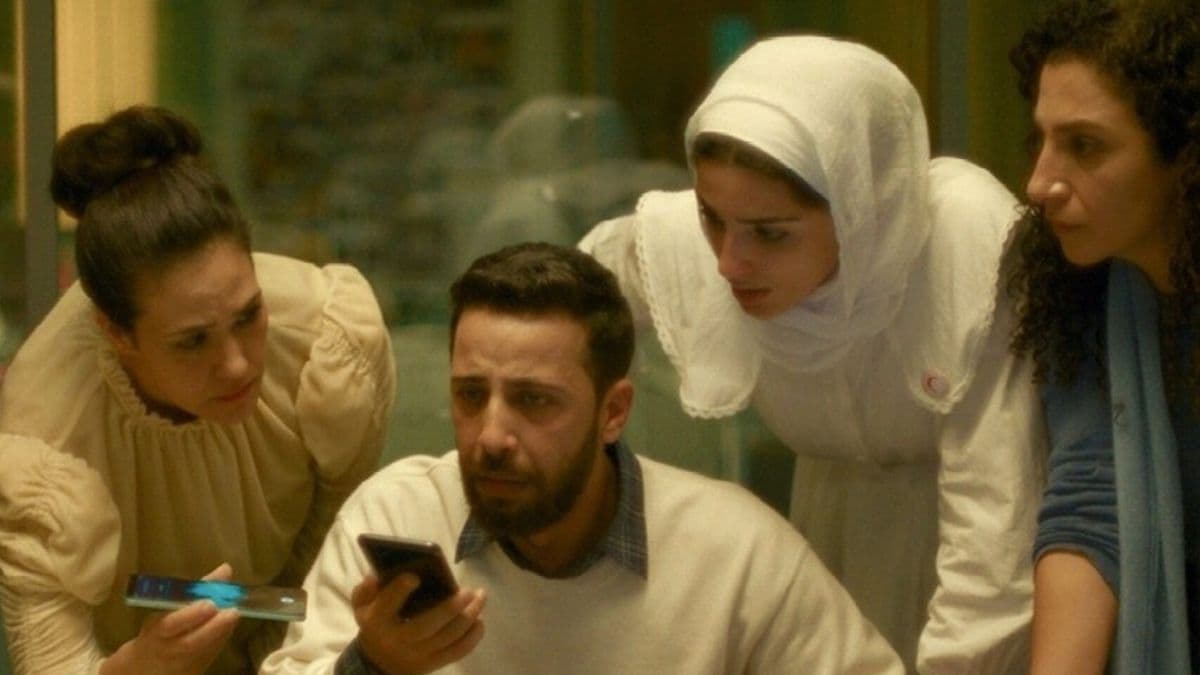
When we first see the audio waveform, we hear a beach. The significance, when finally revealed in the film's ending, hits us like a ton of bricks after everything that came before. It takes a while before we are hit with the haunting cries for help from not Hindi Rajab, the Palestinian girl killed by the Israeli military in Gaza; it belongs to her deceased relative. When this first piece of the audio alone is haunting, can you imagine listening to the rest of it? Can you also imagine how the actors playing the responders from the Palestine Red Crescent Society (PRCS) dealt with Rajab's actual voice, with whom they had to spend hours? Those emotions must be real. The actors looked convincingly distressed. How can you not be? You have to be a cyborg not to feel even an ounce of emotion for her plight. The knowledge that this is a real tragedy that couldn't be averted makes the film incredibly hard-hitting.
For a brief moment, "The Voice of Hind Rajab" reminded me of those sci-fi films where characters from two separate timelines communicated with each other, hoping to save one of their lives. That's fiction. This film, written and directed by Kaouther Ben Hania, is real. It's violent, without showing the violence. No need to see the visuals when the audio alone conjures up vivid images of a girl trapped in a car in a war-torn area, surrounded by Israeli tanks and artillery. Hania keeps the focus on the responders who are basically forced to become counsellors for not just one, but several hours. Though the entire docudrama runs for just 89 minutes, we are appropriately reminded of how many hours have passed since the girl first contacted them. These responders are sitting in glass offices, but the high-pressure situation makes everything around them blurry. One of them even faints momentarily. There is another battle happening simultaneously — with their minds, to maintain sanity.
Hania, aided by cinematographer Juan Sarmiento G, shot these scenes with the sense of urgency often associated with the films of Paul Greengrass ("United 93", "The Bourne Ultimatum"), occasionally filming actors who, despite sitting behind each other separated by a glass panel, with neatly timed focus shifts. At times, the characters are close to the camera, which lingers on their faces enough to convey the unimaginable pain caused by not just the possibility of losing a 6-year-old girl, but also the two paramedics who are gearing up to rescue her.
But that step, of making an ambulance dispatch possible, is harrowing in and of itself. How do they get in touch with the Israeli military to get approval for a route? Not directly. The head of coordination draws a horizontal '8' to show how complicated the process is. It requires him to contact somebody who then contacts somebody else, who then contacts somebody else... Meanwhile, the girl is not sure if the blood on her face is her own or of the corpses around her. And we are also told that the PRCS has already lost many volunteers on duty — some of them with families comprising more than one child! The most memorable scene is, strangely enough, an ironic one: two PRCS employees trying to calm themselves down by playing a violent video game in the restroom.
There are other interesting filmmaking choices. Scenes where the actors are sitting silently while their faces and the audio waveform are presented in double exposure, while the voice of their real-life counterparts, who are trying hard to constantly reassure the girl that an ambulance is on the way, play in the background. A sensible filmmaking choice because I don't believe any actor can faithfully replicate the shaky voices that convey that they have exhausted not only their reservoir of promises but also their strength. "The Voice of Hind Rajab" is one of those anti-war films that simply remind us that the world is a horrible place to which we shouldn't be bringing any kid, and some of us should be grateful, daily, for the privileged circumstances we were born into.
Film: The Voice of Hind Rajab
Director: Kaouther Ben Hania
Cast: Saja Kilani, Motaz Malhees, Amer Hlehel, Clara Khoury
Rating: 5/5
