



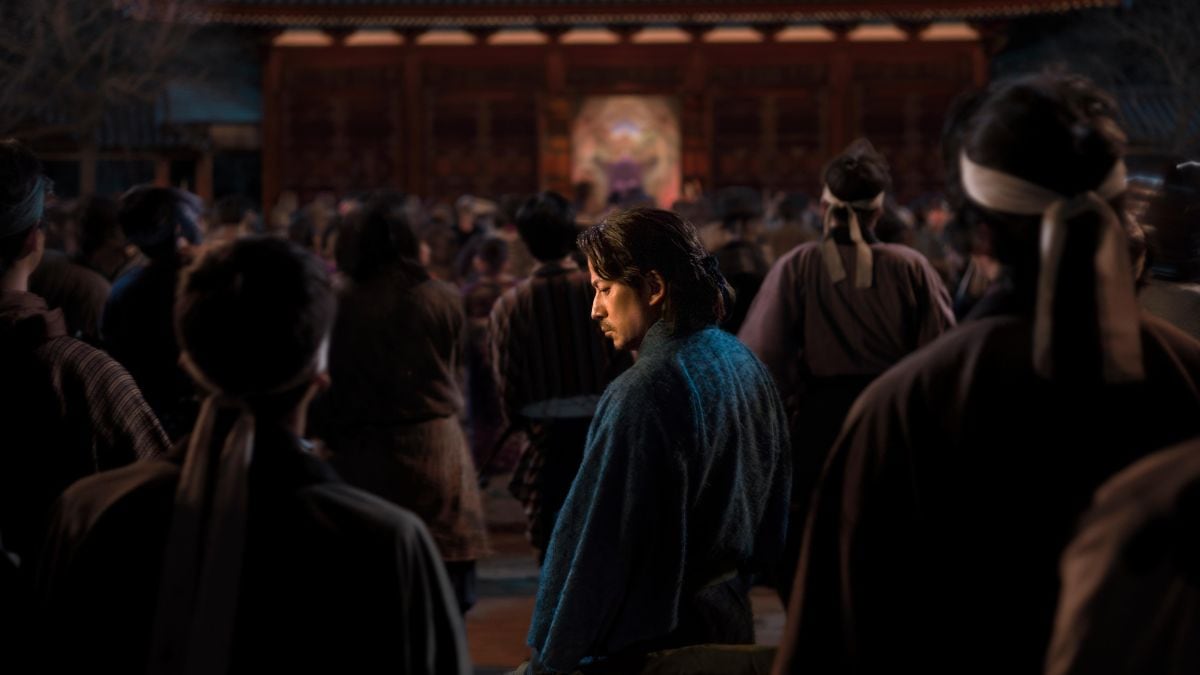
The image of the destitute samurai was a dominant feature of some of the esteemed films in the jidaigeki genre. Of course, the first title that pops up is Akira Kurosawa's Seven Samurai, the greatest and most popular of the genre. Widely regarded as an "action" movie, the film's fast-paced, intense moments are not — when compared to today's action films — that stand out the most, but the human elements: the camaraderie between a band of samurai who stand together, form a brotherhood, a family.... Men who have accepted the reality of their circumstances. Men who are still nursing scars — emotional and physical — from a distant past.
Another notable example is, of course, Masaki Kobayashi's Harakiri, a bleak but immensely rewatchable classic about a disenfranchised ronin (masterless samurai) challenging a vicious feudal power structure. This anti-authoritarian sentiment was recognised in not just the above two examples, but also the relatively lighthearted genre takes, most notably Kurosawa's own Yojimbo and Sanjuro, featuring a cynical hero with a sense of humour.
Shujiro Saga, the protagonist of Last Samurai Standing (on Netflix), bears the stoic, driven quality of the leading men of yesteryear and contemporary epics in the jidaigeki genre and the chambara sub-genre. You can see in Shujiro a bit of Toshiro Mifune's character from Samurai Rebellion, a bit of Tatsuya Nakadai's character from Harakiri, and a bit of Hiroyuki Sanada's character from The Twilight Samurai. (Nakadai passed away two days ago.)
Shujiro, played by Junichi Okada, is yet to fully recover from the trauma of a devastating war that the six-episode first season opens with — a stunning single-take sequence that establishes the character's background. It's a necessary sequence not just to immediately hook the viewer's attention but also to have some bearing on some unforeseen future developments. There is no time wasted in setting up Shujiro's present circumstances. The economical writing gets the information conveyed in under twenty minutes, explaining the motivation for him to participate in a deadly game that will go on to claim the lives of many.
Comparisons to Squid Game are inevitable, but the show makes it clear, about two episodes in, that its intentions are not the same as the blockbuster Korean series. So, I think it would be unfair to frequently compare this one to that show. Last Samurai Standing is less concerned with the variety of the game's levels than with solving the mystery of the game's conception.
Somebody created this game — 'Kodoku', aptly named after a dark art practiced by sorcerers in Japanese folklore, mentioned at one point in the show — for a reason. The smart ones, including Shujiro, suspect that benevolent intentions aren't behind it. The show then adopts an investigative nature, with Shujiro and a few allies deciding to get to the bottom of it while continuing to move through the different levels of the game. Aside from Junichi Okada (also creative director), Masahiro Higashide plays one of the show's most outstanding characters, Kyojin Tsuge, an immensely confident man capable of donning clever disguises.
The open space game, which tracks the characters from town to town on a long path, gives the storytelling an advantage — another quality that makes it different from Squid Game. In Last Samurai Standing, the game is not the only thing these characters have to be concerned about. Mysterious forces from the past and present, introduced through parallel tracks with cross-cutting events, ensure that our interest is sustained through six episodes. The action is kept largely raw, with the frenetic camera capturing the palpable chaos while ensuring coherence and fluidity. There is no attempt to show off.
Different choreography styles are attempted, including a brief instance in which the viewer becomes the “opponent,” taking in the punches. The staging is as gritty as they come, following the principles followed by the masters in their classics. At times, it's a combination of two parallel action sequences that involve, 1) extras getting mercilessly cut down by a psychopath to clear the path while his bloodied opponent readies himself to strike again, and 2) a young girl being "haunted" by a terrifying giant who is on a mission to kill every member of a particular clan.
The ever-increasing threats and unexpected twists and turns — some predictable, others not — signal that the "good guys" may have to contend with more than what can be contained in a six-episode arc. That assumption is proven true in the season finale when, after an intense battle involving a union of fire and water, and a generous gushing of blood, it's revealed that things are only going to get more complicated.
Comparisons to other recent Japanese period pieces like Blue Eye Samurai (animated) and Shogun would be unwarranted since Last Samurai Standing comes with an identity of its own. It's a decidedly mainstream affair, but one that isn't hesitant to get closer to its characters, even though not all are fully formed. However, there is enough political intrigue and espionage running in the background to enhance the foreground action, thereby making some of its shortcomings seem negligible.
Based on Shogo Imamura's novel of the same name, Last Samurai Standing leaves us with a few unanswered questions, which one hopes will be handled in the next chapter. And I hope the makers don't take too long because most multi-season shows today that captivated us in the beginning run the risk of losing our interest by the time the second or third seasons arrive.
Series: Last Samurai Standing
Directors: Michihito Fujii, Kento Yamaguchi, Toru Yamamoto
Cast: Junichi Okada, Yumia Fujisaki, Kaya Kiyohara, Hiroshi Tamaki, Hideaki Itō
Rating: 4/5
