



Never mind that the spotlight is on a Muslim family here. The issues are representative of many households. Take the man of the house, Ashraf, for instance. He is not an invalid — perfectly healthy, in fact — but thinks that even getting up for the fan switch, within reach, is beneath him. For something as simple as this, he keeps bothering his wife, Fathima (Shamla Hamza), while he scrolls through his phone. When he goes out, he asks her to fetch his sandals. Eventually, for audiences watching the film, Ashraf becomes a comical figure who earns their chuckles and laughs. He is not the only one, though. Wait till you discover somebody with a “treasure chest” of demonetised notes.
Ashraf, played by Kumar Sunil, has much in common with Suraj Venjaramoodu's character in The Great Indian Kitchen, but Fasil Muhammed's debut feature, which would make a nice companion piece for the Jeo Baby film, differs vastly in treatment while echoing the same sentiments. A madrasa teacher and "healer", Ashraf sees himself as the lord of his family, comprising Fathima, three kids, and his mother. He thinks he has created a jannat for them. He thinks they have it easy. "Have you seen how other women run households?" he asks Fathima at one point.
This particular point is on the verge of turning pivotal for the entire household. The atmosphere in their house — the camera goes wide enough to constantly remind us of its squalid state, with its walls sullied by dirt and the kids' doodles — is getting tense, but Feminichi Fathima (English: Feminist Fathima) isn't a film interested in loud outbursts and fiery speeches. It knows that loud and clear statements don't necessarily require a raising of the voice. It's funny how men like Ashraf, whose brains were narrowed by years of patriarchal conditioning, see inflicting physical violence as "haram" but don't think twice before subjecting their wives to psychological violence.
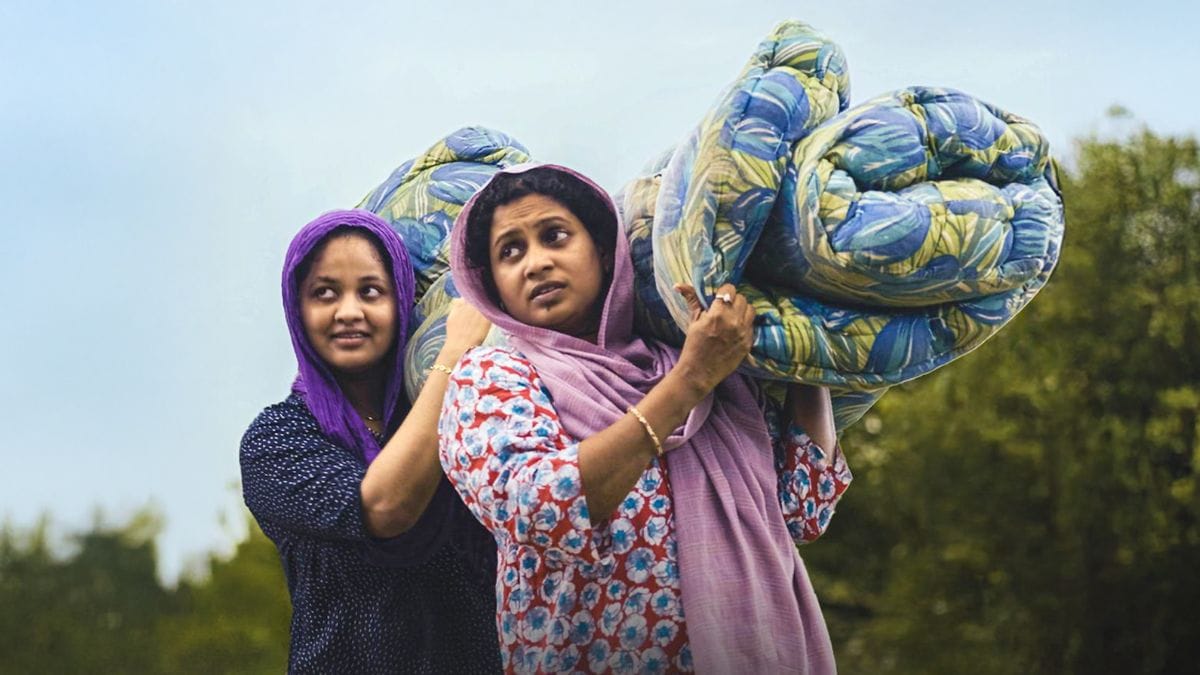
The crisis scenario is triggered by a newly bought mattress soiled by their eldest child, a son old enough to do things on his own. Attempts to clean it successfully are proven futile by constant sightings of a dog that came into contact with it. Ashraf keeps blaming Fathima for her absent-mindedness, but her pressure cooker situation is there for all to see. Being often sidelined eventually takes a toll on the woman, already burdened by the thoughts of spending sleepless nights with a hurting back. What happens when a relative brings a new smartphone? More headaches will follow, and so will an opportunity to turn things around.
Films that traverse the festival circuit are often accompanied by the general preconception of offering experiences akin to "watching paint dry" or peddling "poverty/misery porn". Fortunately, Feminichi Fathima eludes this sort of categorisation, especially the usual arthouse cliches established by pretentious filmmakers eager to please festival juries. Its sense of humour, evocative of the films of Ousmane Sembène and Aki Kaurismäki, and even Malayalam's Sudani from Nigeria, prevents it from falling prey to the aforementioned tendencies. The idea of something as simple as a soiled mattress to draw attention to larger issues also recalls the approach of Iranian filmmakers like Abbas Kiarostami.
Finally reaching wider audiences with a theatrical release on Oct. 10, Feminichi Fathima, which runs a little above 90 minutes, benefits from its able cast members, especially Shamla and Kumar, who don't let the malady of "camera consciousness" interfere with their performances. And Fasil Muhammed announces himself as another important Malayalam filmmaker to be reckoned with.
