



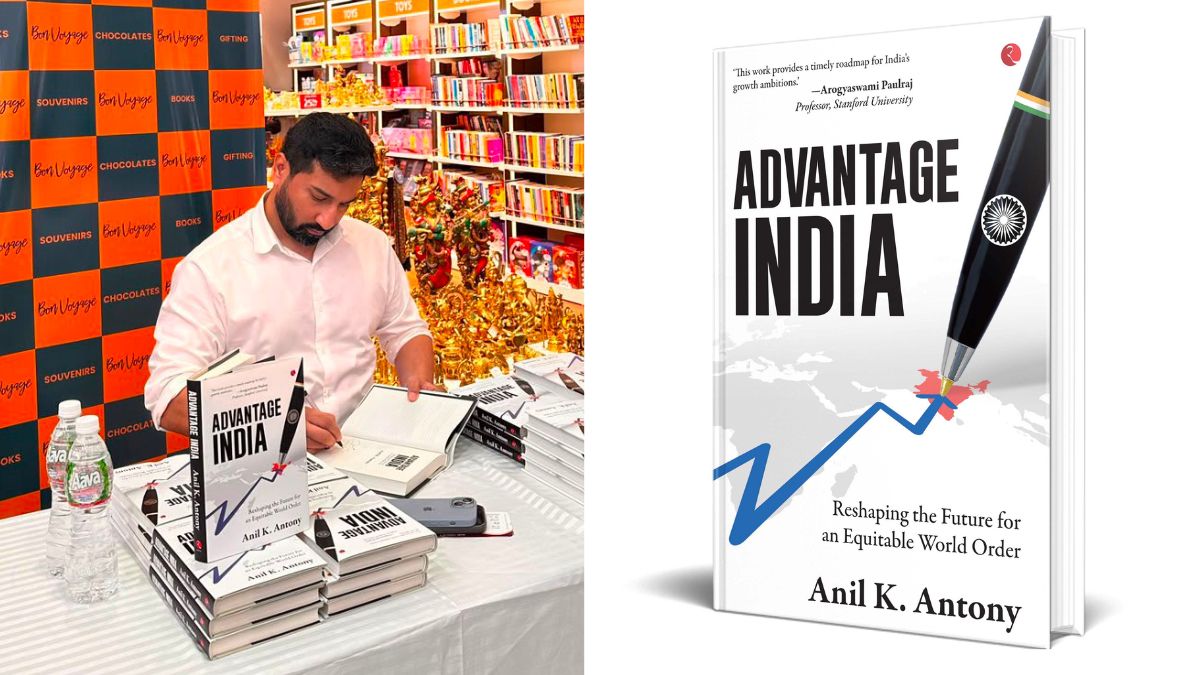
India's emergence as a global power has generated a growing body of literature that seeks to explain both its rise and its future trajectory. Advantage India by Anil K. Antony belongs in that genre as it offers an optimistic account of India's transformation from a post-colonial economy. The author argues that India is capable reshaping international governance by the centenary of Independence in 2047.
Antony, the BJP's national secretary and spokesperson, approaches the subject through the lens of public policy. Having worked in Silicon Valley before entering politics, he brings together insights from technology and governance. Drawing on developments in economics, diplomacy, national security and innovation, he argues that India's rise rests on the strength of its institutions, demographic advantage, civilisational heritage and democratic resilience.
The book is divided into two sections. Part I, The India Story, examines India's economic development, semiconductors, artificial intelligence, digital public infrastructure, defence, space, the green transition, women and youth. Part II, India and the World, shifts to geopolitics, exploring multipolarity, India's foreign policy and concluding with The Road to 2047, which brings together the book's central argument.
The domestic chapters portray India's recent growth as the outcome of sustained institution-building rather than isolated reforms. The discussions on Digital India, education and skilling repeatedly return to the idea that long-term capability matters more than immediate gains.
The chapter on education presents the National Education Policy as an effort to move beyond memorisation towards creativity and critical thinking. According to the author, the policy is "holistic, flexible and rooted in Indian values and worldviews." Antony argues that India's demographic advantage will yield results only if supported by education, skills and greater participation of women in the economy.
Technology is one of the book's strongest themes. Antony argues that India should move beyond being a participant in global supply chains to becoming a technological leader. He identifies semiconductor manufacturing as a strategic priority that can reduce import dependence, generate skilled jobs and attract research and investment. The book also presents India's digital public infrastructure as a governance model that could benefit the Global South.
National security receives equal attention. Antony argues that India's defence strategy must evolve from reacting to threats to anticipating them. He advocates greater self-reliance in defence production alongside strategic partnerships and support for international rules governing emerging domains. The chapters on space and climate policy similarly argue that India can play a larger global role.
One of the book's more interesting themes is its attempt to connect India's civilisational traditions with its geopolitical ambitions. Rather than treating democracy as a post-Independence inheritance, Antony traces its roots to older traditions of deliberation, citing the Vajji Confederacy and Buddhist assemblies.
He also draws on Vedic thought to argue that India's unity has emerged through accommodation rather than homogenisation. The idea that "Truth is one; the wise speak of it in many ways" is presented as a philosophical basis for India's pluralism and its engagement with the world.
The second half turns to international affairs. Antony argues that the post-Cold War order is giving way to a genuinely multipolar world in which institutions created after the Second World War no longer reflect present realities. India, he argues, should not merely seek greater representation within the existing order but help reshape global governance to make it more representative.
Instead of fixed alliances, he advocates strategic flexibility and issue-based partnerships. Influence, he writes, flows from "adaptability and credibility, not from formal alliances alone." The argument is reinforced through External Affairs Minister S. Jaishankar's observation that "the world today is like coalition politics... There is no majority of anyone." Antony sees this as the organising principle of India's foreign policy, allowing it to engage the United States, Europe, Russia, Japan and the Global South without becoming tied to any one bloc.
The concluding chapter argues that India's rise is not merely a story of economic growth but of institutional resilience and accumulated national capability. As Antony writes, "India's rise in recent decades represents one of the most consequential transformations of the 21st century." At the same time, he acknowledges that India still has considerable ground to cover in per capita income and productivity. Whether it can fully harness its demographic dividend over the next two decades will determine the success of its journey to 2047.
Advantage India is an ambitious and accessible work. It views India's progress largely through an affirmative lens, focusing more on opportunities than shortcomings as it presents a blueprint for the future.
Its strength lies in bringing together subjects that are often discussed separately and showing how they reinforce one another. Antony's experience in Silicon Valley and Indian politics gives him a perspective that is limited among contemporary political writers. He combines that experience with research to produce a coherent vision of India's future.
Advantage India is a worthwhile addition to the growing literature on India's rise. It will interest policymakers, students of geopolitics, public policy researchers and readers seeking to understand the ideas shaping India's long-term strategic thinking.
Title: Advantage India
Author: Anil K. Antony
Publisher: Rupa Publications
Pages: 304
Price: ₹795
