



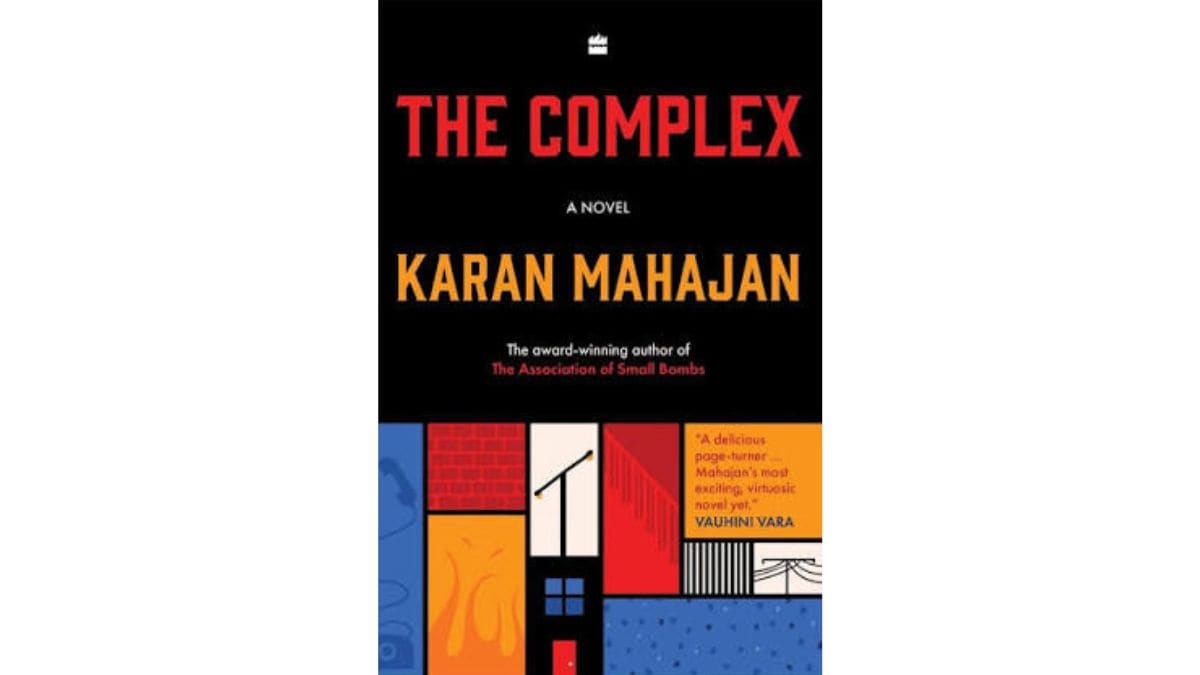
The presence of the late “great” SP Chopra – a politician, framer of India’s Constitution, and governor of the Reserve Bank – looms large over author Karan Mahajan’s new novel The Complex. This larger-than-life patriarch is long dead, but continues to live through his legacy in the minds of his nine children, who, along with their spouses and children – 20 members in all – live in A-19 Modern Colony, Delhi, or “the complex.”
The title is both literal and metaphorical. Literal, because it comprises two multi-storey buildings haphazardly divided into apartments for its many inhabitants, who live in uneasy proximity. There is constant squabbling over living arrangements, gossip and rumours, and even episodes of domestic violence.
Metaphorical, because it lays bare the psychological complexes of its inhabitants – how these insecurities shape them, propel them towards power or self-destruction, and often dictate their relationships, scandalous affairs, and violence against one another.
The cast of characters in The Complex is sprawling. The story is narrated by Mohit, the son of Brij and Karishma, and nephew of Laxman.
Laxman, SP’s youngest son, dominates the novel, not just through his insecurities, but through his misdeeds. A womaniser, he habitually sleeps with the wives of his relatives. He is domineering, manipulative, a failed businessman, and a rapist.
His victim is Gita, the wife of his nephew Sachin. The couple live in the US. When Gita confides in Laxman’s sister Vibha about the assault, the latter brushes it aside, even suggesting it as a viable solution to her shameful problem of childlessness. “Do I look like someone who would try such a thing?” says Laxman, a master manipulator.
The assault pushes Gita into a whirlwind of emotions and decisions, including an affair that gradually drives a wedge between her and Sachin. Yet despite everything, the complex exerts an inexplicable pull, drawing them back to India.
Laxman’s advances, meanwhile, shift towards Karishma, who responds very differently. Their affair is scandalous, incomprehensible, and ultimately destructive.
As the years pass, Laxman also ascends the political ladder. Riding the wave of the Babri Masjid–Ram Janmabhoomi movement, he transforms himself into a powerful politician, even as he remains trapped in the shadow of SP’s legacy.
Only Gita sees him for what he truly is and wonders: “How had this happened?” Gita wondered. “How had the worst person in the family become its doyen? Or was this the fate of all groups? That power accrued to the person with the most energy, regardless of whether that energy was good or evil?”
Karishma’s emotional void is, in many ways, even deeper. It drives her to fall in love with a rapist, neglect her husband and children, and eventually pushing towards death.
“As for Karishma, after Gita had left her flat, a memory had come to her,” Mahajan writes. “It was a memory of Gita on a visit to India, looking very American and guileless and saying, “Does Laxman force you also to drink whiskey?” ‘Is that when I became interested in Laxman?’ Karishma thought. ‘Is that why I did it? Am I really so jealous and bottomless? Am I always a second choice?’”
It takes considerable sensitivity and precision for a male author to delve into the tumult of the female psyche, especially women as volatile and emotionally conflicted as Gita and Karishma. Mahajan does so remarkably well.
Laxman, meanwhile, is an intensely unlikeable character from the outset. Yet Mahajan peels back the layers of his psyche without ever diluting his moral repulsiveness. It is a feat of ambitious and deeply controlled writing.
The novel teems with characters, and it is a pleasure to watch Mahajan inhabit each of their minds with equal conviction. None feels underdeveloped or overwhelms the narrative.
The complex itself emerges as a character in its own right – claustrophobic, chaotic, and unsophisticated; a perfect reflection of the people who inhabit it and the lives they lead.
This is Mahajan’s third novel. Having already established himself with Family Planning (2008) and The Association of Small Bombs (2016), he delivers yet again with The Complex, a gripping family saga that is as psychologically astute as it is politically resonant.
Publisher: HarperCollins India
Pages: 428
Price: ₹799
