



In the post-COVID years, particularly when air travel began to boom in India and all across the world, the two biggies that account for 9 out of 10 civilian aircraft in the world, Europe’s Airbus and America’s Boeing, suddenly found themselves woefully running a backlog on their expanding order sheet.
On one side, the travel bug that had bit a sizeable chunk of human beings after months of lockdown and varying levels of restrictions, which saw them cooped up indoors, meant flights were going full, and airlines couldn’t have enough of the aircraft that were rolling out of production lines. But then, to make matters worse, both the manufacturers faced a disruption in the supply chain due to their pruning down of workflow after the pandemic hit, which meant they were simply not able to churn out planes fast enough to satiate the world’s airlines and their customers.
Making matters worse were engine and other issues being reported from some of the workhorse models like Dreamliner and 737MAX, as well as workers' strikes at some plant or another.
It was at this point that a question that had always bubbled under the surface in the aeronautics field in India suddenly popped over onto the mainstream — why is it that India, forget manufacturing its own planes, had not even made a sizeable attempt?
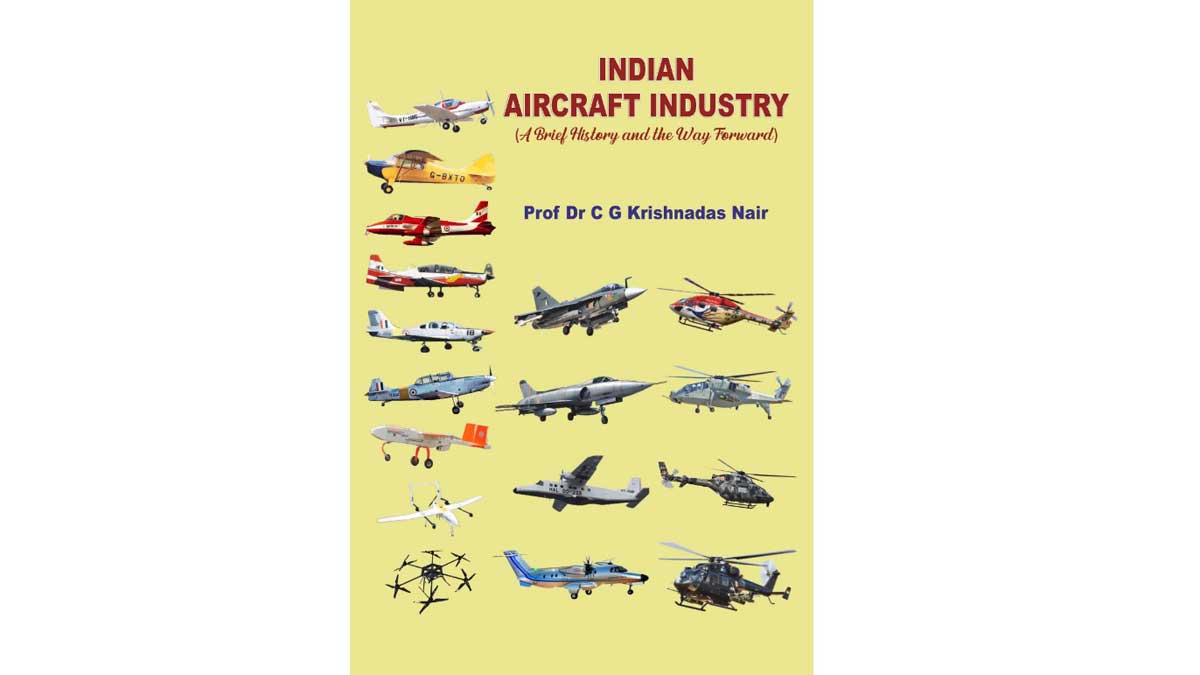
C.G. Krishnadas Nair, in his latest book ‘Indian Aircraft Industry’ sets any doubts on this topic to rest with his exhaustive tome to India’s aircraft manufacturing past. And sets the cat among the pigeons by pointing out the historical opportunities lost, and detailing a way forward.
Nair is no plain expert or observer. A doyen of India’s aerospace and defence sector, he helmed Hindustan Aeronautics or HAL for nearly a decade during a pivotal moment in history — when India was stepping out of the licence raj of governmental controls, and taking baby steps into the free-for-all of competition and market economics. Nair quietly but efficiently diversified HAL’s staid flightpath from being a government sector player in defence manufacturing into an innovative R&D-led sarkari player that didn’t scare away from doing the tango with the private sector and supply chain partners. He was also the founding president of the Society of Indian Aerospace Technologies and Industries (SIATI) as well as the Society of Defence Entrepreneurs and Technologists.
The book ‘Indian Aircraft Industry’ is a detailed compendium of India’s long aviation track record, which, as the many models and historical records he lays out make amply clear, was not just limited to being a consumer, but very much a technology upstart that tried its best even when policy, know-how and market economics were pitted against it. As Nair himself says in the preface, there are barely a couple of books documenting the Indian aircraft industry, and the last one came out in the previous century. Despite the odds stacked against it, Indian aerospace has soared high since then.
One of the biggest positive, which was also a negative, in this track record, has been the focus on defence production. Despite proven expertise in making civilian aircraft, too, many World War II era Dakotas were converted for use as commercial domestic flights by HAL in the initial years of India’s independence. But for the Indian government, the priority was defence production and coming out with enough and new aircraft to protect the fledgling new nation’s skies.
While that policy meant HAL threw its energy and strength, it did crimp any aspiration the nation could have had in becoming a commercial aviation manufacturer — the way countries like China and Brazil today have, even if the likes of COMAC and Embraer is still no match to Airbus or Boeing.
Nair touches upon all this and also methodically lists down future scenarios, including challenges and opportunities, as ‘Make in India’ hits the aerospace scene, too, better late than never. The book is textbookish in its aspirations, making one wonder whether it could have found a larger audience if it was given a coffee table treatment by the publishers — after all, who wouldn’t mind a finely printed glossy book filled with pictures of plane models? Nevertheless, even in its present form, it is very much a resource which will serve India’s aerospace industry in good stead, both as a reminder as well as a guiding light, as it takes sturdy steps into the unknown.
Indian Aircraft Industry (A Brief History and the Way Forward)
Written by: Prof Dr C.G. Krishnadas Nair
Price: Rs 950
Pages: 273
Published by: Society for Aerospace Studies; printed at Navbharath Press, Bengaluru
