



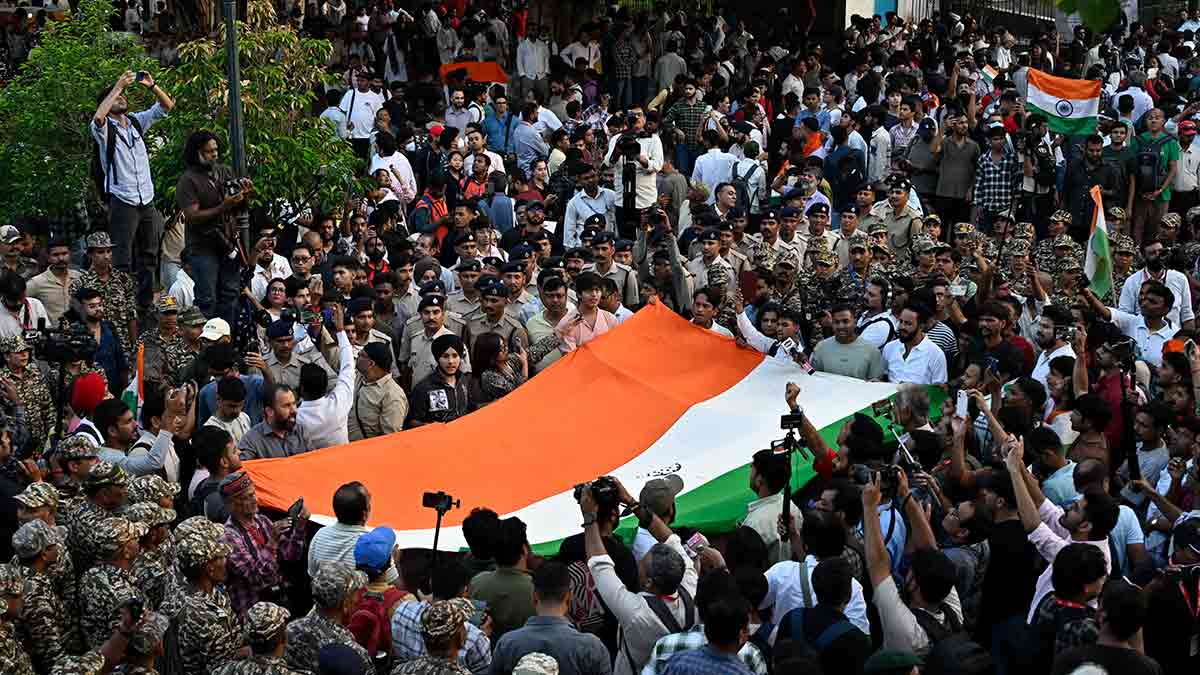
When faced with protest, the present government and its supporters always accuse the dissenters of being paid protesters. The prime minister has called them andolanjeevi, indicating on several occasions that they protest merely out of habit. If you look carefully, you will find that in many different contexts across the world, powerful entities have condemned powerless people for hurting them.
It does need to be repeated that powerful groups, persons and entities use multiple mechanisms such as open violence, unfair wages and welfare exclusions to oppress and control the masses. But it appears that we need to pay more attention to the use of accusations as tools of social control. Persons who benefit most from an unequal social order sometimes claim to be its victims, while those who actually suffer under that order are repeatedly accused of threatening stability and peace. Caste order in India is a good illustration of this.
The powerful define any behaviour they wish as wrongdoing and then assign guilt to these behaviours, further strengthening their hold and dominance. Take, for example, industrial relations, where excesses on the part of the management do not invite much scrutiny, but workers are painted as troublemakers as soon as they raise their voice.
You may think that anyone can accuse anyone else, but the test of power imbalance lies in the consequences of the accusations. Accusations carry different weight when made by a person who is proximate to those in power compared to when made by someone in a precarious or subordinated position. In the wake of #MeToo, we have observed this in umpteen cases. When those without power accuse the powerful, they experience suspicion, investigation or retaliation.
The powerful want to capture institutions precisely because it helps them control consequences of their actions. But even without it, the powerful often enjoy greater credibility within institutional procedures. Interested readers may look up critical commentary on how cases that should be registered and tried under the Scheduled Castes and the Scheduled Tribes (Prevention of Atrocities) Act are weakened by the police and the courts alike.
Unfortunately, the matter does not end here. The demands for equality are rightly perceived by the powerful as a challenge to their privileges. Consequently, in the narratives of the dominant groups, the subordinated groups are accused of being the aggressor, such as in the case of Palestine.
The other test to check who the real aggressor is to make a distinction between the loss of privilege and the experience of oppression. When a historically dominant group is required to share power, opportunities or institutional access, they may experience that change as a loss. However, losing an unequal advantage, such as male privilege, is not the same as being subjected to injustice.
The most durable quality of privilege is that it comes to see its advantages as natural entitlements and any challenge to them as an act of aggression. For example, women’s rights are experienced by most societies as unnatural or as newfangled ideas. This argument is particularly relevant to debates over reservations, but to ethnic supremacist or majoritarian accusations as well.
When subordinate groups, including religious minorities, organise around their experiences of exclusion, they are often accused of being divisive, ungrateful or excessively preoccupied with identity. There is deliberate denial that the inequalities that make such collective mobilisation necessary have continued since generations. In fact, one may argue, they are getting worse now; we live in a far more unequal world today.
Most mobilisations around the world are by people, especially young people—from Latin America and Europe to Asia—who refuse to accept the accusation that identifying a social problem is more dangerous than the circumstances that produced the problem in the first place.
The writer is a member of the Rajya Sabha from the RJD.
