


 Add as a preferred source on Google

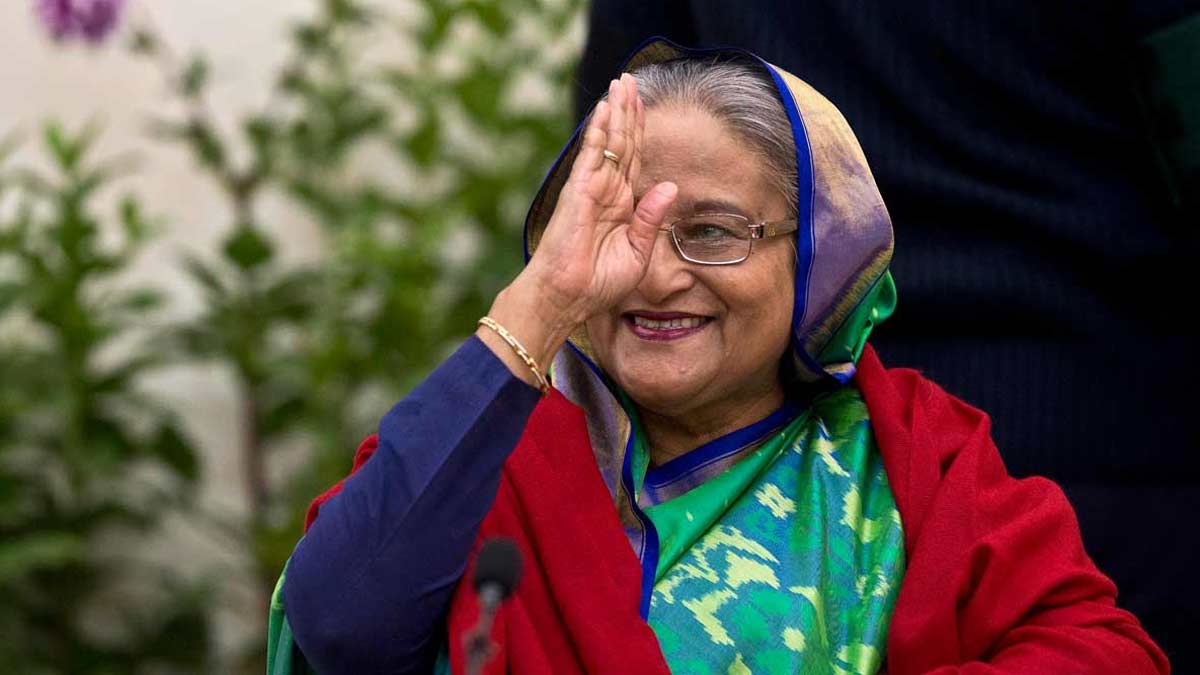
The case of Sheikh Hasina, the ousted Prime Minister of Bangladesh, is a curious one. It has regained focus after her announcement that she would enter her country on December 16 — be it on a Biman Bangladesh Airlines flight back home, or on foot via the Petrapole-Benapole India-Bangladesh border if the flying plan was refused.
December 16 is not an ordinary date. It is celebrated as Victory Day, or Bijoy Dibosh, to mark the end of the 1971 Bangladesh Liberation War and the surrender of the Pakistani military to Indian and Bangladeshi joint forces. And it was Hasina's father, Sheikh Mujibur Rahman, who led the fightback against Islamabad.
That is why the date matters. She is not just choosing a day to return. She is choosing a symbol.
On the re-entry plan, the powerful Bangladeshi Army — which was instrumental in flying Hasina in its military aircraft to India — has remained mum and refrained from making political statements. Its officially stated position is that it is backing the civilian government on law and order.
New Delhi may be insisting that if Hasina has to go back, the Bangladesh Army has to take complete responsibility for escorting her back — either by sending a military plane to Delhi, or by receiving her at a designated land border crossing with Bangladeshi soldiers.
But what the Bangla Army would be more bothered with may be the fallout of Hasina's entry into Bangladesh, as it would serve as a central plank for the Awami League to regroup and rally for a fightback, leading to extensive law and order issues.
And a civil war could be the next thing if Hasina is interned or executed. This is not an option that a slow-growing Bangladesh — with about 3.5% economic growth and beset with high inflation and growing labour unrest — can actually afford.
One must not forget that the Awami League was a major political party and Hasina had the distinction of being the longest-serving PM in the country's history, who led Bangladesh for 21 years spread across two terms.
While many in the Awami League's senior leadership have been put behind bars, the organisation has only gone underground and not disappeared completely, despite efforts to take down the political and administrative structures identified with her party and its student wing, the Chhatra League.
So Hasina's plan has landed both Delhi and Dhaka in a predicament.
In India, where she had fled to after bloodthirsty, riotous crowds took to the Dhaka streets that fateful day of August 5, 2024, she is a state guest replete with high security and the secrecy paraphernalia, but with restricted freedom of movement due to security reasons.
While the Indian position on Bangladesh is that it supports a 'democratic, stable Bangladesh and the will of the Bangladeshi people', India is obligated to Hasina in many more ways than one. At the same time, it is having to fend off forceful extradition requests from Bangladesh, where she has been sentenced to death in absentia in November 2025 for crimes against humanity over a July 2024 crackdown that she ordered.
India and Bangladesh have an extradition treaty that was signed in 2013 and amended in 2016 to fast-track and simplify the transfer of fugitives.
The Indian position distinguishes between two types of extradition requests. As MEA spokesperson Randhir Jaiswal explained: "The extradition request is being examined in line with our established process. The case of a citizen willing to return voluntarily to her country on a travel document is a matter separate from the extradition request."
Bangladesh's Tarique Rahman's BNP-led government insists that Hasina cannot enter her country like an ordinary citizen but has to be extradited.
Bangladesh's state minister for foreign affairs Humaiun Kobir has described her as a "thorn" in India-Bangladesh bilateral relations and said that India was in a difficult position as it could neither send her away nor avoid dealing with her presence. Kobir had earlier said that the deposed PM can only be brought back "in handcuffs or under strict surveillance".
Bangladesh's information adviser Zahed Ur Rahman goes a step further when he said that the government plans to carry out the death sentence if she returns. Home minister Salahuddin Ahmed and others have said she will be arrested on entering Bangladeshi territory.
But in reality, Dhaka's demand for her extradition may not be what it wants.
Because extradition would force Dhaka to do what it has threatened to do — arrest her, try her, and execute her. And that is the one outcome that could unite a fractured Awami League, inflame Gopalganj and Dhaka's streets, push the Army back into a political role it has tried to avoid since August 2024, and turn a legal victory into a national crisis.
What Dhaka may actually want is not Hasina in handcuffs, but Hasina in limbo — far enough to be irrelevant, close enough to be blamed.
What Delhi may actually want is the same thing — not a hero's return, not a humiliating handover, but a managed suspension.
Like Trishanku of mythology, Sheikh Hasina now hangs in mid-air. She wanted to return to her heaven in Dhaka, but Indra in Dhaka refuses to receive her. Vishwamitra in Delhi has stopped her fall, but cannot push her into heaven either. She has a heaven of protection in Delhi, but it is a Trishanku Swarga: safe, but suspended, belonging to neither country.
And until someone decides to cut the rope or pull her up, she will remain exactly where she is — Delhi's political minefield, Dhaka's hot potato, and South Asia's most dangerous in-between.
