



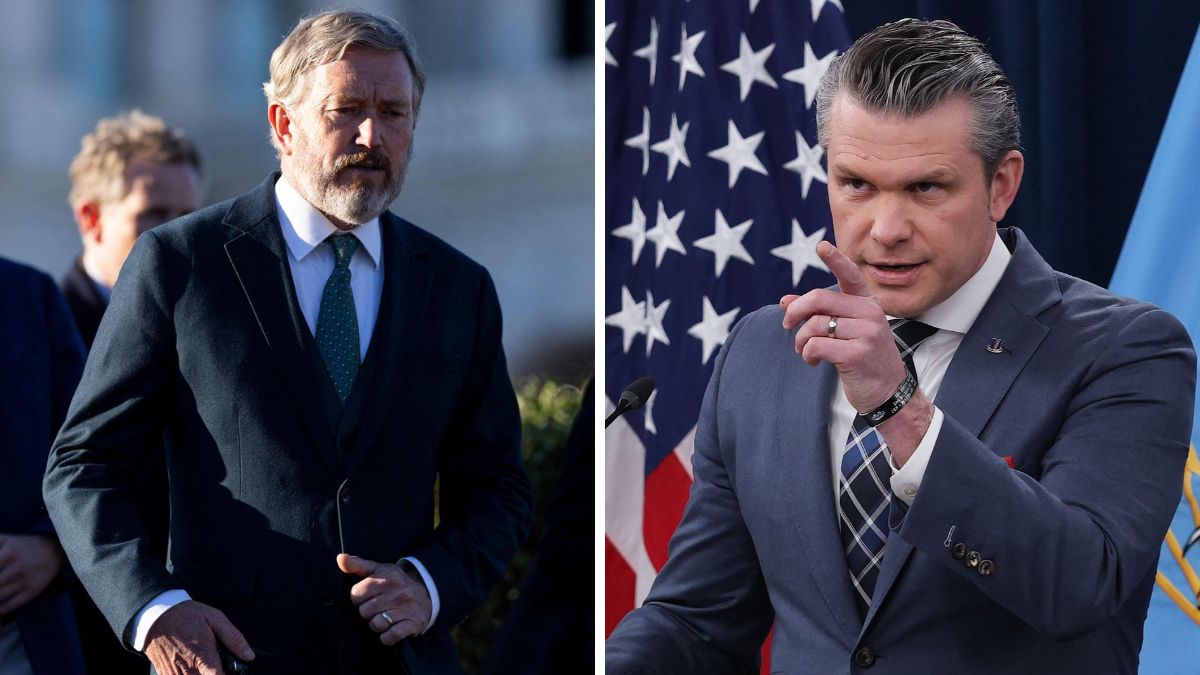
Thomas Massie got a second chance, and the Kentucky Republican took it. With his party battered in the midterms and his own congressional career about to end, he reintroduced articles of impeachment against Defence Secretary Pete Hegseth yesterday. He did so as a privileged measure, which starts a 48-hour clock. House Republican leadership must either bring the resolution to the floor or try to table it.
Massie had tried this before. In September, he moved to force a vote, but Speaker Mike Johnson cancelled the final legislative day before the pre-election recess and the effort lapsed. The lame-duck session offers no such escape. Republicans lost both chambers of Congress, and the House they still control is a thin one: 218 Republicans against 214 Democrats. As few as three defections, or a handful of conveniently empty seats, could carry the resolution.
Massie read the eight articles aloud for an hour and 20 minutes. Three concern the war with Iran, which began without a formal declaration of war, a statute authorising force, an attack on American soil or an imminent threat. The charge is that Hegseth sustained hostilities well beyond the 60-day limit set by the 1973 War Powers Resolution, and carried on even after Congress directed the administration to stop. The remaining five cover lethal strikes on alleged drug-trafficking vessels, the capture of Venezuelan President Nicolás Maduro, combat operations in Yemen, disregard for statutory protections against civilian casualties and retaliation against Senator Mark Kelly for protected speech.
The sponsor is an unlikely one. Massie is a constitutional conservative who lost his primary this year to a challenger endorsed by Donald Trump. He wants the president to replace Hegseth with a Senate-confirmable nominee before Democrats take the House in January. He says if Trump fails to act, the country will get a long Democratic spectacle of aggressive hearings and formal trials. It is an unusual pitch: impeach him now to avoid something worse.
Democrats need little persuasion to push Hegseth out or at least humiliate him. Incoming Speaker Hakeem Jeffries has called himself a 'hard yes' and has long vowed to 'run Hegseth out of town'. He casts the Iran campaign as a reckless war of choice that raised energy prices and left Americans less safe. If the present effort stalls, his caucus has made plain that investigating Hegseth will be among its first orders of business in the new Congress.
The arithmetic therefore rests with Republicans, and a few have begun to hedge. Don Bacon, who is retiring, says he will listen to the floor debate and concedes that Hegseth has made 'bad mistakes'. Massie professes confidence that enough colleagues will break ranks. Party anger over the midterm losses may do some of his work for him, since a sulking member who simply stays away lowers the bar for passage as surely as one who votes yes.
Trump says he will 'stand by' Hegseth even if the House impeaches him, and has dismissed Massie as a 'loser' driven by personal hatred. He insists that his Pentagon chief 'won the war' in both Iran and Venezuela, and points to strong recruitment figures. Aides have also brushed aside talk that Hegseth might step down or move to the Senate seat vacated by Marsha Blackburn. Hegseth himself calls the resolution a 'political sham' cooked up by a 'disgruntled, defeated congressman' in league with partisan Democrats. He has promised to hold his ground, and a press conference awaits.
The mood in the party, however, is seriously downcast. Vice President JD Vance and Trump have both conceded that the unpopular Iran war weighed heavily on the midterm result. Senator Thom Tillis has gone further and called for Hegseth's dismissal, citing 'inept management' and a fixation on culture wars at the expense of readiness. House Oversight Chairman James Comer has admitted that questions about the Iran strategy remain unanswered.
Procedure, meanwhile, offers the leadership several exits. Johnson may move to table the resolution or refer it to a committee, which would spare members an up-or-down vote. Should the articles pass, he could sit on them rather than send them to the Senate, borrowing the delaying tactic Nancy Pelosi used in 2019. That would also spare Republicans the awkward duty of naming impeachment managers to prosecute an official their own leader defends.
Only two cabinet secretaries have ever been impeached, and conviction requires two-thirds of the Senate, a threshold nowhere in sight. Massie knows as much. His gamble is that a House vote, whatever its outcome, will force Republicans to say aloud what many say in corridors.
