



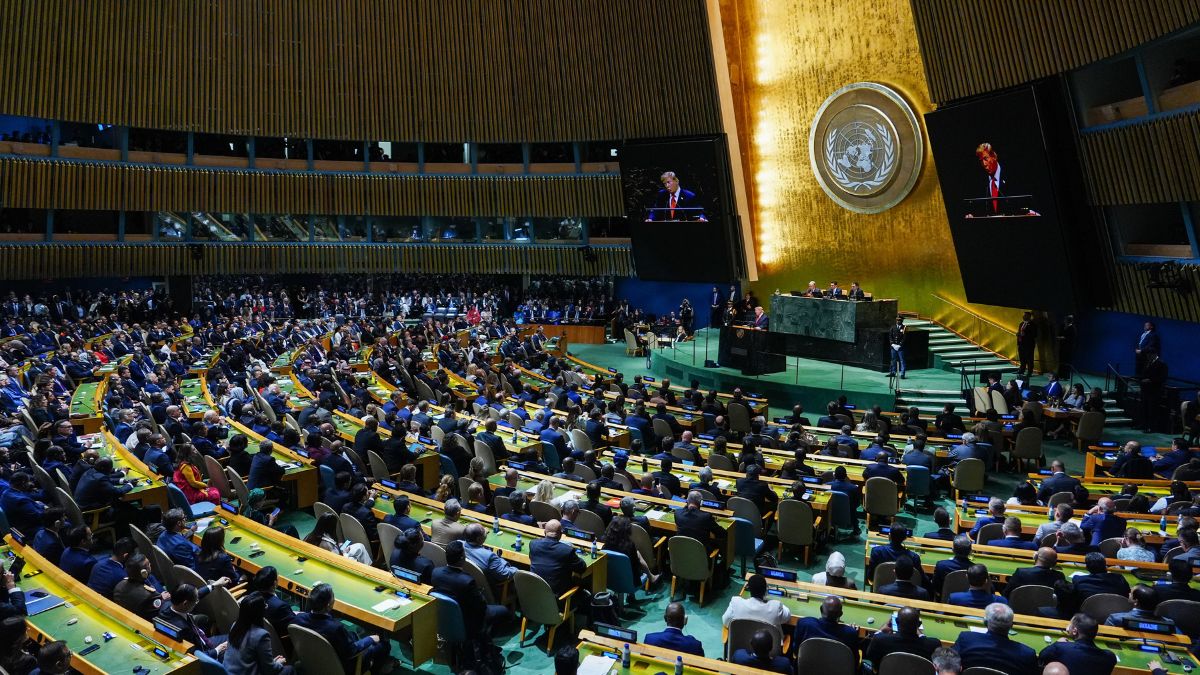
President Donald Trump's address to the 81st United Nations General Assembly on Tuesday lasted about 40 minutes, and despite the wide gamut of issues it covered, one thing was quite clear: the speech was built for American voters, not the assembled leaders of the world. Delivered weeks before the midterm elections, with Reuters/Ipsos polling placing his approval at an all-time low of 32 per cent, the address functioned less as statecraft and more as an exercise in domestic damage control.
The departure from convention was explicit. Addressing the war with Iran, Trump predicted that a diplomatic settlement would likely arrive "right after the election" in November, suggesting that Tehran was deliberately stalling to see how Republicans fared at the polls. He also reminded his audience, and by extension the voters watching at home, that he himself was not on the ballot. Tying the war's endpoint to election day was a way of managing expectations and shielding Republican candidates from any fallout should the conflict drag on.
Republicans face a defence of narrow majorities in both chambers of Congress, and strategists within the party have grown wary of an electorate increasingly willing to punish incumbents over the cost of living. By suggesting that a resolution in Iran was imminent, and specifically timed to land once the votes were safely counted, Trump offered his own candidates a message they could carry into November: that the costs of the conflict were temporary and that relief was scheduled, if not yet delivered.
That electoral framing extended into the speech's opening minutes, which read closer to a campaign rally than a diplomatic address. Trump ran through tax cuts, deregulation, low unemployment and record stock markets, declaring the American economy "the envy of the world." It was clearly a direct response to polling showing that voters blamed administration policy for the state of their household finances, not as an attempt to set out an agenda for the visiting world leaders.
Energy prices supplied the clearest illustration of that domestic pressure. With petrol averaging $4.47 a gallon, a rise of 50 per cent since the conflict began, and diesel running as high as $6.52, Trump used the UN platform to address motorists. He insisted that oil was moving freely through the region, a claim at odds with industry figures showing tanker traffic through the Strait of Hormuz had fallen to 17 ships a day against a pre-war average of 110 to 120. He then pivoted, telling the gathering he was not thinking about elections or petrol prices but about denying Iran a nuclear weapon, an attempt to recast economic strain as a necessary cost of a larger struggle.
His treatment of multilateral institutions followed the same domestic logic. He accused the United Nations of pursuing a "far-left agenda," called the International Criminal Court a "rogue institution" and an "evil group," and criticised international bodies for prioritising transgender rights, Christian persecution and immigration over security. His description of Cuba as an "absolutely failed state," which prompted its delegation to walk out, along with his emphasis on American control of Venezuelan oil reserves, spoke less to the UN floor than to conservative voting blocs in battleground states.
Even the address's detour into artificial intelligence carried a domestic signature. Trump announced that federal documents would now refer to the technology as "Super Intelligence," arguing that the word artificial made it sound false. He dismissed international safety frameworks as a "globalist scheme" and likened warnings about existential AI risk to what he called the hoax of climate change. Observers read this less as an attempt to shape global standards than as a message to domestic tech executives and voters that innovation would take precedence over oversight, wherever that oversight originated.
None of this sat easily with the setting. A UN address is traditionally an occasion for building consensus among allies and rivals alike, not for relitigating culture-war grievances or rebranding federal terminology. Yet across nearly every section, the aim was the same: reassure a jittery electorate, defend interventions that have grown costly and shore up the Republicans facing a difficult November.
Trump insisted, more than once, that the midterms were not on his mind. The speech he gave suggested otherwise.
