



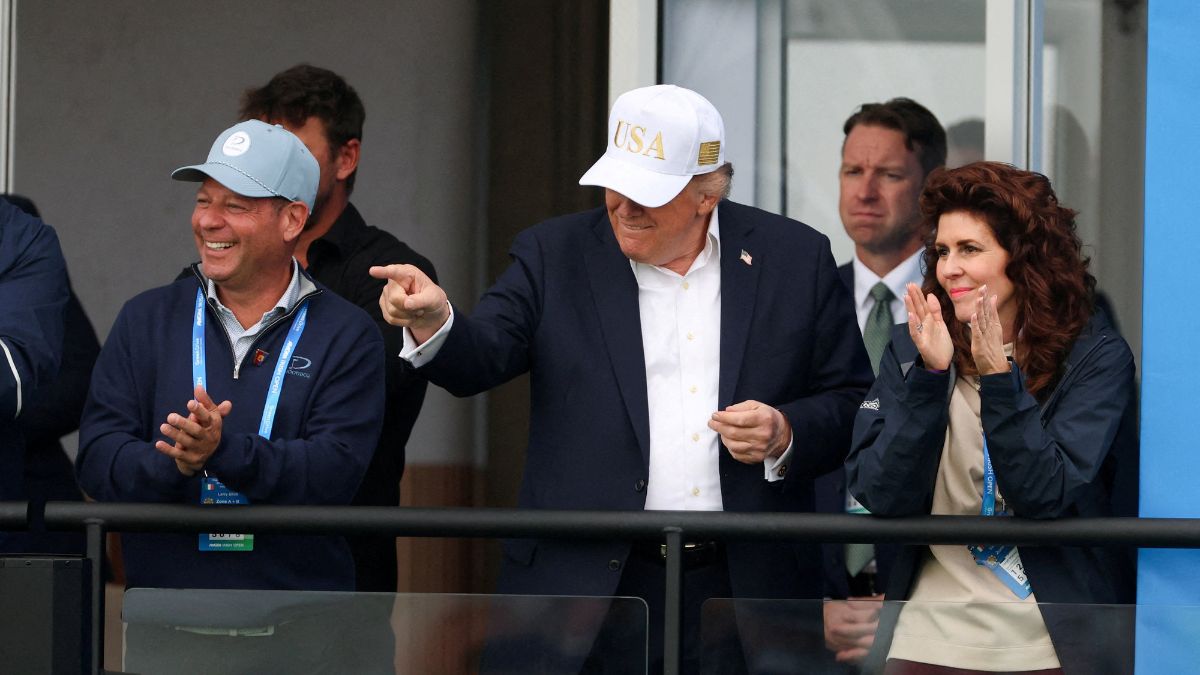
Donald Trump did not travel to Ireland this weekend to talk about constitutional politics. He came to watch golf at his own course. Yet a single answer to a reporter's question in Dublin on Saturday has reopened a debate that Washington has spent nearly three decades trying to stay out of.
Speaking alongside Taoiseach Micheál Martin at a joint appearance yesterday, Trump was asked for his view on Irish reunification. He did not hedge. A united Ireland, he said, would be "fantastic", a "great feather in everybody's cap", something he would "love" to see happen. It was, in his telling, inevitable and overdue: "going to happen eventually" and it "may as well happen now". Turning to Martin, he added that the Taoiseach was "the right man over here to get it moving". Later that evening, addressing business leaders at the US ambassador's residence, he called a united Ireland "a very cool thing", conceding with evident awareness that the remark would not sit comfortably anywhere: "No matter what you say or how you say it, there's no good answer."
The words were delivered in the improvisational style that has come to define Trump's public appearances. But their substance broke with decades of studied American neutrality on Northern Ireland's constitutional status, maintained in deference to the Good Friday Agreement that Washington itself helped broker in 1998.
The timing was not accidental. Two weeks ago, British Prime Minister Andy Burnham had visited Belfast and declared a border poll "off the table", citing the absence of majority support for one. That comment had already drawn sharp criticism from Sinn Féin and Irish nationalists and had put the unity question back on the regional agenda just as Trump touched down. His remarks also landed amid protests: thousands had gathered in Dublin against his administration's record on Gaza and Iran, and by endorsing a core nationalist aspiration, Trump complicated the position of demonstrators who favour Irish unity but oppose him personally. A domestic incentive was also plausibly at work. With the midterms approaching and roughly a tenth of Americans claiming Irish heritage, a remark calibrated to appeal to that constituency would not be out of character for a president who rarely separates diplomacy from audience.
The reaction split along familiar lines. Downing Street reaffirmed Burnham's position and insisted the government remained committed to the Good Friday framework. Conservative leader Kemi Badenoch called the comments "deeply unhelpful", likening them to Trump's earlier musings about Greenland and Canada.
Reform UK's Nigel Farage was equally blunt, insisting Northern Ireland remains part of the United Kingdom. Within Northern Ireland, DUP leader Gavin Robinson rejected the intervention outright, arguing that the region's constitutional future rests on the "settled democratic will" of its own electorate rather than commentary from Washington, London or Dublin. Sinn Féin's Mary Lou McDonald, however, seized on the remarks to press Martin toward active planning for unity, even as she continued to criticise Trump's record in the Middle East. The Irish government itself stayed measured. Martin declined to be drawn further and pointed instead to the existing Shared Island initiative, which favours cross-border economic cooperation over any immediate push toward a vote. American officials, meanwhile, were quick to stress that nothing had formally changed: US policy remains anchored in the Good Friday Agreement.
That last point matters more than the headlines Trump generated. The 1998 agreement sets out a specific mechanism: a border poll can only be called by the UK government if it appears likely that a majority in Northern Ireland would vote to leave the union, and unification would require concurrent majorities north and south. Nothing in current polling or in the UK's own assessment suggests that threshold has been met. Burnham's position was unchanged within hours of Trump's remarks. Demographic shifts and the lingering effects of Brexit trade arrangements keep the unity question alive as a long-term proposition, but they do not accelerate the legal timetable, and no amount of presidential enthusiasm alters that.
What Trump's intervention does confirm is how much room the subject occupies in public debate on both sides of the Irish Sea, and how easily an American president can inject himself into it without meaning to reshape anything at all.
