



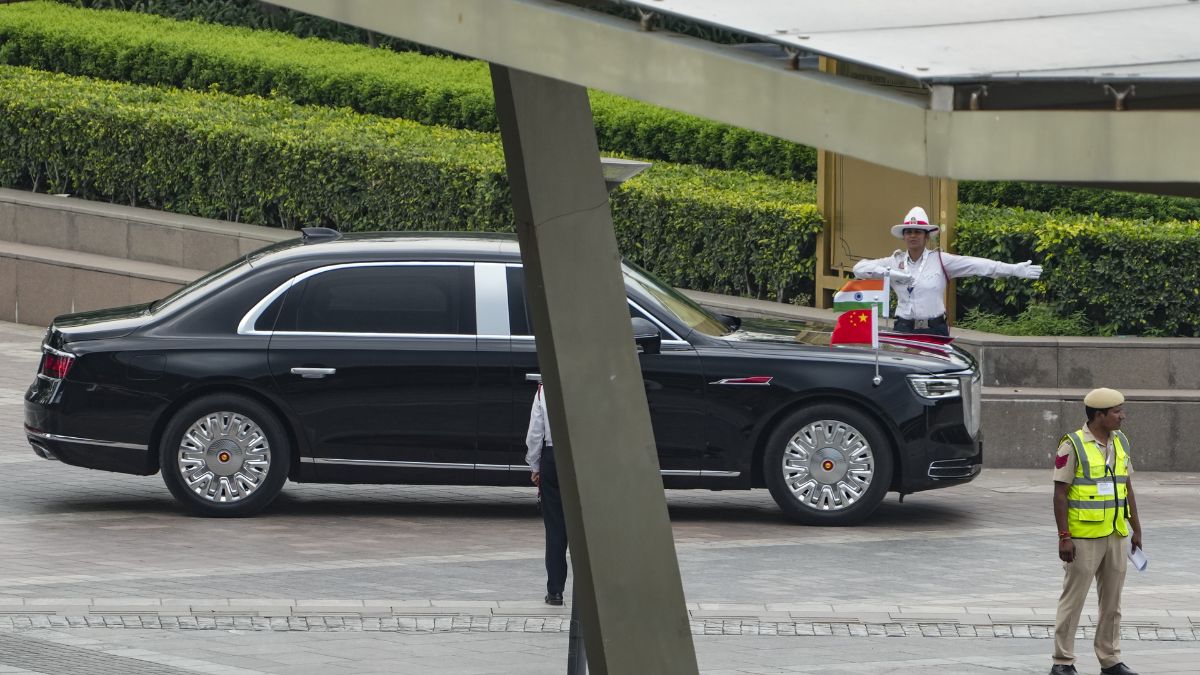
As the 18th BRICS Leaders’ summit kicks off in New Delhi, the leaders’ motorcades are receiving as much attention as the presidents themselves. Russian President Vladimir Putin and Chinese President XI Jinping arrived at the Bharat Mandapam sporting their own home-grown branded limousines.
While Vladimir Putin generally travels in a motorcade of around two dozen vehicles, he uses his Aurus Senat limousine for foreign visits. He switched to the Aurus in 2018 after replacing the Mercedes-Benz S 600 Guard Pullman, which was used by the Russian presidency. Built by Aurus Motors, it was developed under Russia’s Kortezh project. The car was specially made to avoid relying on foreign brands and is a heavily armoured luxury sedan.
The car is seven metres long and is powered by a 4.4-litre twin-turbo V8 hybrid engine. It can produce around 598 horsepower and 880 NM of torque. The limousine can reportedly accelerate from zero to 100 kilometres per hour in about six seconds, reaching a top speed of roughly 249 kilometres per hour.
Often called a “fortress on wheels”, the Senat is reportedly capable of withstanding high-calibre, armour-piercing bullets, grenade blasts and underbody explosions. The limousine also has its own oxygen filtration system to protect the president from chemical attack scenarios. The windows are made with thick multi-layer bullet-resistant glass. A civilian version of the Senat is available in limited numbers and costs around 18 million roubles or ₹2.5 crore.
XI Jinping, who arrived on September 12, was travelling in the Hongqi N701. Hongqi brand was established in 1958 by First Automotive Works, and its models have traditionally been used by senior Communist Party officials.
The Hongqi N701 arrived in Delhi in a black protective cover because of security and transportation protocols. The N701 is estimated to be 5.5 metres long and weighs over three tonnes. It is also expected to have a 6-litre V12 engine producing around 408 horsepower.
While China has not released information about the limousine, it is believed to have heavy armour, bullet-resistant glass and other security features, including life-support and secure communication systems.
Both the limousines are displays of Russia and China’s domestic manufacturing capabilities and their reduced reliance on Western car manufacturers.
