



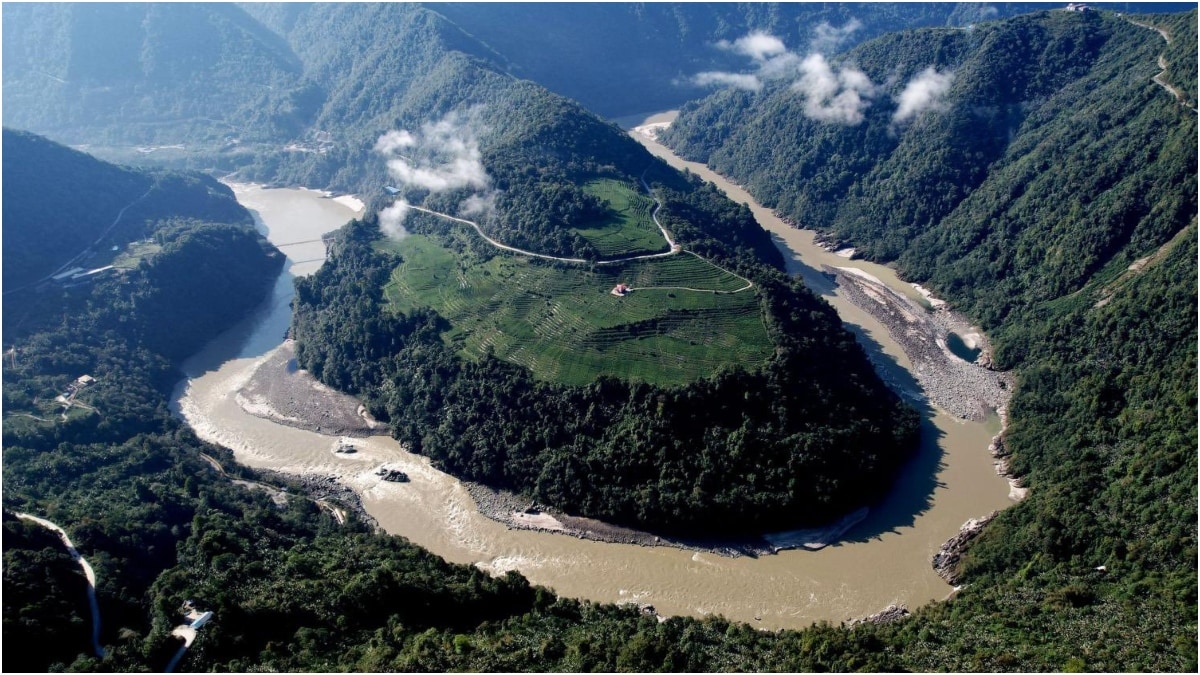
Legends abound among locals in the area of the Great Bend of the Yarlung Tsangpo-Brahmaputra river system, including the dominant belief that the mythical land of Shambhala, or paradise in Tibetan Buddhism, exists somewhere near the India-China border just across northeastern Arunachal Pradesh.
Very remote and inaccessible because of very high mountains, steep river valleys and insect-infested thick jungles, it was only in 1998 that a British explorer and Buddhist scholar first managed to complete the last unexplored navigation of the river.
Home to some of the earth’s highest peaks, like Gyala Peri (7293 m) and Namcha Barwa (7780 m), the Yarlung Tsangpo gushes down here in a torrent of cascades and rapids, also carving out the deepest gorge on earth — so deep that even satellites find it difficult to probe deeper. The Yarlung Tsangpo becomes the Brahmaputra in Assam.
And now, it is here that China’s supremely ambitious plan to dam the Yarlung Tsangpo-Brahmaputra river has run into a problem of Himalayan proportions, with a recent report saying the dam area sits above a huge geological fault.
The findings said the dam site is being constructed directly above the Paizhen Fault, a tectonic fault zone in southeastern Tibet that has remained highly active since the Ice Age (Pleistocene epoch). Therefore, any structure bears the enormous risk of being hugely impacted by earthquakes and landslides.
The area was hit by a 6.9 magnitude earthquake in 2017.
The eastern Himalayan mountains have their origins in the collisions between the Indian and Eurasian tectonic plates.
The report was published in June in a scientific paper under the aegis of the state-owned China Geological Survey, with the research being undertaken together with geologists from the Chengdu University of Technology, the Civil-Military Integration Centre of the China Geological Survey, and the Middle Yarlung Zangbo River Natural Resources Observation and Research Station.
The planned $147-billion mega hydropower project has an estimated annual capacity of 300 billion kilowatt-hours of electricity. The construction, which began last year, has sparked protests among tribal communities in Arunachal Pradesh who are fearful of the downstream impact.
On July 19 last year, Chinese Premier Li Qiang attended the groundbreaking ceremony for the launch of the mega dam project in Nyingchi, a Tibetan city less than 50 km aerial distance from the Indian border in Arunachal Pradesh.
While the study did not recommend the scrapping of the project, it did urge engineers to strengthen slope stability and implement retaining protections to mitigate the risk of landslides and earthquakes.
