



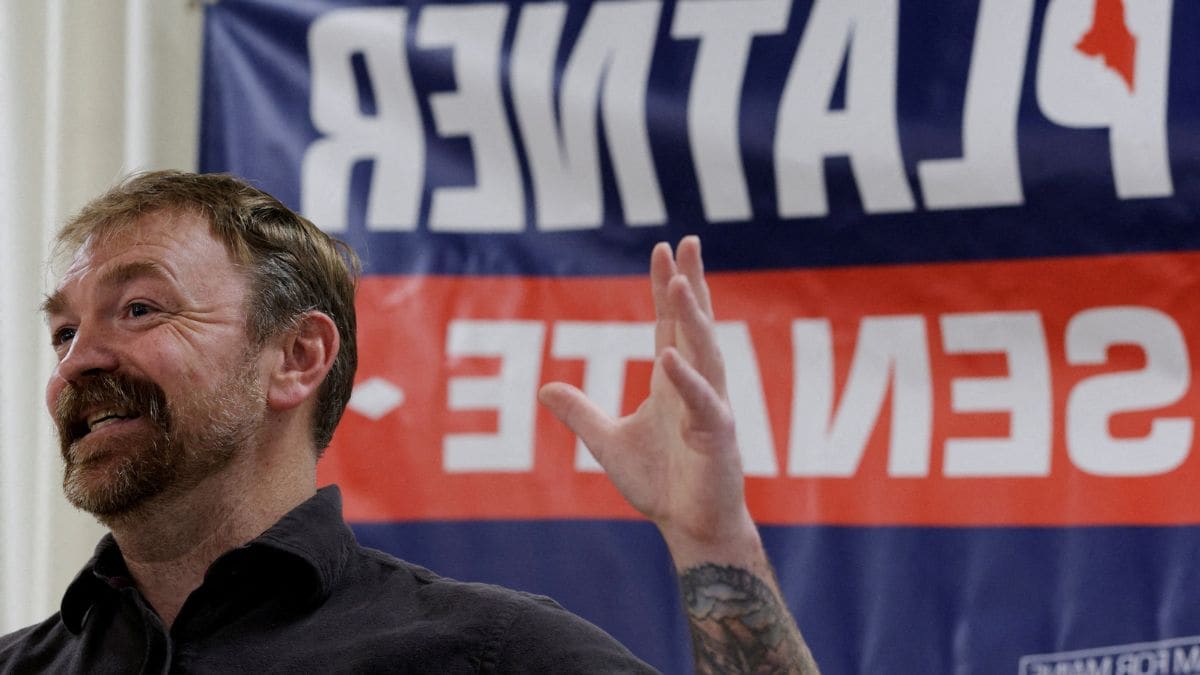
Progressive Democrats were confident that Graham Platner, a former Marine and oyster farmer, would be the party’s insurgent future in Maine. Running an unapologetically anti-establishment campaign, Platner rode a wave of progressive enthusiasm and working-class populism to secure the Democratic nomination for the US Senate. His momentum became so overwhelming that the party establishment's preferred candidate, Governor Janet Mills, suspended her primary campaign, effectively clearing Platner's path to the nomination.
That remarkable rise has now unravelled. A succession of controversies, culminating in credible allegations of sexual assault, has triggered the complete collapse of his candidacy and plunged Democrats into a political crisis with national implications.
Long before the allegations that ultimately proved fatal, Platner's campaign was dogged by controversy. Questions were raised over a chest tattoo resembling the Nazi Totenkopf symbol, a history of misogynistic Reddit posts that appeared to dismiss rape, and revelations that he had exchanged sexually explicit messages with women outside his marriage.
Despite these controversies, along with reports of volatile behaviour towards former partners, Platner survived the primary. His progressive and socialist backers felt that despite all his flaws, he could be a compelling outsider capable of channelling widespread voter frustration with the political establishment. Many of them compared him with Trump, arguing that if the president could overcome serious personal controversies, Platner deserved the same opportunity. He publicly apologised for aspects of his past, while many supporters overlooked concerns about inadequate vetting in favour of his charisma and populist appeal.
The campaign reached its breaking point when Jenny Racicot, who had dated Platner on and off for more than two years, accused him of sexually assaulting her in late 2021. According to her account, Platner arrived at her home heavily intoxicated, forced his way inside and assaulted her despite repeated pleas for him to stop. In an interview with CNN, Racicot said she regarded the incident as rape.
Shortly afterwards, another woman, Lyndsey Fifield, accused Platner of non-consensual condom removal, commonly known as "stealthing", during sex. Platner categorically denied engaging in any non-consensual conduct, dismissed the allegations as politically motivated and said he was taking time to consider his future.
The allegations prompted an immediate collapse in political support. Progressive leaders who had defended Platner through earlier controversies swiftly abandoned him. Senators Bernie Sanders and Elizabeth Warren, along with Representative Ro Khanna, withdrew their endorsements and urged him to leave the race.
His campaign's financial support also evaporated. The Democratic National Committee, the Democratic Senatorial Campaign Committee (DSCC) and the Senate Majority PAC all cut ties with his campaign and halted spending in the Maine contest. Senate Minority Leader Chuck Schumer also demanded that Platner withdraw, acknowledging the growing political damage his continued candidacy posed to the party.
Platner's implosion has alarmed Democrats far beyond Maine. The state's Senate seat is regarded as one of the party's best opportunities to reclaim a Senate majority. He had been expected to mount a serious challenge to five-term Republican Senator Susan Collins in a state that backed the Democratic presidential nominee in 2024.
Without a competitive candidate in Maine, Democrats may be forced to pursue far more difficult and expensive victories elsewhere, including in states such as Texas. Party strategists fear that a seat once considered winnable has suddenly become far more uncertain.
Platner has until July 13 to remove his name from the ballot. Should he step aside, the Maine Democratic Party has until July 27 to determine how it will choose a replacement nominee. Potential contenders, including former state Senator Troy Jackson, Secretary of State Shenna Bellows and former health official Nirav Shah, have already begun positioning themselves for the race.
The controversy has also exposed deep ideological divisions within the Democratic Party. Centrist figures have criticised progressive activists for failing to scrutinise Platner adequately before rallying behind his campaign. Progressives and leftists, however, are unlikely to allow the scandal to be used as a pretext for introducing a more moderate nominee and diluting the anti-establishment agenda.
Adding to the tension are reports that Platner hopes to use his remaining influence to help shape the choice of his successor, insisting the nominee should share his progressive vision. Moderate Democrats argue that any candidate closely associated with him would inherit the political baggage of the scandal.
With the deadlines fast approaching, Maine Democrats face an increasingly difficult task: replacing a discredited nominee, healing widening ideological divisions and preserving one of their most important opportunities to regain control of the Senate.
