



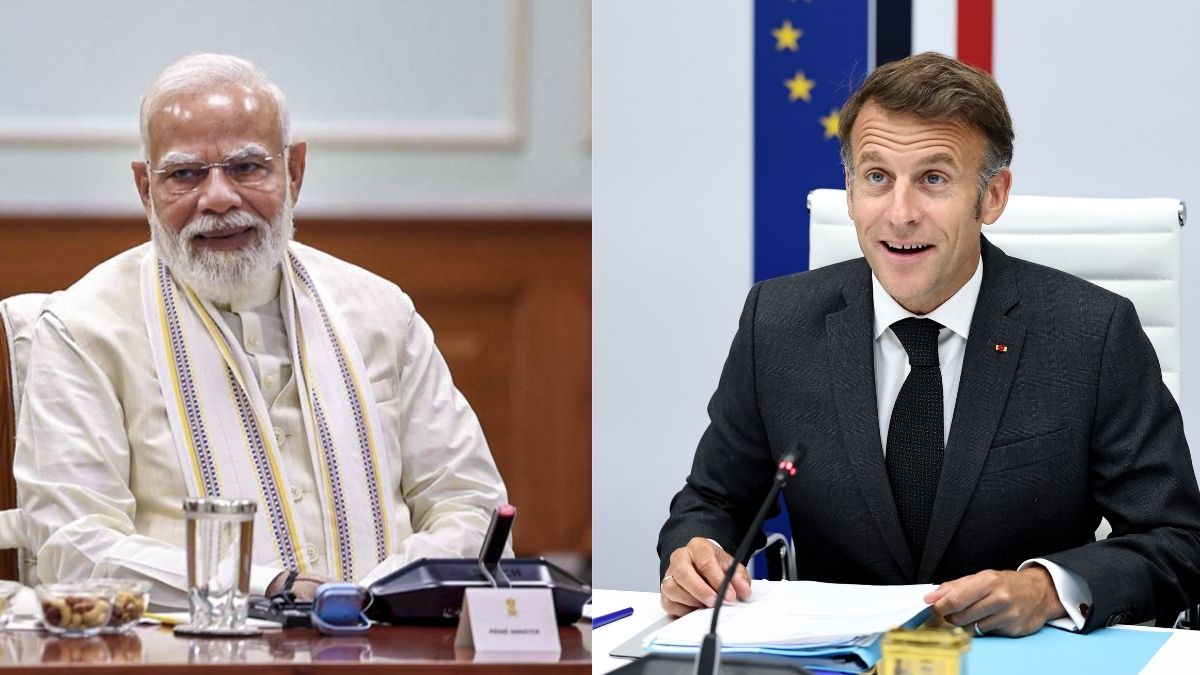
As Prime Minister Modi heads to Paris, his meeting with President Macron may be among the last defining moments of a remarkable chapter in India–France relations, as Macron’s presidency approaches its final phase. While the two leaders could meet again in Miami on the sidelines of the G20 Summit, this is likely to be their last bilateral exchange in either country. France heads into a presidential election in 2027, a contest that could recalibrate Paris’ foreign policy priorities. Yet, the significance of this moment lies in what it reveals about the evolution and status of Indo–French ties.
Paris has been a frequent destination for Modi, as he visited the country twice in 2015 and five times between 2017 and 2025. Macron, in turn, has visited New Delhi on four occasions in his two terms. These visits have often been combined with other countries or involved participation in a global conference, such as the G7 Summit this time. Nonetheless, each visit has been consequential and delivered outcomes across defence, technology, and strategic cooperation.
A partnership forged in strategy and delivery
Over decades, the relationship has moved beyond individual leaders and visits and election cycles to become strategically anchored and structurally resilient. For New Delhi, France has gone from supplying enriched uranium fuel for the Tarapur Atomic Power Station (1982) and the only Western country to not condemn its nuclear testing (1974 and 1998), to one of the strongest advocates against Pakistan-sponsored terrorism and a dependable defence partner. For France, New Delhi has emerged as a trusted strategic partner in the Indo-Pacific, the biggest market for defence exports, and a like-minded power committed to a multipolar world order.
Their close ties are exemplified through the signing of a ‘Strategic Partnership’ in 1998, one of the first times that India used the term, and both sides elevated it to a ‘Special Global Strategic Partnership’ earlier this year. Macron described the relationship as one that “delivers concrete results” but also values strategic autonomy, which is “super important.” In the current world of instability and chaos, this relationship is “an island of stability and of responsibility.”
At the heart of the relationship lies defence cooperation, and their first deal dates to 1953 for the French Dassault aircraft, which were used by India in the 1962 war with China. More than 50 years later, not much has changed, and India used the Rafale jets in its latest strike on Pakistan under Operation Sindoor in May 2025. France is currently the second biggest arms supplier in the world, and India is its largest recipient, accounting for 24 per cent of its total exports from 2021 to 2025. After Russia, it is also the second largest importer for New Delhi overall, at 29 per cent, in the same period, and the numbers have only grown. Importantly, the defence relationship has transformed into one of co-production, with notable advancements in Rafale purchases and the engine for India’s fifth-generation fighter, Advanced Medium Combat Aircraft (AMCA).
Beyond defence, the Indo-Pacific has emerged as a key area of convergence. Unlike many European powers, France is a resident Indo-Pacific actor with overseas territories and a permanent military presence. This shared geography has translated into coordinated approaches on maritime security, freedom of navigation, and balancing an assertive China.
However, there is scope to increase the bilateral trade and intensify the economic partnership. France currently does not feature in the list of India’s top fifteen trading partners, though trade has more than doubled in the last decade to $15.81 billion. A further push is expected with the signing of the India-EU Free Trade Agreement.
2027 French elections and the view from New Delhi
Considering their longstanding ties and mutual trust, there is little to suggest a fundamental reorientation of France’s India policy. Yet as this chapter closes, a question naturally arises of what endures when the personalities change, and France's upcoming presidential election makes that question urgent.
It is a hotly contested election with reports suggesting about thirty potential candidates in the fray—including former presidents and prime ministers, old veterans and young guns, and swings across the ideological spectrum to include the far-left and far-right. As per various polls, Marine Le Pen’s National Rally, a far-right and deeply controversial front, also currently the single largest party in Parliament, is expected to emerge victorious, subject to the resolution of a legal battle. The party differs from Macron’s approach on domestic economic policy, immigration, relations with the EU and NATO, ties with Russia, among other sensitive issues.
A stronger policy on immigration could harm India, but so far, Le Pen and her supporters have focused more on Islamic migrants. Additionally, an inward-looking and protectionist economic and military policy does not spell good news, although India has managed such challenges with countries in the past. A lack of commitment in the Indo-Pacific can also be concerning, especially as the US grows unreliable. Meanwhile, Le Pen is also a strong critic of France’s relationship with the EU and rejects its supranational constraints. An altered French approach to the EU will certainly impact the bloc’s external posture and consequently have ramifications for India. For long, New Delhi has preferred dealing with European countries bilaterally, with its turn towards the EU being relatively recent, an evolution significantly enabled by France. Any shift in Paris, therefore, risks depriving India of a key and friendly voice within the Union.
However, on Islamic terrorism and countering the threat from China, Le Pen’s approach may be closer to India’s. She and her party are also likely to have a greater understanding of New Delhi’s relationship with Russia, its policy of self-reliance and self-interest, and other nationalist positions. Nonetheless, uncertainty over the National Rally’s foreign policy, like that of any prospective president, will take time for partners to interpret and adjust to.
The elections are being seen as consequential not only for the future of France, but also for all of Europe, and the ideological right across the world. So far, these developments seem to mean little in India’s policy circles, and the optimism of continuity is significant. Unlike relationships that are vulnerable to electoral cycles or ideological shifts, India–France ties have acquired a degree of insulation and rely on converging strategic interests, not personalities and parties.
Thus, the Modi-Macron era may end soon, but the relationship was always larger than the two leaders. A new government in Paris will certainly bring some changes and cause apprehensions in New Delhi, although India has navigated ideological shifts in capitals before, and those instincts and learnings should serve it well.
The writer is research assistant and program coordinator, Carnegie India.
The opinions expressed in this article are those of the author and do not purport to reflect the opinions or views of THE WEEK.
