


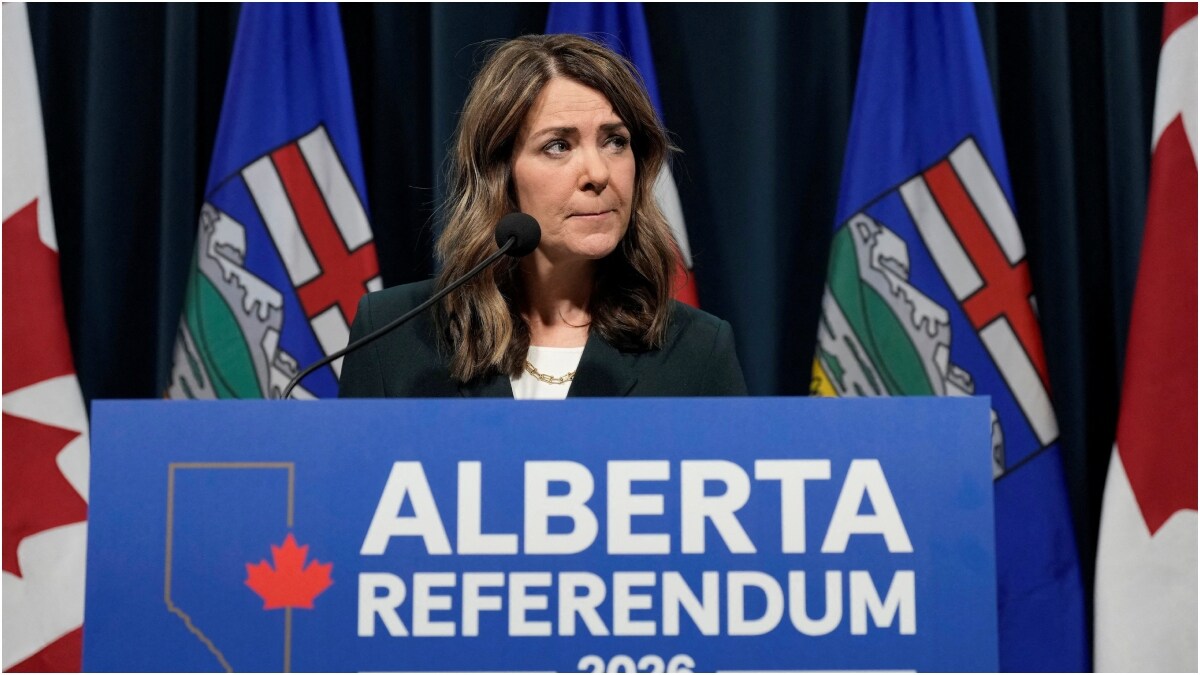
Canada is confronting its most serious unity debate in decades as Alberta prepares for a controversial referendum that could reopen the question of secession. Alberta Premier Danielle Smith’s government has announced a vote on October 19 that will ask Albertans whether the province should remain within Canada or begin the process towards a future binding referendum on independence.
The proposed ballot does not directly ask voters if they want Alberta to leave Canada. Instead, it seeks approval to launch the constitutional and legal steps required for a second, binding vote on separation at a later stage. Critics have described the move as a politically calculated “referendum on a referendum”, one that keeps separatist momentum alive while stopping short of an outright break with Canada.
The issue has rapidly become one of the most divisive political questions in the country. A growing independence movement in oil-rich Alberta argues that the province has long been ignored and economically constrained by political decision-makers in Ottawa. Yet despite the rising noise around separatism, opinion polls continue to show that most Albertans oppose leaving Canada.
The complicated structure of the vote emerged after an Alberta judge struck down an earlier separatist petition because organisers failed to properly consult Indigenous communities whose treaty rights could be affected by secession. The new proposal is widely seen as a legal workaround designed to sidestep immediate constitutional challenges while preserving the political momentum of the independence campaign.
The Smith government insists the move is simply an exercise in direct democracy. Ministers point to two citizen petitions that together gathered roughly 700,000 signatures. One, backed by separatist groups, reportedly collected around 300,000 unverified signatures calling for a vote on independence. The other, known as the “Forever Canadian” petition, gathered approximately 400,000 verified signatures from Albertans who strongly oppose separation and want the province to remain part of Canada.
Yet even the federalist petition has become a source of controversy. Its creator, former Alberta deputy premier Thomas Lukaszuk, has accused Smith of cynically using the campaign to justify a ballot question about separation. Lukaszuk says his petition was never intended to legitimise separatism. Rather, it was designed to pressure legislators into publicly affirming Alberta’s place within Canada and politically isolate separatist activists. Instead, he argues, the government has effectively turned his initiative into evidence of a divided province requiring a referendum process. Lukaszuk and many federalist supporters say they feel politically manipulated by a government they accuse of deliberately blurring the distinction between defending Canada and questioning it.
At the centre of the crisis lies the internal politics of Smith’s United Conservative Party. Although Smith publicly describes herself as a federalist who wants a strong Alberta within a united Canada, she faces intense pressure from separatist factions inside her own political base.
Polling suggests only around 30 per cent of Albertans support outright separation. However, among UCP members, support for leaving Canada is significantly higher, with some surveys showing a majority sympathetic to the idea. Former premier Jason Kenney has warned that the party is increasingly being driven by a highly mobilised fringe movement that historically enjoyed only marginal public support.
Critics argue Smith has steadily accommodated these factions to protect her leadership. Her government lowered the threshold required for citizen-led initiatives and later altered legislation in ways critics say were specifically designed to revive the separatist campaign after its earlier legal setbacks. Opponents contend the premier is less interested in independence itself than in preventing a revolt from the increasingly radicalised sections of her party.
Economic grievances remain central to the separatist movement’s appeal. Groups such as the Alberta Prosperity Project claim an independent Alberta would become dramatically wealthier by retaining money currently sent to Ottawa through federal redistribution programmes, particularly equalisation payments. Some advocates even argue Alberta could eventually eliminate personal income taxes, corporate taxes and provincial sales taxes altogether.
Economists strongly dispute those claims. They think separatist projections routinely ignore the enormous costs independence would impose. These include assuming Alberta’s share of Canada’s national debt, which now exceeds C$1.3 trillion, as well as replacing billions of dollars in lost federal transfers and programmes, including child benefits, pensions and old age security.
Independence would likely produce severe fiscal pressure, trade disruptions and long-term economic uncertainty. A newly independent Alberta would face higher borrowing costs, barriers to interprovincial trade and the challenge of renegotiating access to international markets. Rather than becoming richer, Alberta could face deep deficits and prolonged economic instability.
Oil and pipelines are another major source of separatist anger. Many Albertans believe Ottawa has unfairly obstructed the province’s energy sector and prevented the construction of pipelines to coastal export terminals. Separatists often claim that an independent Alberta, as a landlocked country, would possess a guaranteed legal right under international law to build pipelines through British Columbia to tidewater ports.
Legal experts say that argument is misleading. While the UN Convention on the Law of the Sea recognises certain transit rights for landlocked states, access arrangements must still be negotiated with neighbouring transit countries. In practice, an independent Alberta would still require Canada’s co-operation to build export infrastructure through British Columbia, potentially making pipeline politics even more complicated than they are today.
Even if a future referendum on separation were successful, the legal road to independence would be extraordinarily difficult. Under Canada’s Clarity Act, a clear majority on a clear referendum question would only compel the federal government to begin negotiations. It would not automatically grant Alberta independence. Any actual secession agreement would require constitutional amendments approved by at least seven provinces representing 50 per cent of Canada’s population. Such approval would be politically daunting, especially given strong opposition from several provinces.
The territorial consequences of separation would also be deeply contested. Much of Alberta sits on lands covered by Treaties 6, 7 and 8 regarding Indigenous rights. Indigenous leaders argue these treaties are nation-to-nation agreements with the Crown and cannot simply be dissolved through a provincial referendum. Many First Nations have already signalled they would reject automatic inclusion in a sovereign Alberta. This raises the possibility that an independent Alberta could emerge with fragmented territory, complicated jurisdictional disputes and prolonged legal battles involving Indigenous nations, federal lands and national parks. Cities such as Edmonton, which tend to be more strongly federalist, could also resist separation politically.
Citizenship presents another uncertainty. Some separatists assume Albertans would automatically retain Canadian citizenship and passports after independence. But constitutional experts warn there are no guarantees, particularly if negotiations become hostile or acrimonious.
Across Canada, the debate is causing growing alarm. Manitoba Premier Wab Kinew and British Columbia Premier David Eby have criticised Smith for unnecessarily straining national unity at a time when provinces should be focusing on economic co-operation and internal trade.
Business leaders are equally concerned. Many warn that simply entertaining the prospect of separation creates uncertainty that discourages investment and delays major economic projects. Political instability, they argue, carries real financial consequences long before any actual referendum on independence takes place.
