



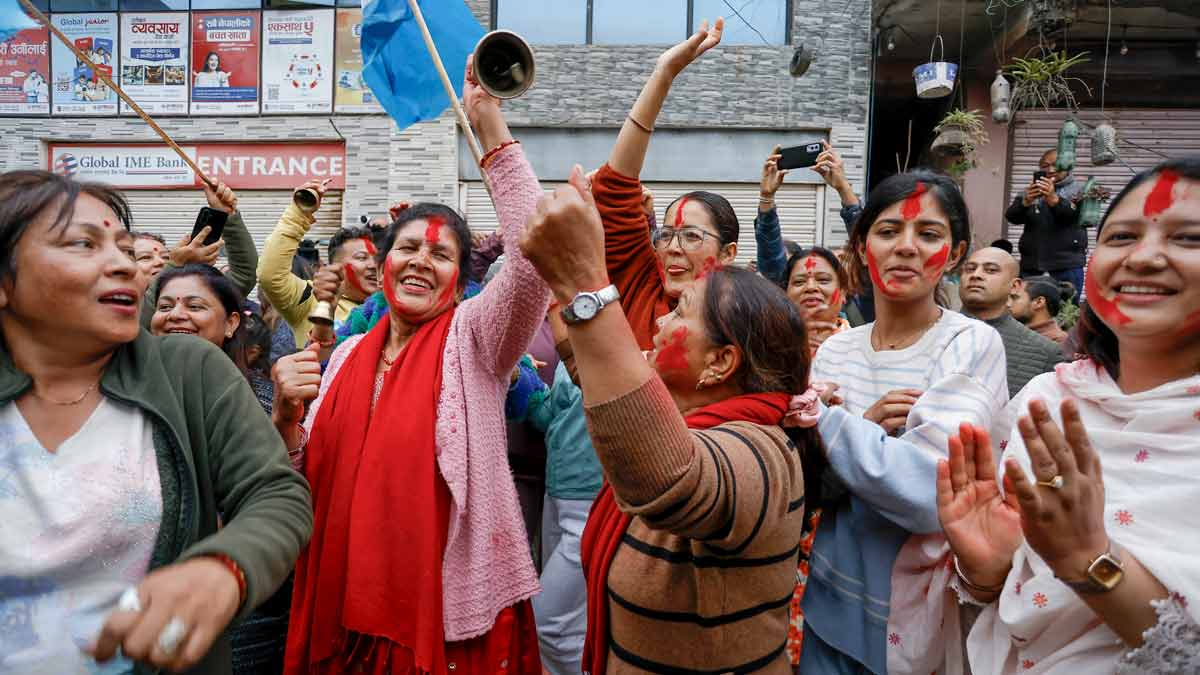
Nepal stands at a politically significant moment. The House of Representatives election on March 5 came after months of instability, anger, grief, and public distrust following the Gen Z protests of September 8 and 9, 2025. Those protests did not emerge in a vacuum. They came from years of frustration with corruption, weak governance, broken promises, and an increasingly widening distance between the people and the political class. The early election itself was a result of that rupture.
The early trends from vote counting suggest a major political shift. The Rastriya Swatantra Party (RSP) has taken a strong lead in the proportional vote and has also won or led in a large number of first-past-the-post constituencies, especially in Kathmandu Valley, indicating that many voters have chosen change over continuity. These are still developing results, but the signal is already clear: a large section of the Nepali public has punished older parties for underperformance and turned toward newer political alternatives with hope and urgency.
This election must therefore be read not only as a contest for power, but as a democratic message. For years, many people in Nepal voted for traditional parties such as the Nepali Congress, CPN-UML, Maoist Centre, and Rastriya Prajatantra Party, expecting governance, development, accountability, and national vision. But repeated failures, internal power games, and unfulfilled commitments weakened public trust. The rise of newer forces reflects not only dissatisfaction but also a demand for a more transparent, organised, and stable government.
As a Gen Z leader, I see this election as both a democratic correction and a moral test. I welcome the people’s mandate because I believe in the Constitution of Nepal and in the principle that sovereignty ultimately rests with the people. Democracy cannot be meaningful unless the people’s will is respected. The preamble and spirit of our Constitution make clear that the state must reflect the aspirations, dignity, and authority of its citizens. An election, then, is not merely procedural; it is an expression of democratic ownership.
But while Nepal moves forward electorally, the wounds of September remain open.
We are still waiting for the Karki Commission report on the Gen Z protests. That delay itself has become part of the crisis of trust. The commission’s term was extended multiple times, and rights groups have publicly called for the report to be released. At the same time, public concern has grown over possible impunity for those involved in vandalism and arson, even before the full truth has been officially established.
For many of us who were part of that moment, this is not an abstract issue. It is deeply personal.
We were not in favour of destruction, vandalism, or chaos. We believed the movement should remain peaceful. We expected peaceful transformation, not violent escalation. We wanted democratic pressure, not disorder. But somewhere between the aspiration of protest and the tragedy that followed, that movement was pushed into a horrifying direction. Young people were injured. Some lost their lives. Families lost their children, friends lost their companions, and a generation lost a part of its innocence.
That is why accountability matters.
Those responsible for the violence of September 8 and September 9, 2025 must be identified and punished not selectively, not politically, but justly. Those who killed protesters must be held accountable. Those who turned a public movement into a scene of destruction must be held accountable. Those who allowed the country to drift toward a state of institutional collapse and fear must also be held accountable. Nepal cannot build a stable democracy on top of silence, selective memory, or impunity.
The new government, whatever coalition or leadership finally emerges, must understand this clearly: electoral victory alone is not enough legitimacy. Legitimacy must now be earned through conduct. People will expect at least five things.
First, they will expect stability. Nepal has suffered too long from fragile coalitions, constant bargaining, and governments that focus more on survival than on service. Analysts had already warned before the vote that no single party was likely to secure an outright majority, which means coalition politics may continue. That makes political maturity even more important.
Second, people will expect transparency. Public trust has collapsed not only because promises were broken, but because decisions were too often opaque, elite-driven, and insulated from accountability. Any new government must communicate honestly, govern cleanly, and restore the credibility of public institutions.
Third, the people will expect organisation and delivery. Nepal does not need another government that speaks in slogans and performs in fragments. It needs functioning institutions, policy coherence, timely decisions, and visible public service.
Fourth, the public will expect justice. That includes releasing the Karki Commission report, acting on its findings, and ensuring that no one, whether from the state or from any group involved in violence, is above the law.
Fifth, the people will expect respect for democratic citizenship. The September protests showed that young people in Nepal are no longer willing to remain symbolic participants in democracy. They want to be heard, represented, and taken seriously. The political system must now respond to that reality.
The strong support for RSP shows how much hope people have invested in a new political force. But hope is not immunity. If RSP indeed becomes central to the new governing order, it too will be judged not by its rhetoric, but by its integrity, competence, and courage. The old parties were rejected because they failed to deliver on their own words. The new force must not repeat that cycle. The country is watching closely.
As someone from the younger generation who has stood in the middle of protest, democratic aspiration, and national uncertainty, I do not see this election as the end of a struggle. I see it as the beginning of a harder responsibility. Voting was only the first step. Governing well is the real test. Justice is the real test. Listening to the people is the real test.
Nepal’s democracy will not be saved merely by changing faces. It will be strengthened only when the state becomes accountable, when violence is not hidden behind political convenience, and when the people’s mandate is treated not as a tool for power, but as a duty of service.
This is what we expect from the new government: stability, transparency, order, constitutional commitment, and justice.
And above all, we expect truth.
Because a democracy that asks young people to vote, but denies them justice when they bleed, is a democracy in danger.
Jasmine Ojha is a Gen Z activist, lawyer, and youth leader from Nepal. She is the founder of Mission Smile Nepal and works to advance human rights, gender justice, civic participation, and inclusive policy change through grassroots advocacy.
