



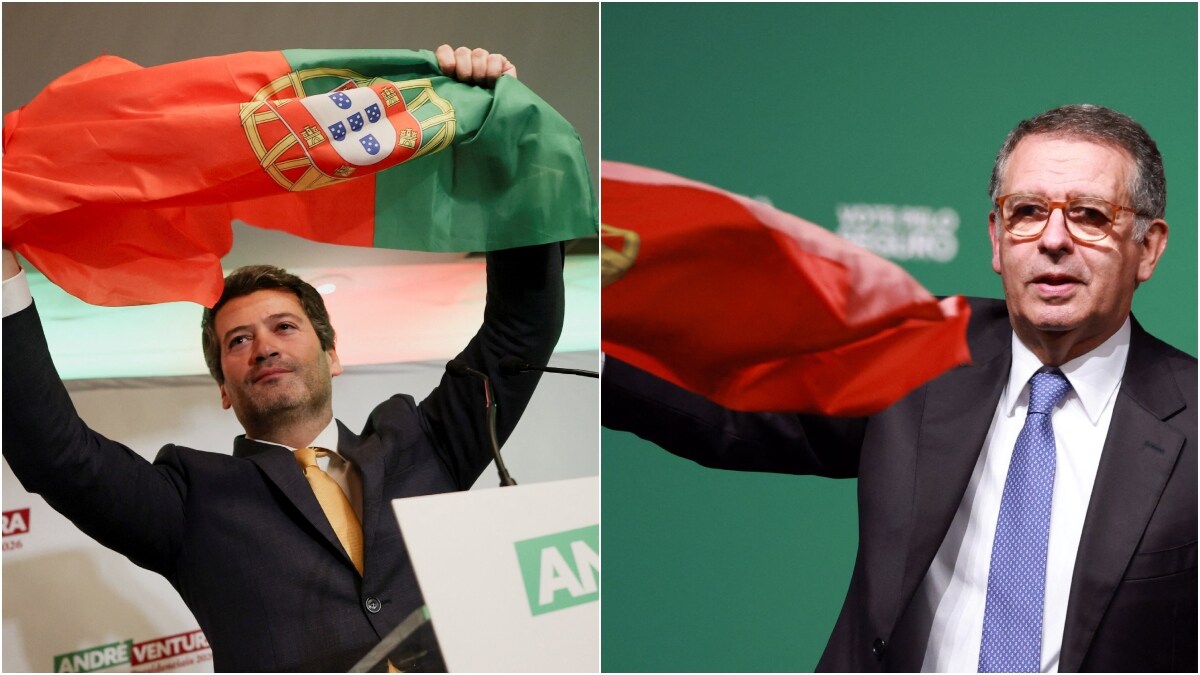
António José Seguro won the first round of the presidential elections. During his victory speech at Caldas da Rainha, he remarked that “democracy won” and that “we will win again on February 8th” (the second round of the Portuguese presidential election). He even called out to democrats, progressives, and humanists to join his candidacy to “defeat extremism”. Multiple exit polls predicted him to secure between 30% and 35% of the vote, and he won 31.1%. Running second, André Ventura, leader of Chega, won 23.5% of the vote in total. João Cotrim Figueiredo of Liberal Initiative followed in third. Henrique Gouveia e Melo (former Chief of the Naval Staff of Portugal) and Luís Marques Mendes (Social Democratic Party) followed, and were finally followed by António Filipe and Catarina Martins (both with 1–3%), Manuel Martínez Vieira (1–2%), and Jorge Pinto, André Pestana, and Humberto Correia (all between 0–1%), all eliminated from the second runoff. The results, however, suggest that a majority of voters still see the presidency as an anchor of stability, as the political environment over the past four years has been unstable and volatile.
A runoff between a moderate socialist and a far-right contender had been anticipated for months, and with Sunday’s results the prophecy came true. An unthinkable scenario after the fall of the dictatorship in 1974, something similar had happened only once before, in 1986. “The growth of the far right and voter dissatisfaction with mainstream parties have further divided the political landscape,” commented Paulo Tinoco, municipal architect and active supporter of the Socialist Party (PS).
António José Seguro’s victory reflects a preference among many voters for institutional steadiness. A former leader of the PS, Seguro campaigned on constitutional responsibility, social cohesion, and a promise to restore a calmer tone to national politics. Exit polls consistently placed him ahead throughout the evening. His campaign also leaned heavily on the idea that the presidency should remain a moderating force and a counterweight to polarisation rather than mere participation.
The most striking yet shocking development of the night was André Ventura’s second-place finish, which confirms his place in the runoff. For decades, Portugal stood out in Europe as a country where the far right remained marginal to non-existent. Tonight’s results have completely changed the scenario. Mainstream media outlets such as RTP, CNN, and SIC all projected that Ventura would receive between 20% and 25% of the vote. In response to the projections, Ventura declared that they placed him as “leading the right”, even framing the impending runoff as an “ideological war”.
The result solidified his spot in the second round and put him well ahead of Figueiredo. For the first time since the Carnation Revolution, a far-right contender came dangerously close to winning the presidency. He even won the first rounds in Faro and Madeira. According to most political analysts, even though he would not have won outright, this was enough to reshape the Portuguese political landscape. Based on the numbers and the broader European anti-establishment political trend, Portugal now appears to be aligned with this continental shift.
“Ventura’s win was methodical and consistent. The public’s dissatisfaction with economic stagnation, corruption, and fears about immigration and social harmony were all very well exploited by Chega and by him,” commented writer and journalist Joaquim Correia. Earlier in the day, exit polls had even hinted that Ventura would win the race, something that would have been unimaginable decades ago.
In Portugal, liberalism has, for the time being, found a home. Although Figueiredo’s message struck a chord with younger voters and urban professionals, it was unable to overcome the pull of the two prevailing narratives: the far right’s demand for disruption and the centre-left’s promise of stability. He was estimated to receive between 16% and 21%. However, his third-place result demonstrates that liberal politics are no longer incidental and may even constitute a steady governing force, albeit in a minority position.
Sunday’s results also revealed a new political map for Portugal that is more ideologically diverse, more polarised, and more politically assertive than in any previous election in recent years. Seguro’s projected lead offers continuity, but Ventura’s rise ensures that the next presidency will unfold in a more contested environment.
The runoff will now be framed as Ventura himself described it: “a confrontation between two visions of Portugal, one rooted in institutional continuity, the other in populist rupture”.
