



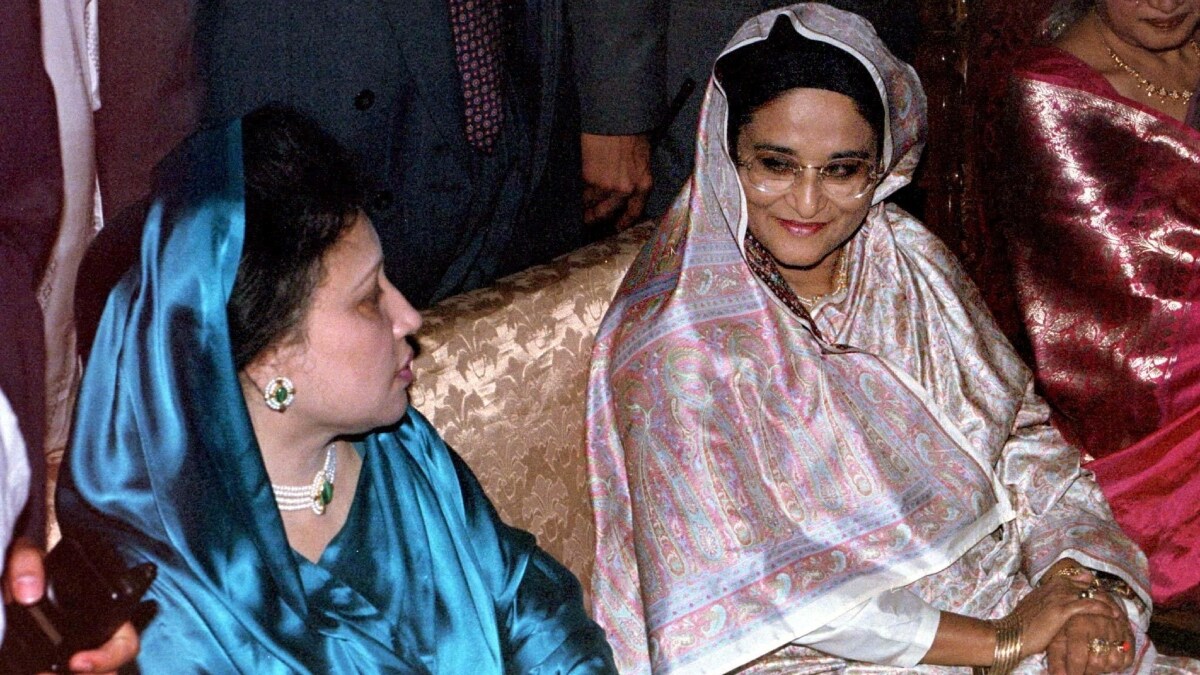
Historical accounts of leaders in developing democracies often favor one-dimensional narratives over messy realities. This is especially true for Begum Khaleda Zia; following her passing on Tuesday at age 80, she remains one of Bangladesh’s most oversimplified and misunderstood political icons.
Too often she is reduced to a rival, a widow, a partisan combatant in a bitter duopoly with her arch nemesis Sheikh Hasina who was ousted from power last year through a mass uprising.
Yet such shorthand obscures a larger truth: Khaleda Zia was a class apart because she stood, repeatedly and at great personal cost, against the consolidation of authoritarian power, and because she helped steer Bangladesh through one of the most consequential transitions in its political and economic life.
She did not arrive in politics through pedigree or technocratic grooming. Thrust into public life after the assassination of her husband, President Ziaur Rahman, she could easily have remained a ceremonial figure.
Instead, she became a decisive political actor at a moment when Bangladesh stood at the edge of democratic collapse. The country had endured years of military rule, power consolidation, institutional decay and political intimidation.
When Khaleda Zia [along with Hasina] led the movement that helped bring down General Hussain Muhammad Ershad in 1990, she was essentially restoring the principle that power must answer to the people.
Her victory in the 1991 election, widely regarded as free and competitive, marked a turning point. One of her government’s first acts was to reverse the presidential system that had concentrated authority in the executive and restore parliamentary democracy.
In doing so, she weakened the structural foundations of authoritarianism rather than strengthening them. In South Asia, where leaders often use democratic transitions to entrench personal power, that choice alone set her apart.
Khaleda Zia’s democratic credentials were rooted in restraint. She governed amid intense polarization, military shadow play and donor pressure, yet she never attempted to extinguish political opposition or suspend electoral competition permanently.
Power changed hands during her career, sometimes painfully, but it did change hands. Bangladesh did not slide into one-party rule on her watch. That, in a region crowded with strongmen, is no small achievement.
Her rivalry with Sheikh Hasina defined an era and deeply scarred the political culture. Street confrontations and mutual delegitimization weakened institutions and eroded public trust.
Khaleda Zia bears responsibility for contributing to this zero-sum politics. Yet even at the height of that rivalry, she did not dismantle the electoral system or rule by decree. The democratic arena remained bruised, but it remained open.
Behind the relentless political conflict, a quieter transformation was taking place. When Khaleda Zia first assumed office, Bangladesh was still overwhelmingly agrarian, poor and vulnerable to famine. Her governments pursued pragmatic economic policies that lacked ideological flourish but delivered structural change.
Export-led growth became the centerpiece of modernization. Under her leadership, ready-made garments replaced jute as the country’s economic spine, integrating Bangladesh into global supply chains and creating employment for millions, particularly women.
Garment exports expanded rapidly, even surviving the end of the Multi-Fibre Arrangement, which many analysts believed would cripple the industry. Instead, Bangladesh emerged more competitive, not less.
Labor migration followed a similar logic. Under Khaleda Zia, overseas employment expanded dramatically, particularly in the Gulf and Southeast Asia. Remittances, once a marginal factor, became a central pillar of the economy. They financed rural consumption, housing, education and small enterprise, functioning as an informal welfare system long before the term became fashionable.
The financial lifeline that would later stabilize Bangladesh during periods of political upheaval was built during these years, deliberately and without fanfare.
Economic growth under her watch did not come at the cost of food security. Rice production increased steadily through expanded irrigation, high-yield varieties and the rise of Boro cultivation.
Cropping intensity improved. Bangladesh moved closer to self-sufficiency in rice, loosening its historical dependence on food aid. The balance she presided over—industrial growth without agrarian collapse—reflected an instinctive understanding that development must be broad-based to endure.
Her social policies, particularly toward women, were equally consequential. Nationwide stipend programs for girls’ secondary education transformed enrollment patterns and altered the country’s long-term human capital trajectory.
These interventions were not framed as feminist manifestos, but their impact was unmistakable. Millions of women entered schools, factories and labor markets, reshaping family structures and economic expectations in ways that outlasted her governments.
And yet, Khaleda Zia’s record is not without serious flaws. Her alliances with Islamist parties, often forged for tactical advantage, raised legitimate concerns about the boundaries between state and religion.
The creation of elite security forces like the Rapid Action Battalion (RAB) during her tenure, later implicated in grave human rights abuses, revealed the dangers of prioritizing order without sufficient accountability. These decisions complicate her democratic legacy and demand honest reckoning.
Her later years exposed the fragility of the very democracy she helped restore. The legal cases that led to her imprisonment were widely viewed as politically motivated, part of a broader strategy to neutralize opposition through the courts. Whether or not every charge was unfounded, the spectacle of a former prime minister confined for years underscored how far the state had drifted from democratic norms.
In that sense, her suffering became symbolic of a deeper crisis: a state willing to sacrifice justice to secure power.
Khaleda Zia’s endurance in the face of that repression transformed her into something more than a politician. She became a quiet symbol of resistance, not through speeches or mobilization, but through refusal.
She did not bend. She did not seek absolution from power. Her silence, forced and frail, carried moral weight. It helped nourish the political consciousness that eventually erupted in mass protest and upheaval.
She leaves behind no perfect blueprint and no unblemished record. What she leaves instead is something rarer. A proof that democratic restraint is possible, that power can be contested without being monopolized, and that economic transformation does not require authoritarian discipline.
Khaleda Zia did not make Bangladesh a flawless democracy. But she helped prevent it from becoming a closed one.
The author is the Minister (Press) of Bangladesh High Commission in New Delhi
The opinions expressed in this article are those of the author and do not purport to reflect the opinions or views of THE WEEK.
