


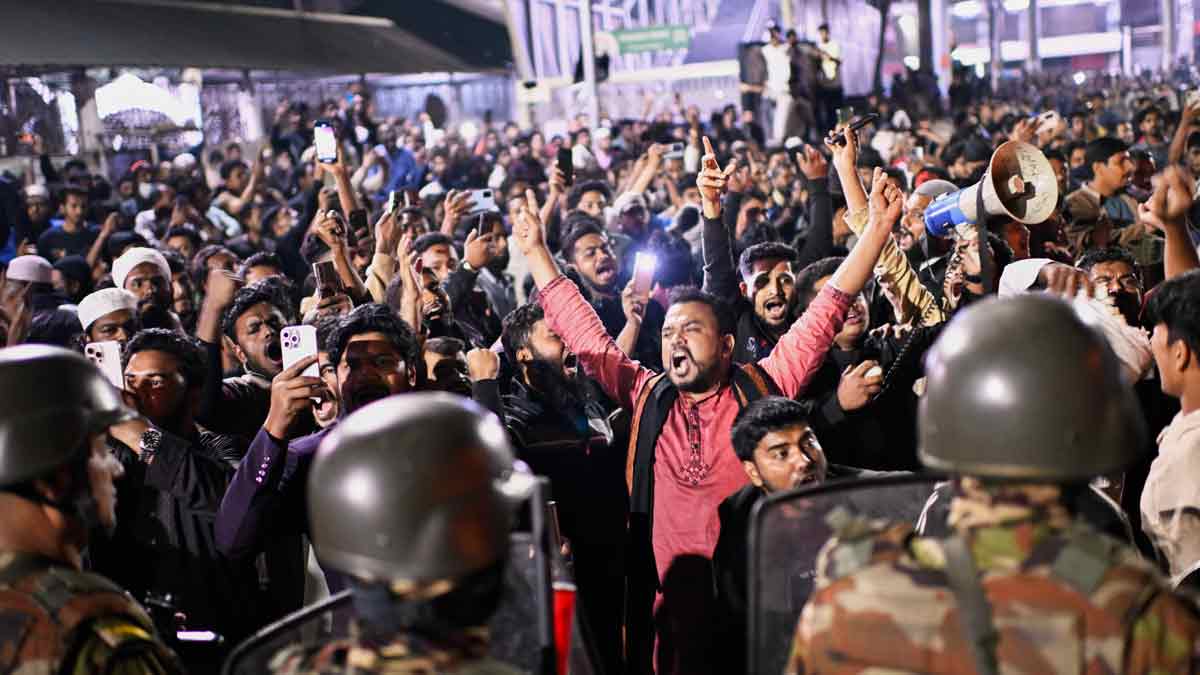
Violent and massive protests broke out once again in Bangladesh after Sharif Osman Hadi, a prominent leader of the July Uprising who was shot last week, succumbed to injuries while undergoing treatment at a Singapore hospital.
Hadi, who was a candidate in the February 12 general elections, was shot in the head by masked gunmen last week soon after he launched his election campaign at central Dhaka's Bijoynagar area. With doctors in Dhaka terming his condition extremely critical, the interim government of Muhammad Yunus had flown Hadi to Singapore in an air ambulance for advanced treatment.
Violent Protest outside the Indian Assistant High Commission in Chittagong, Bangladesh tonight. pic.twitter.com/0ik1YOJP3w
— Aditya Raj Kaul (@AdityaRajKaul) December 18, 2025
Yunus confirmed his death in a televised address to the nation on Thursday night, and promised to arrest those responsible for the attack, emphasising that "no leniency will be shown" to the killers.
"Today, I came before you with very heartbreaking news. Sharif Osman Hadi, the fearless frontline fighter of the July Uprising and spokesperson of the Inqilab Mancha, is no more among us," chief adviser Yunus said. "I sincerely call upon all citizens to keep your patience and restraint."
‘Until India returns assassins of Hadi Bhai...’
However, soon after news of Hadi’s death was made public, hundreds of students and citizens gathered at the Shahbagh intersection in the capital, near Dhaka University, chanting slogans in his memory. A student group named Jatiya Chhatra Shakti held a mourning procession on the Dhaka University campus, eventually joining the larger demonstration at Shahbagh. It also burnt an effigy of the adviser, calling for his resignation over the failure to arrest Hadi's killers.
They were joined by the National Citizen Party (NCP), a major offshoot of the 'Students against Discrimination' (SAD) movement. The NCP voiced anti-India sentiments, claiming Hadi's attackers had fled to India and demanding the closure of the Indian high commission until they are returned. "The Indian High Commission to Bangladesh will remain closed until India returns assassins of Hadi Bhai. Now or Never. We are in a war!" said Sarjis Alm, a key NCP leader.
also read
- Bangladesh protests | Who is Zyma Islam? ‘Can’t breathe anymore... you are killing me’, posts Daily Star journalist from burning office
- India-Bangladesh ties need to overcome political instability, regional security concerns: Parliamentary panel
- ‘Hasnat after Hadi’: Hasnat Abdullah's anti-India threats met with cryptic warning from Ex-Indian colonel
- Why India summoned Bangladesh High Commissioner over Seven Sisters remark
The Inqilab Mancha, a group Hadi represented, had earlier warned it would organise a sit-in protest at the Shahbagh intersection until the attackers were arrested. "If the killer flees to India, they must be arrested and brought back at any cost through discussions with the Indian government," the group had said.
In his address, Yunus called Hadi an "enemy to the defeated forces and fascist terrorists," which was seen as a reference to former prime minister Sheikh Hasina's now-dissolved Awami League party. Hadi was a frontline leader in the protests that led to the ousting of Hasina's government on August 5, 2024.
Media offices set on fire
The protests took a violent turn when a group of demonstrators attacked the offices of the Bangla newspaper Prothom Alo and the nearby The Daily Star in the capital's Karwan Bazar area.
The mob, reportedly, vandalised several floors of the Prothom Alo building while employees were trapped inside. The group then lit a fire in front of the Daily Star office.
Protesters also set fire to the house of former education minister Mohibul Hasan Chowdhury Nowfel in the port city of Chattagram, with similar attacks reported in other parts of the country.
The Bangladesh Nationalist Party (BNP) and its rival, Jamaat-e-Islami, expressed sorrow over Hadi's passing.
