



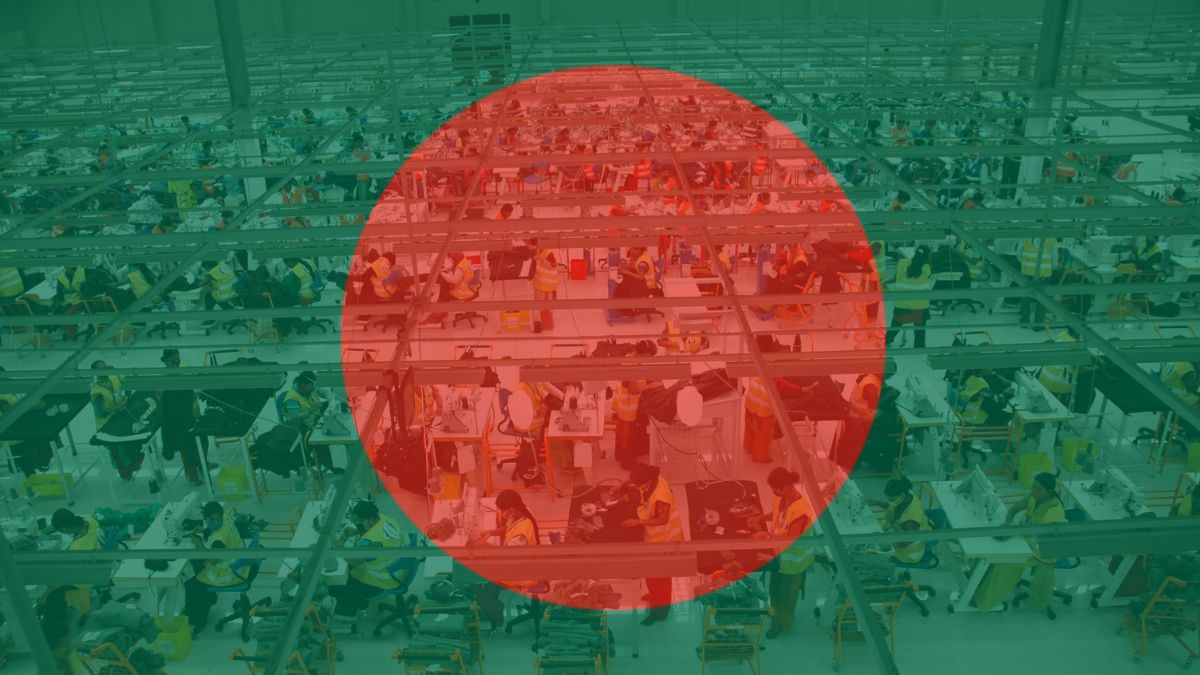
By any conventional measure, Bangladesh today appears economically strained. Inflation hovering above 8 per cent, private-sector lending slowing, and the banking system wrestling with a mountain of non-performing loans.
However, to present them as evidence of the country’s interim administration’s economic failure—as some commentators have recently done—is to misunderstand both the depth of the damage that preceded this government and the nature of economic recovery after a prolonged period of institutional abuse, because the truth is far less melodramatic, and far more structural.
Bangladesh’s economy is normalising and normalisation, after a decade-and-a-half of financial distortions, inevitably looks painful.
The widely circulated claim that the interim government inherited a “crippled economy” and will hand over a “stagnant economy” to the next elected government is tidy rhetoric, but analytically thin.
It treats economic statistics as static metrics rather than contextual signals, and omits the necessary frame of reference: what exactly did Bangladesh inherit on Day One? A manipulated accounting book or a functioning ledger? A genuine marketplace or a stage-managed showroom? An economy of productive investment or an economy of politically secured extraction?
One cannot speak honestly about Bangladesh’s present economy without acknowledging how profoundly the financial system was warped under the previous ruling order. For fifteen years, politically connected groups enjoyed what amounted to a private ATM relationship with the country’s commercial banks.
State-linked conglomerates borrowed staggering sums with minimal collateral and negligible pressure to repay.
In some cases, such as the figure of Taka 80,000 crore associated with the Islami Bank and Taka 24,000 crore from the Janata Bank for Beximco, the loans didn’t merely go unpaid. They simply left the country. The money migrated invisibly into properties in Singapore, Dubai, London, Toronto and many other places.
Here is the uncomfortable point: those loans inflated private-credit growth during the Hasina era. They made investment numbers look healthy, but only cosmetically. Recently, Prothom Alo, the largest vernacular daily of Bangladesh, ran an analysis which cites the decline in private-sector lending as evidence of stagnation.
But that is like lamenting a slowdown in illegal logging after the forest has already been decimated. Yes, borrowing has decreased ... but borrowing of what kind? For what purpose? To fund what activity?
Under the interim administration’s supervision, loan issuance has become less political, if more conservative. Banks are no longer being forced to extend sweetheart loans to ruling-party affiliates. The consequence is predictable: lending volume decreases, lending quality improves.
The argument that private sector credit growth is at a multi-decade low is true, and also deeply misleading when presented in isolation. The relevant question is whether the credit that is being issued is flowing into productive domestic use rather than into overseas asset accumulation, and by that measure, the trend is unquestionably healthier than before.
Then there is inflation. Bangladesh’s 8 per cent inflation is often compared—sometimes eagerly—with Sri Lanka’s 2.1 per cent today. However, this juxtaposition ignores fundamental context.
Sri Lanka is emerging from a catastrophic sovereign-default bankruptcy under IMF-mandated fiscal discipline so severe that it has choked domestic demand. Inflation there is low partly because consumption has been crushed.
Bangladesh, by contrast, still retains a functioning consumer base. Yes, everyday life feels expensive for ordinary citizens. Yes, wage growth has lagged. But the inflation rate today is not simply a reflection of current policy ... it is the still-burning tail of a currency artificially suppressed and a money supply artificially expanded under political directive.
During a period in which nearly every country tightened monetary policy post-pandemic, Bangladesh under Sheikh Hasina did the opposite—it injected liquidity. Inflation today is essentially not a new illness. It is a delayed fever.
This brings us to the role of data integrity. For 15 years, Bangladesh’s economic reporting resembled theatre. Official GDP figures glowed, reserves were inflated through accounting maneuvers, NPL numbers were massaged, and employment indicators quietly doctored.
It was a Potemkin economy—painted beautifully, hollow structurally.
Once this administration ceased the massaging and displayed authentic numbers, the facade vanished. Suddenly, the economy looked worse—not because it deteriorated, but because it finally presented itself unfiltered. Bad numbers are essentially not a symptom of failure: rather, they are a symptom of honesty.
Among the most significant bright spots—rarely acknowledged in the narrative of despair—is foreign direct investment. Despite domestic uncertainty and a difficult global economic climate, Bangladesh managed nearly 20 per cent growth in FDI last fiscal year.
Foreign investors who conduct forensic due diligence far more ruthlessly than domestic commentators don’t invest to reward good intentions. They invest when they detect structural credibility: regulatory transparency, reduced corruption, potential returns.
That FDI is rising while politically-orchestrated loan-circulation is declining tells a clear story. The money that once came from domestic banks is now—slowly, cautiously—beginning to arrive from external markets.
Critics of the interim government frequently point to rising poverty. The Prothom Alo article cites a 28 per cent figure from a small-sample private survey, conveniently ignoring global organisations whose methodologies are peer-validated.
The World Bank projects a decline in poverty this fiscal year, not an increase. Again, context and source matter.
But beyond data tables lies a broader philosophical shift underway. Investor confidence is not simply a function of percentage points and policy rates. It is a function of trust. Trust does not reappear overnight.
And here, the interim government’s legacy, though imperfect, is meaningful. It has not eliminated rent-seeking or bureaucratic inertia—no one should pretend otherwise—but it has stopped shielding it. The age of protected oligarchs appears to be over. Business groups that once operated like private governments are now being treated as market players.
The challenge ahead is real. Cleaning a banking sector in which up to 28 per cent of loans have gone bad is Herculean. Merging five banks may fail, and political interference may re-enter if a partisan government returns.
The interim government has not shown deep fiscal austerity—foreign trips and symbolic expenditures persist. Inflation expectations remain stubborn. Street-level law-and-order uncertainty is a genuine drag on investment.
But what must be resisted is the temptation to equate visibility of problems with deterioration of conditions. The Hasina years left behind problems that were hidden or cosmetically disguised. The interim government has allowed these problems to surface—and then gets blamed for their visibility.
Recovery after state-captured capitalism is not measured by how quickly statistics rebound. It is measured by whether the underlying system evolves from extraction to production, from privilege-access to merit-access, from political favouritism to institutional autonomy.
Bangladesh today is not the success story some hoped it would instantly become, but neither is it the failure some claim.
It is a wounded economy in convalescence—breathing more freely than before, even if still coughing. To insist that slow healing is evidence of failure is to confuse recovery with relapse.
The country’s next government will probably inherit not a stagnant economy, but a stabilised one—one that has stopped bleeding, exposed its infections, and begun the long return to real health.
The danger however is narrative manipulation: analysis that focuses on symptoms rather than causes, snapshots rather than timelines, and headlines rather than histories.
For too long, economics in Bangladesh was treated as a story to be curated. It is time we insisted on treating it as a reality to be understood.
The author is the Minister (Press) of the Bangladesh High Commission in New Delhi.
The opinions expressed in this article are those of the author and do not purport to reflect the opinions or views of THE WEEK.
