



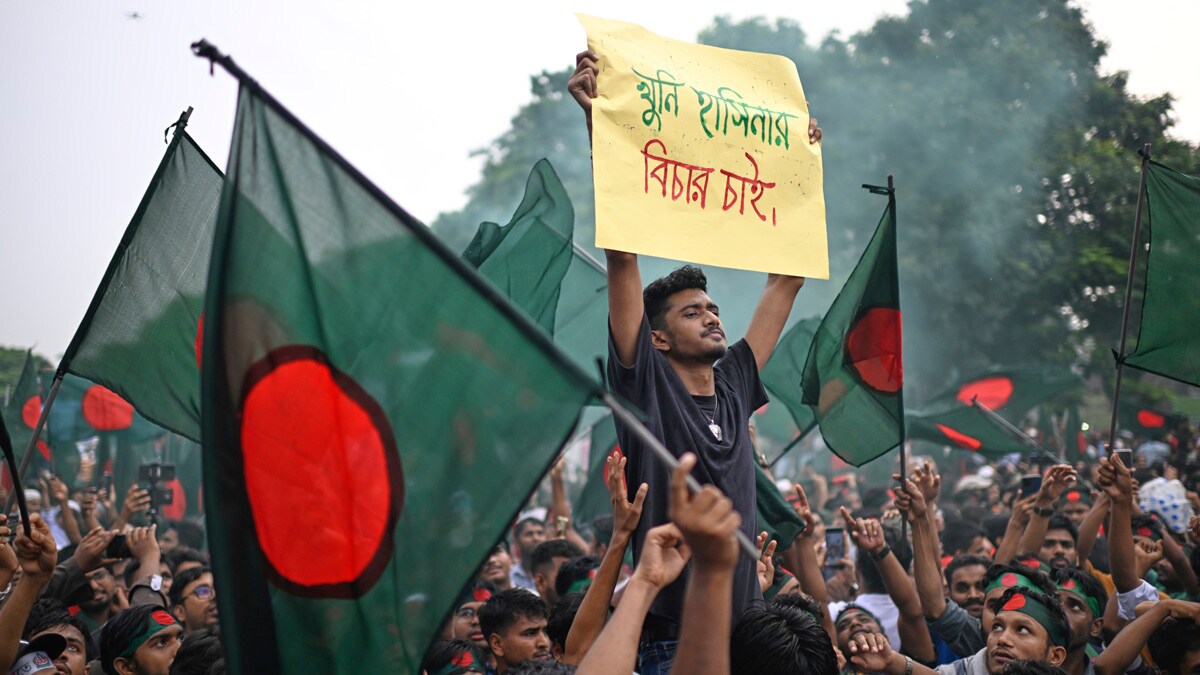
Reimagining Bangladesh after Sheikh Hasina is difficult, not because her 15-year rule dominated the country’s politics, but also because the people of Bangladesh are waiting to see the shape their country will take after the transition to an elected government. The past year under the Interim government of Muhammad Yunus has not allowed people to forget the student protests of July 2024 against the alleged misrule and authoritarianism that had seeped into governance.
When THE WEEK visited Dhaka this April, the crumbling walls of the once heavily guarded prime minister’s residence, Gana Bhaban and the graffiti across the city, bore testimony to the fact that the time has come for people to have a say in their governance, their problems, and their future to rebuild a new Bangladesh. Today, Hasina’s home is being turned into a museum, likely to be called the 'July Uprising Memorial Museum'. The VIP complex was originally built by Hasina’s father, the first leader of Bangladesh, Sheikh Mujibur Rahman.
But today, the broken walls now under repair tell the tale of the violence that had hit the streets and arrived at Hasina’s doorstep, forcing her to flee. She is believed to be staying at an undisclosed location in Delhi.
A year later, back in Bangladesh, different political forces are at play. Firstly, all eyes are on Mohammad Yunus, chief adviser of the Bangladesh interim government, who has declared that elections will be held soon. The timeline the Yunus government is looking at is to hold elections in February 2026. Sources say, the process is likely to kick off soon, with the Election Commission soon discussing the dates . The central challenge stems not from a lack of vision - Prof Yunus has outlined reform, justice, and elections as the way forward - but from an attempt to balance too many contradictions.
Meanwhile, the Bangladesh Nationalist Party (BNP), which had been sitting out in the cold for the last 15 years, is sensing an opportunity to rally the masses and roll out its elaborate agenda for reforms - an agenda that has been on the minds of the people over the past year. The BNP was the first party to present a detailed reform plan called the 31-point charter for reforms. BNP Secretary General Mirza Fakhrul Islam Alamgir says his party had presented the charter back in May 2016, to assure reforms in the country’s political and economic structures. He says it was the BNP, under party founder Ziaur Rahman, that brought in the multi-party system in 1975, and under Begum Khaleda Zia in 1991, returned democratic rights to the people by introducing the parliamentary form of government. Today, the BNP is demanding that elections be held as soon as possible to bring in an elected government.
The Jamaat-e-Islami’s domestic space has also opened up after being banned during Hasina’s regime. But the next steps will determine how ready Bangladeshis are to embrace it. There are already apprehensions in India about the possible persecution of minorities and concerns over the expansion of radical space. However, Dr Shafiqur Rahman, Ameer of Jamaat-e-Islami Bangladesh, assures that the party stands for constructive politics and mutual respect - values he believes can drive Bangladesh away from violence on the streets and help address economic and social issues.
The new party, the National Citizen Party (NCP), formed by students who took part in the July protests, is also preparing to make its debut. The young leaders, in their 20s and 30s, are seen as the voice of the youth and the face of change that Bangladeshis are seeking from people-centric governance, employment opportunities to independent foreign policy.
The struggles of an average Bangladeshi citizen are evident in how NCP leaders like Tasnim Jara and Nahid Islam operate. They work out of a makeshift office, hold meetings in crowded marketplaces and local halls, and travel by rickshaws and autos. As Tasnim explains, she is driven by the hope that one day they will bring positive change and inject life into the economy and politics of Bangladesh. The challenge is to keep their heads above water and expand their reach beyond Dhaka into the rural belts, in order to emerge as a political force capable of mobilising voters. One year after their successful attempt to dislodge Hasina, their next test lies in the electoral arena.
What hangs heavy in the air is the sudden disappearance of the Awami League’s voters, leaders and supporters, not just their physical absence, but the silence that has replaced them. It will take a free, fair, and participatory election to truly reimagine Bangladesh - one that avoids forced governance or forced exclusion, and instead taps into the real pulse of the people. As an Indian anthropologist from Nagaland, Abraham Lotha rightly said, “If you don’t listen to the people, you don’t have the right to fight for them.” A lesson that resonates on either side of the Brahmaputra.
