



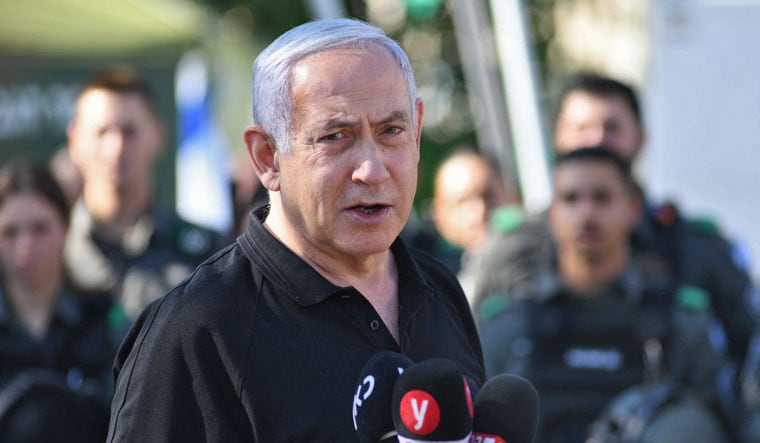
Israel Prime Minister Benjamin Netanyahu has reiterated that there would be no ceasefire despite growing international pressure. He, however, said that Israel would allow "tactical little pauses" in Gaza fighting to facilitate the entry of aid or the exit of hostages.
In an interview with ABC News interview, Netanyahu said there would not be a ceasefire until all hostages were released, but suggested there would be humanitarian pauses. Israel's ally US, including President Joe Biden and US Secretary of State Anthony Blinken, have been urging Israel to arrange pauses in the conflict to allow aid to enter.
"As far as practical, little pauses — an hour here, an hour there. We’ve had them before. We’ll check the circumstances [to have additional pauses] in order to enable humanitarian goods to come in or our hostages, individual hostages to leave," Netanyahu added.
Netanyahu said he would agree to a ceasefire if Hamas released all of the roughly 240 hostages being held in Gaza. "There would be a ceasefire for that purpose, and we’re waiting for that to happen. It hasn’t happened so far," he says.
He, however, downplayed any differences with the US as the White House claimed it discussed pauses and possible hostage releases in a phone call with Netanyahu on Monday. The US too has stated that it was against a ceasefire but emphasised Israel must protect civilians.
Netanyahu added that Israel will have "overall security responsibility" over the Gaza Strip "for an indefinite period" after the war against Hamas ends. "I think Israel for an indefinite period will have the overall security responsibility because we’ve seen what happens when we don’t have it. When we don’t have that security responsibility, what we have is the eruption of Hamas terror on a scale that we couldn’t imagine," he tells ABC News.
Meanwhile, the UN has called for an urgent ceasefire in Gaza. U.N. Secretary-General Antonio Guterres warned on Monday that Gaza is becoming a "graveyard for children". "Ground operations by the Israel Defense Forces and continued bombardment are hitting civilians, hospitals, refugee camps, mosques, churches and U.N. facilities – including shelters. No one is safe," Guterres told reporters.
"At the same time, Hamas and other militants use civilians as human shields and continue to launch rockets indiscriminately towards Israel," he said.
The U.N. Security Council met behind closed doors on Monday. The 15-member body is still trying to agree on a resolution after failing four times in two weeks to take action. Diplomats said a key obstacle is whether to call for a ceasefire, cessation of hostilities or humanitarian pauses to allow aid access in Gaza, reported Reuters.
