



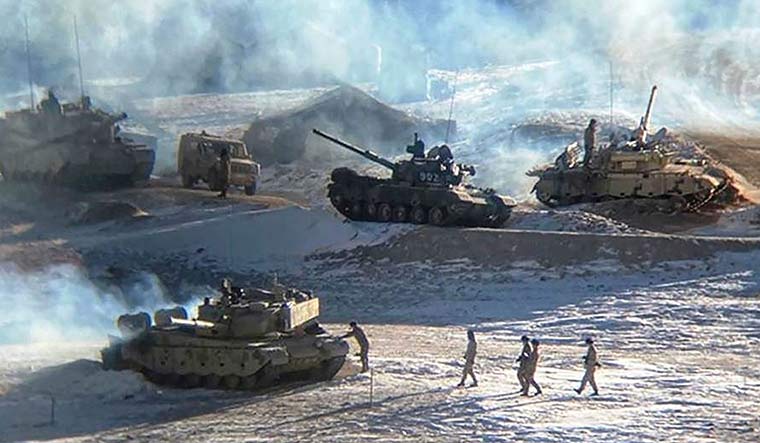
The expanded military postures by both India and China along the disputed border increase the risk of armed conflict between two nuclear powers, the US intelligence community said in its Annual Threat Assessment 2023.
While calling for US intervention, the assessment submitted to the US Congress by the Office of the Director of National Intelligence, added that the conflict might involve direct threats to US persons and interests.
Though both countries have engaged in bilateral border talks, relations will remain strained, the report said, adding that previous standoffs have shown that the continuous low-level friction on the Line of Actual Control (LAC) could escalate swiftly.
Regarding India-Pakistan relations, the assessment said that under the leadership of Prime Minister Narendra Modi, India is more likely than in the past to respond with military force to Pakistani provocations.
"The crises between India and Pakistan are of particular concern because of the risk of an escalatory cycle between two nuclear-armed states. New Delhi and Islamabad probably are inclined to reinforce the current calm in their relationship following both sides' renewal of a ceasefire along the Line of Control in early 2021."
"However, Pakistan has a long history of supporting anti-India militant groups, and under the leadership of Prime Minister Narendra Modi, India is more likely than in the past to respond with military force to perceived or real Pakistani provocations. Each side's perception of heightened tensions raises the risk of conflict, with violent unrest in Kashmir or a militant attack in India being potential flashpoints," it said.
Besides, the report also said that the U.S. is expected to face "complex" security risks posed by China, Russia, North Korea, and Iran. It added that the country would need to work to confront two "critical" strategic challenges: rising powers like China, seeking dominance in the global order, and challenges like climate change.
"These two strategic challenges will intersect and interact in unpredictable ways, leading to mutually reinforcing effects that could challenge our ability to respond, but that also will introduce new opportunities to forge collective action with allies and partners, including non-state actors," the report states.
Concerning China, the report said that the Chinese Communist Party will continue its efforts to make China the "preeminent power in East Asia and a major power on the world stage." Chinese President Xi Jinping, in his third term, will work to press Taiwan on unification and will seek to "undercut US influence" by driving "wedges between Washington and its partners."
Reports warned that China may build on its actions from 2022, and include more Taiwan Strait centerline crossings or missile overflights of Taiwan.
On Russia, the report said that "formidable and less predictable challenge to the United States in key areas during the next decade but still will face a range of constraints."
"Russia probably does not want a direct military conflict with US and NATO forces, but there is potential for that to occur," the intelligence community assessed. "Russian leaders thus far have avoided taking actions that would broaden the Ukraine conflict beyond Ukraine's borders, but the risk for escalation remains significant."
