



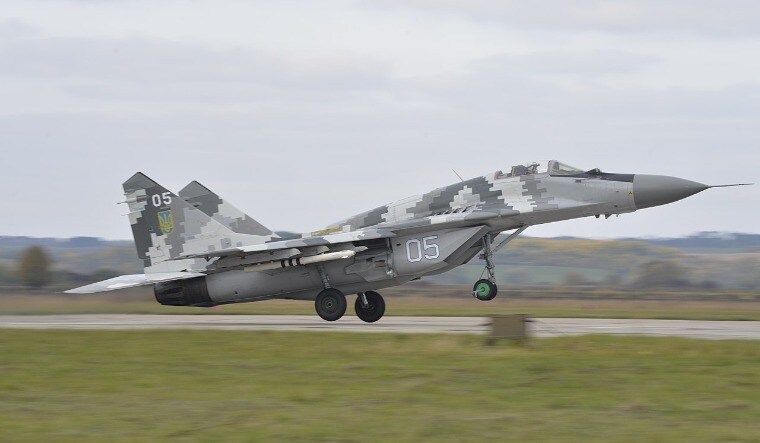
Hours after Russia began its multipronged attack on Ukraine, an unlikely 'hero' emerged. Social media went wild with clips of what appeared to be a lone MiG-29 of the Ukrainian Air Force flying over Kyiv.
The pilot was dubbed the 'Ghost of Kyiv', ostensibly due to the grey paint scheme of the Ukrainian MiG-29 fleet. Several users claimed he had downed six Russian fighter aircraft on the first day of the conflict. His 'kill list' included the much-vaunted Su-35 fighter, which features significantly more agility, range and superior electronics than the ageing MiG-29s flown by Ukraine.
By midday on Friday, the Ukrainian ministry of defence also jumped on the Ghost of Kyiv bandwagon with a tweet that can only be described as a teaser. It claimed several retired pilots had returned to duty and “maybe one of them is the air avenger on the MiG-29, which is so often seen by Kyivites!”
Later on Friday, the ministry of defence shared a video clip of what it claimed was a Ukrainian MiG-29 shooting down a Russian Su-35. However, some Twitter users claimed the clip was not a real dogfight, but rather a fake based on the Digital Combat Simulator (DCS) videogame.
Many social media users pointed out that clips purportedly showing the Ghost of Kyiv were doctored or fake. But the legend still flies on, with some social media users even sharing purported names of the pilot(s).
So could a single MiG-29 have accounted for six kills?
In theory, yes. This is because the MiG-29 remains highly agile and potent in dogfights. And dogfights (and even longer-range combat) are inherently unpredictable, with pilot skill (and error) mattering as much as situational awareness and presence of modern weapons and sensors.
But experts who are sceptical of the urban legend of the Ghost of Kyiv point to the design limitations of the elderly MiG-29 fleet used by Ukraine. The MiG-29 was designed to be a lightweight, short-range fighter that would complement the larger and heavier Su-27 fighters of the Soviet Union. This meant that the MiG-29 was exceptionally nimble, but had a lower weapons load and shorter range.
US defence journalist Thomas Newdick wrote in The Drive “The basic MiG-29 can carry a maximum of six air-to-air missiles and 150 rounds of 30mm ammunition. Its infamously limited range provides relatively little time to patrol on station—especially at low level. That would suggest multiple sorties, which would require one or more aircraft to be armed, fueled, made serviceable, and then assigned to the same pilot. Once in the air, the pilot in question would have to be lucky enough to encounter the right targets at the right time and survive each encounter.... then they would need all their weapons to function as advertised, achieving a far better-than-normal kill probability.”
Newdick referred to the fact that Russia had targeted Ukrainian bases where the MiG-29s were stationed at the start of the conflict. These included Vasylkiv, in the Kyiv Oblast of central Ukraine, and at Ivano-Frankivsk in western Ukraine. “The operational status of these bases and their resident aircraft is at least questionable, although it’s likely that aircraft were also moved to other locations ahead of the first round of Russian attacks,” Newdick wrote.
Missiles' age
Veteran military aviation journalist and author Tom Cooper was also sceptical about the Ghost of Kyiv. Cooper wrote on Facebook on Friday “… for a MiG-29 to score that many kills, it would have to carry lots of AAMs (air-to-air missiles), too. Just for example, the MiG-29 captured on 2-3 videos over Kyiv yesterday was carrying drop tanks... but no visible AAMs.”
The reference to drop tanks, which are externally mounted fuel tanks, is pertinent. While they endow an aircraft with greater range, these tanks also make it sluggish, which necessitates that an aircraft jettison them before entering into combat.
Cooper also referred to the type of the air-to-air missiles carried by Ukraine's MiG-29 jets, which he said Russian forces were familiar with. “Missiles in service with the Ukrainian air force are such like R-27R… R-27T… and R-73.... Both types are well-known even to the CIA since Adolf Tolkachev's treachery of 1979-1985 (i.e. before they entered service); both are in service with the Russian Air-Space Force, too, and thus well-known to the Russians. They have certainly developed effective countermeasures already long ago,” he wrote.
While the limitations of the MiG-29 design and the nature of war means it is unlikely a single pilot could have downed multiple aircraft, experts acknowledge the potency of the Ghost of Kyiv as a morale booster.
Newdick wrote “Stories like the Ghost of Kyiv certainly help bring the nation, and its many supporters around the world, together, in the face of terrible odds. The fact that Ukrainian MiG-29s, and other jets, can be seen on patrol in the skies over the country at all also has a significant morale-boosting role and one that ties back into the hero pilot narrative.”
