



Boris Johnson began with a bang, with a massacre, to be precise. On July 24, as he took over as the new prime minister of Britain, he mercilessly sacked as many as 17 ministers in the outgoing Theresa May cabinet. Johnson rewarded loyalty and ruthlessly culled those who sided with Jeremy Hunt in the Tory leadership race.
Hunt is among the biggest casualties of the purge, finding himself on the backbenches within hours of finishing second in the race for the top post. The outgoing foreign secretary was offered the defence portfolio, which he felt was a demotion, and chose to decline, confirming his return to the Tory backbenches.
Among the biggest gainers from the latest political upheaval is Indian-origin politician Priti Patel, who was named home secretary. Born to Gujarati parents who came to the UK from Uganda in the 1960s, Patel was international development secretary in the May cabinet till November 2017. She was forced to resign for undertaking an unauthorised freelance trip to Israel, where she met with local politicians. An ardent right-winger, Patel is a vocal Brexit supporter. She has courted controversy earlier by opposing foreign aid and by supporting death penalty.
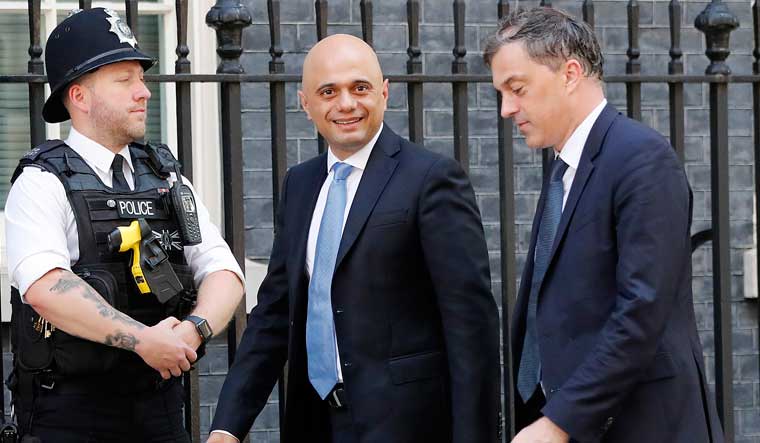
Another prominent member of the Johnson cabinet, too, has roots in south Asia. Sajid Javid, whose father came to the UK from Pakistan, has been promoted as he moves from the home office to take over as chancellor of the exchequer. He replaces Philip Hammond, who chose to quit rather than serve under Johnson. A former investment banker, Javid was part of the Tory leadership race till the fourth round, after which he cleverly threw his weight behind Johnson. A competent minister but a bland orator, Javid could well be one of Johnson's trusted lieutenants.
Dominic Raab, who is appointed as the new foreign secretary, is another Johnson favourite. Just like Johnson, Raab has called for Brexit on October 31, with or without a deal. He was justice minister in the David Cameron cabinet, but was sacked when May took over. He had served briefly as Brexit secretary last year, but he chose to quit owing to differences with May. An ardent right-winger, Raab had courted controversy in the past for calling feminists “obnoxious bigots” and for demanding the abolition of the Government Equalities Office. He has been critical of Britain promoting international aid and has campaigned to make the department for international development a part of the foreign office. Raab is one of the conservative stars, who could one day vie for party leadership. Interestingly, Raab is also designated as the first secretary of state, meaning the de facto deputy prime minister.
Johnson appointed his former rival Michael Gove as chancellor of the Duchy of Lancaster, which is a minister without portfolio. Back in 2016, Gove had scuttled Johnson's leadership campaign by agreeing to chair it first, and later offering himself as candidate, forcing Johnson to withdraw from the race. As the head of the cabinet office, Gove is expected to work closely with Johnson on Brexit.
The new Brexit secretary is Stephen Barclay, the third secretary to hold office in the last six months. The MP from Cambridge is the only high profile cabinet member to retain his portfolio during the transition. Ben Wallace is another key gainer under the new regime as he replaced Penny Mordaunt as defence secretary. Trained at Sandhurst before serving as an officer in the Scots Guards in Northern Ireland, Wallace had served as security minister in the home office under May.
Liz Truss, a vocal Johnson supporter, is the new international trade secretary. She had previously served as chief secretary to the treasury and as environment secretary. Truss was also the first female lord chancellor of the UK. A champion of free enterprise and deregulation, she is an ideological soulmate of Johnson. Truss once courted controversy by calling the British “among the worst idlers in the world”.
Another person of Indian origin who has found a place in the Johnson cabinet is Alok Sharma, who has been named international development secretary. Born in India, Sharma was trained as a chartered accountant. Although he was against Brexit, he threw his weight behind Johnson during the leadership campaign and has been rewarded with an important post. Rishi Sunak, son-in-law of Infosys founder N.R. Narayana Murthy, has been named chief secretary to the treasury under Chancellor Javid. Sunak, who was a junior minister in the May government, has got an elevated rank this time, enabling him to attend cabinet meetings.
Johnson has named his brother Jo as minister of state at the department for business, energy and industrial strategy and the department for education.
The mass culling of his detractors could pose problem for Johnson within the Conservative Party. The move to drop Hunt, Mordaunt and trade secretary Liam Fox has evoked resentment among anti-Brexit law makers. They say the sacking of Mordaunt, who was in office for just three months, smacks of vindictiveness. Johnson needs the support of all his MPs as he is likely to face a vote of no-confidence without much delay. His majority is wafer-thin and he can ill afford a major rebellion within the Conservative Party.
Johnson, however, has begun in the right earnest. He has already announced a broad domestic policy agenda, which includes reforming the social care system, appointing 20,000 new police officers and launching a satellite navigation system for the UK. He has cancelled his summer vacation and has given a clear signal that he is going ahead with the October 31 Brexit deadline, no matter what. He has appointed Dominic Cummings, the mastermind of the 2016 Brexit campaign, as his senior adviser. Drawing inspiration from his hero Winston Churchill, Johnson has made his intentions clear, “With high hearts and growing confidence, we will now accelerate the work of getting ready, and the ports will be ready and the banks will be ready, and the factories will be ready, and business will be ready, and the hospitals will be ready.” It could mean a no-deal Brexit, but the parliament has already resolved not to consider such an exit from the European Union. If Johnson fails to form a 'coalition of the willing', he may have to go to the country sooner than expected.
