



As a child, I was fascinated with fairy tales. I would relate to The Ugly Duckling, imagine the titular character’s life in The Little Mermaid, and laugh at The Emperor's New Clothes. I didn’t know that all these were written by Hans Christian Andersen, a famous Danish author and storyteller.
It was much later, as an adult, that I learnt about Andersen and the scale of his writing. His books have been translated into more than 150 languages worldwide. His writings have a massive fan following in India, having been translated into many Indian languages. On a recent trip to Odense, in Denmark, I spent time learning about my favourite fairy tale author in the Hans Christian Andersen Quarter.
I started with his birthplace, which is a small corner house located on Hans Jensens Stræde. The yellow-painted house was tiny, giving a real indication of the modest beginnings of the Danish storyteller whose childhood was full of stories. His mother worked as a washerwoman, while his father was a shoemaker.

Denmark’s most famous storyteller is an inspiration for me – he proved that poor beginnings cannot drag you down. His talent won him worldwide fame; during his life, he travelled abroad around 30 times.
My next stop was Hans Christian Andersen’s House, which is a fascinating museum that took me through the journey of the author’s life – I learned about his family, his love of travel, his achievements, and relived his joy of storytelling. The museum complex has been designed by Kengo Kuma & Associates, the Japanese architectural firm that also designed the Japan National Stadium, Tokyo, the main venue of the Tokyo 2020 Olympics and Paralympics.
What I liked was that the museum is not a conventional one with boring exhibits; instead, there are immersive art installations, original objects related to Andersen, and light and sound effects that made me feel like I had entered a magical world. Feeling happy, I strolled to Hans Christian Andersen’s Garden, which is part of the museum experience and is a garden next to the museum.
As I walked down its winding gravel pathway, I was greeted by plants that made me feel like I was in one of his imaginative fairy tales. There were some trees with cascading branches that resembled living sculptures. I felt dwarfed among them, kind of like Thumbelina, the tiny girl who was the size of a thumb in one of Andersen’s popular fairy tales.
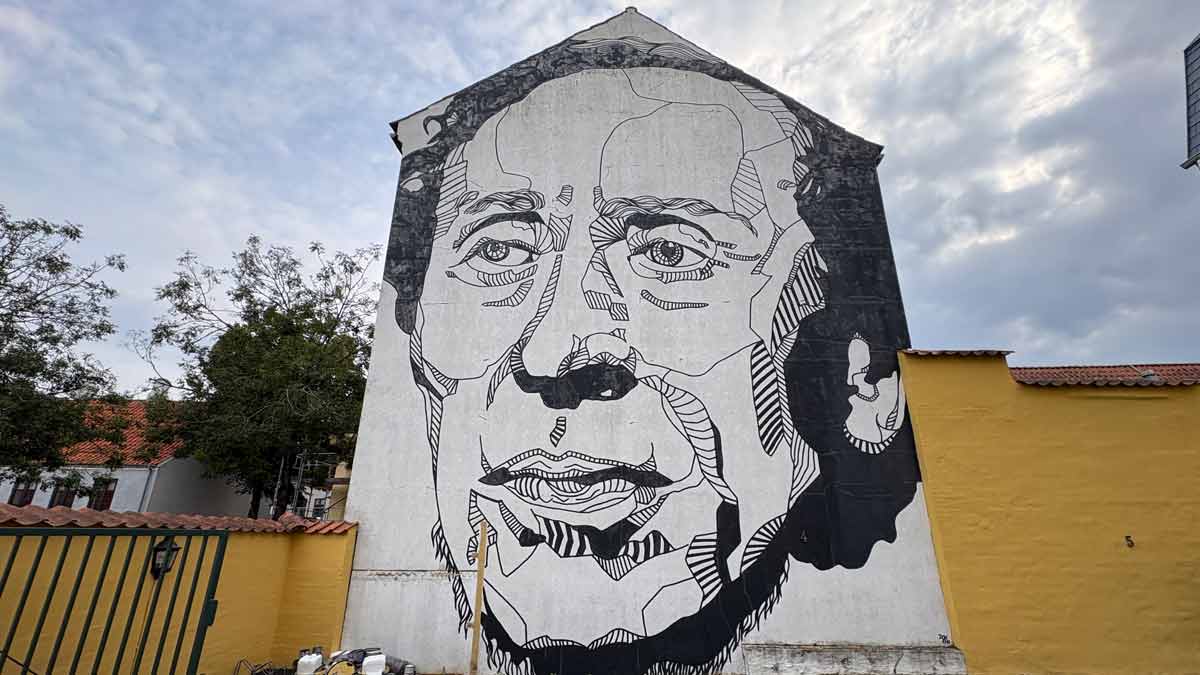
The area around is postcard-perfect, with cobbled streets opening onto brightly coloured houses. Some have a yellow-painted façade, while others are red or white in colour- many have tiled roofs. Close by, on one side of a building, a mural of the Danish fairy tale writer stared at me. This 12-metre-high black-and-white portrait of Hans Christian Andersen is a popular photo-op. It was a memorable way to end my time in the quarter.
