



Come April, Ladakh softens. The stark, dramatic landscapes that define this high-altitude desert begin to yield to something gentler, almost dreamlike. Apricot trees—locally called chuli—burst into bloom, scattering blush-pink and white across valleys like Nubra, Aryan and Sham, and around Leh. For a few fleeting weeks, the region is transformed into an ethereal wonderland, signalling the arrival of spring in a land otherwise known for its extremes.
These apricot trees are not mere seasonal adornments. Introduced centuries ago along the Silk Route, they are deeply interwoven into Ladakh’s cultural and economic fabric—offering fruit, oil, wood, and a rhythm to rural life that has endured across generations.
It was into this fleeting season that I arrived in Nubra Valley, drawn by stories of the Apricot Blossom Festival in Tiggur (Kyagar), a traditional village that still carries echoes of its Silk Route past. Rigzin Wangtak of Lchang Nang, a passionate advocate of Ladakhi heritage, insisted that I experience it first hand.

“The festival is our way of celebrating not just the blossoms, but our way of life,” he told me as we drove towards the village, where orchards stretched like soft clouds against a rugged Himalayan backdrop.
A festival rooted in life
What unfolded felt less like an event and more like stepping into a living tapestry. Beneath canopies of blossoms, men and women in traditional attire moved gracefully to the rhythm of folk music. Children ran freely, their laughter mingling with the gentle fall of petals that drifted down like blessings.
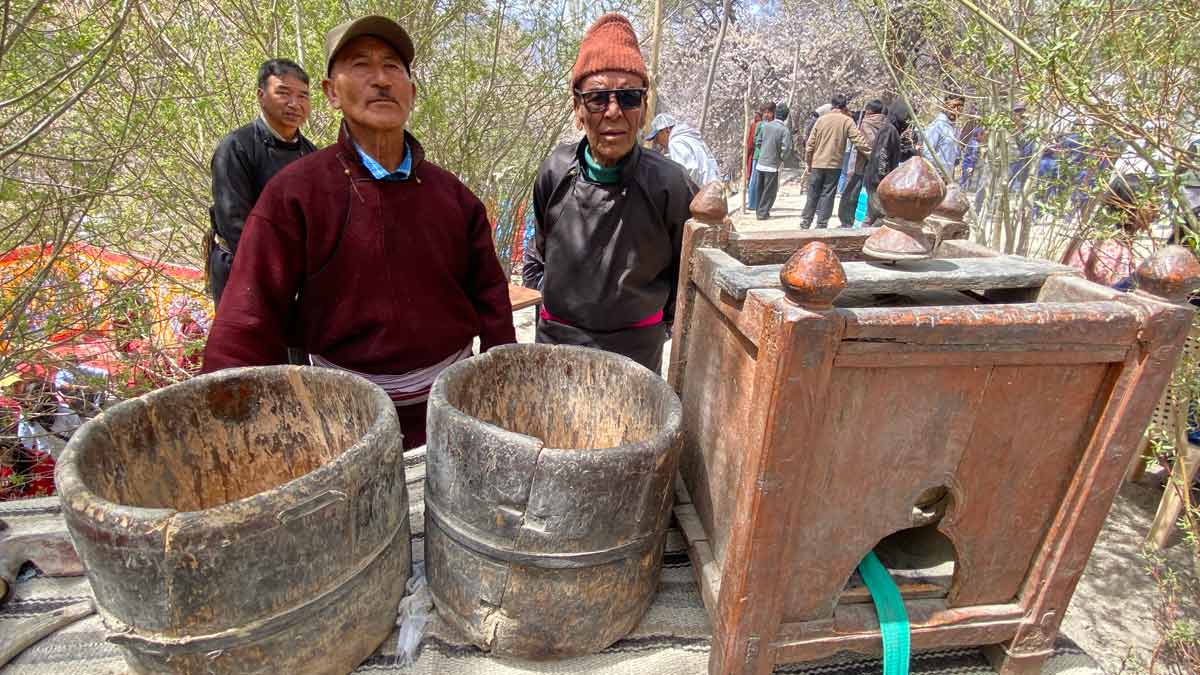
There was no spectacle here in the conventional sense—no hurried crowds or amplified noise. Instead, there was a quiet, collective joy. Women wearing elaborate peraks prepared for performances, artisans demonstrated age-old crafts, and visitors were invited to try their hand at simple, tactile traditions—roasting barley, weaving baskets, or sampling local foods.
I was treated to “Phey- Mar”, a mix of roasted barley flour, and a hint of sugar pressed and shaped by hand until it binds together, which is paired with fresh butter—a humble preparation, yet deeply satisfying. Nearby, two dzos—hybrids of yak and cow—ploughed the fields in a slow, rhythmic demonstration of traditional farming practices that continue to sustain Ladakhi life.
What struck me most was the sense of order and grace. Monks sat quietly in designated rows, schoolchildren watched attentively, and locals moved with an unhurried discipline. Butter tea and snacks were served in rounds, received with quiet gratitude. There was no rush, no clamour—only a shared understanding of space, time, and respect.
Seasons of tourism, stories of growth

It was here, amidst blossoms and quiet celebration, that I met Tsering Paldan, Director of Tourism, Ladakh, who offered insight into the larger vision behind the festival.
“We began organising the Apricot Blossom Festival about six or seven years ago, inspired in part by Japan’s cherry blossom celebrations,” he said. “Until now, Ladakh has largely been a summer destination. Tourists would come between May and July. But we want to introduce spring tourism—so people can experience this beauty as well.”
To make that possible, the administration has now fixed the festival dates—from April 6 to 16 each year—allowing travellers to plan in advance. “Not everyone can travel to Japan,” he added with a smile, “but Ladakh offers something just as special.”
This effort is part of a broader strategy to reshape Ladakh’s tourism calendar. Beyond spring, the region is steadily expanding its offerings across seasons.
“In summer, we are planning a Star Gazing Festival,” Paldan explained. “Ladakh’s clear skies make it ideal for observing the night sky. We’ll have telescopes set up in different locations, along with cultural programmes. Visitors can stay in homestays, guesthouses, or resorts.”
Other festivals—such as those in Zanskar and the eastern regions—offer glimpses into the lives of nomadic communities who move with their livestock across vast, open landscapes. “These experiences allow visitors to engage with cultures that are very different, yet deeply rooted,” he said.
Equally important is the impact on local communities. Festivals create opportunities for artisans, farmers, and small entrepreneurs to showcase their work and earn livelihoods. “Tourism is growing every year,” Paldan noted. “Earlier, it was only summer tourism. Now we have spring, and we are also promoting winter tourism.”
Winter, once considered too harsh, is now being reimagined as a season of possibility—with snow sports, ice hockey, and skiing in places like Kargil. Infrastructure, too, is evolving, with better roads and a growing emphasis on homestays that allow travellers to experience Ladakh more intimately.
As the day in Tiggur drew to a close, the blossoms continued to fall—soft, unhurried, and indifferent to time. There was a quiet contentment in the air, a sense of people deeply at ease with their lives and their land.
In that moment, Ladakh revealed a different kind of luxury—not in excess, but in simplicity, rhythm, and connection.
And as I left the valley, I knew this would not be my last visit. Whether for the glow of monastery festivals, the stillness of starlit skies, or the fleeting poetry of apricot blossoms, Ladakh, in all its seasons, was calling me back.
